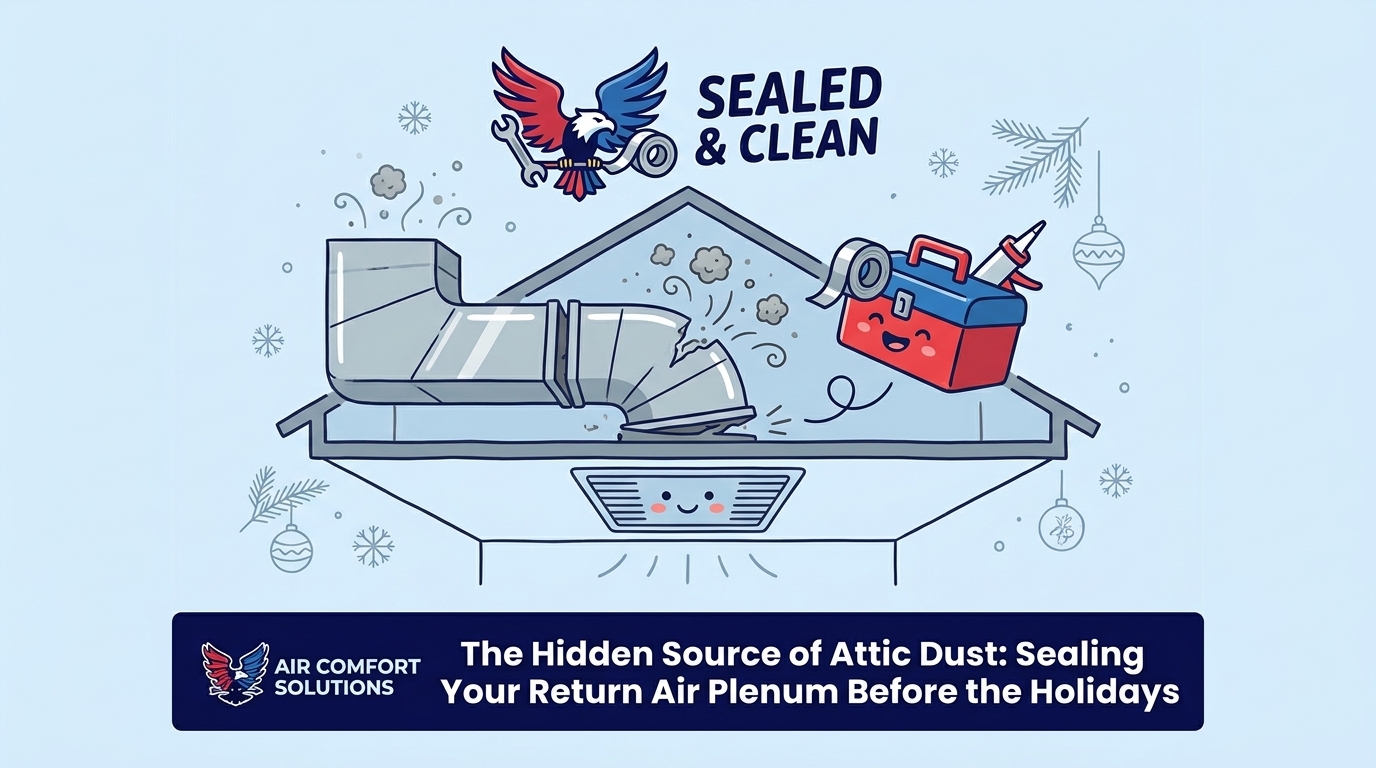
The Value of Sealing Your Return Air Plenum Before the Holidays
Most homeowners buy expensive filters to fix dusty air, not realizing a leaky return plenum in the attic is the real culprit. See why sealing it now saves your holiday gatherings.
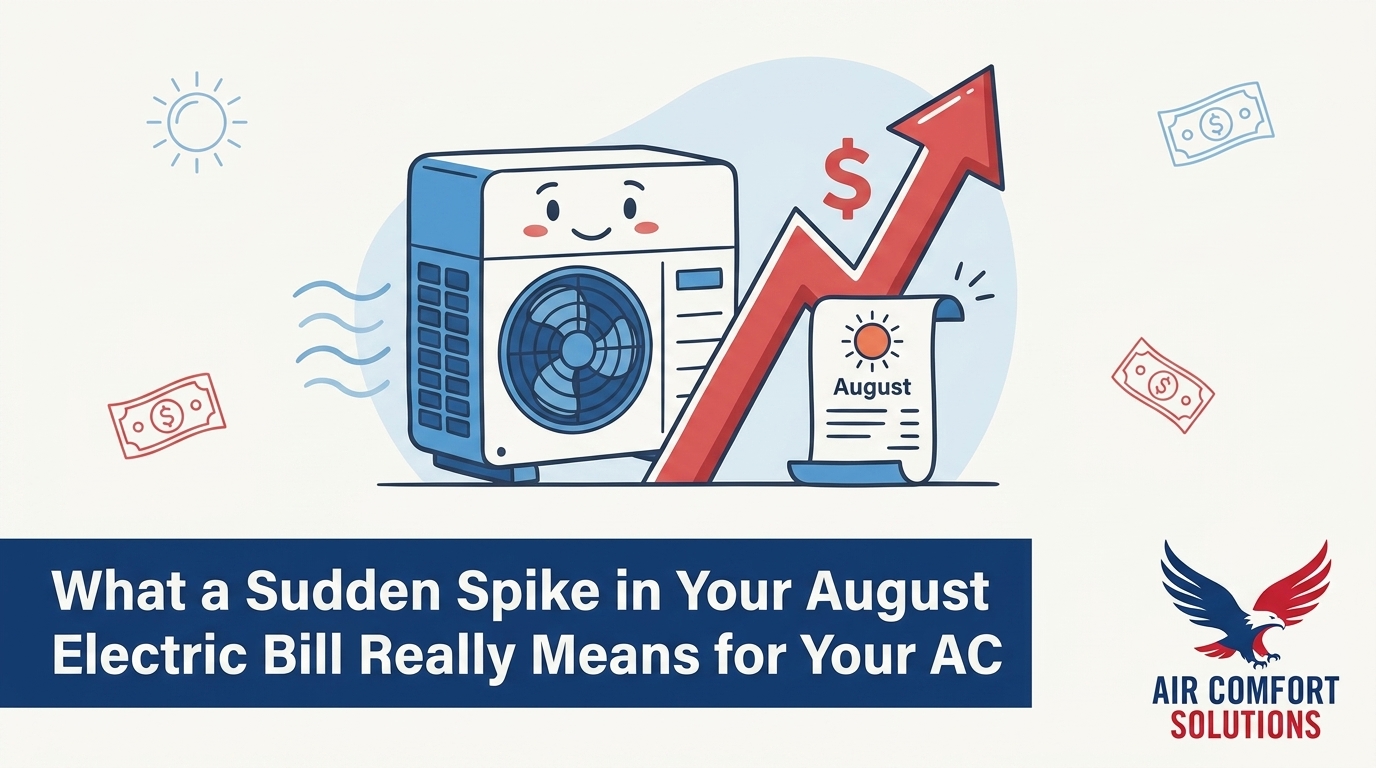
August in Southeast Texas is brutal enough without opening a utility statement that leaves you in shock. At Air Comfort Solutions, our team fields countless calls every late summer from Pinehurst homeowners dealing with this exact frustration. If you are wondering exactly what a sudden spike in your August electric bill really means for your AC, you are certainly not alone. You have not touched the thermostat. Your family has not changed their daily routine. The house feels roughly the same as it did in June. Yet, your household energy usage has skyrocketed to levels that simply do not make sense.
It is incredibly frustrating to receive a massive late-summer energy statement when your indoor habits remain completely unchanged. Most homeowners immediately assume the utility company raised their rates, or they blame the slightly hotter outdoor temperatures. While hotter weather does force your cooling equipment to run longer, ambient temperature alone rarely accounts for a dramatic, unexplainable surge in electrical consumption.
Instead, an unexpected August bill spike usually points to hidden mechanical inefficiencies. Your cooling equipment has been running for months. Over that time, minor wear and tear, accumulated dust, and subtle performance drops begin to compound. What started as a tiny loss of efficiency in May has snowballed into a heavy burden by late summer.
This leaves you with a distinct decision point: you can accept the high bill as an inevitable punishment of late summer, or you can investigate the mechanical health of your air conditioning systems. Choosing to investigate often reveals correctable flaws that are quietly forcing your equipment to consume excessive power.
To understand why your bill surges late in the year, you have to look at how cooling demand stacks up over time. HVAC professionals measure seasonal workload using a metric called "cooling degree days." This measurement tracks how far the average outdoor temperature rises above a baseline comfortable indoor temperature. By the time August end-of-season cooling arrives, your system has accumulated thousands of cooling degree days.
An air conditioner that operated with a slight inefficiency during the mild days of spring will become heavily burdened by late summer. The equipment simply does not get a break. When temperatures stay high overnight, the system runs continuously, preventing the compressor and blower motors from cooling down and recovering. This continuous operation accelerates wear on every moving part.
Mechanical wear does not happen all at once. It builds slowly through a specific chain of events that ultimately drains your electricity:
1. Dust and Debris Accumulation: Throughout the spring and early summer, pollen, grass clippings, and airborne dust get pulled into your outdoor unit. Indoors, pet hair and household dust slowly load up the air filter.
2. Gradual Loss of Lubrication: As blower motors and condenser fans run for hundreds of hours, the factory lubrication begins to break down. The motors encounter more friction, requiring slightly more electricity to turn at the same speed.
3. The Tipping Point: By August, these minor issues converge. The restricted airflow and increased friction force the system to run 20 to 30 percent longer during each cycle just to maintain your thermostat setting.
Catching these compounding issues requires proactive intervention. Enrolling in a professional AC maintenance plan ensures that these minor friction points and airflow restrictions are resolved before they translate into major energy consumption.
The Problem: Your air conditioner does not actually "create" cold air. Instead, it absorbs heat from inside your house and pumps it outside. The component responsible for releasing that heat into the outdoor air is the condenser coil, located in the large metal cabinet sitting in your yard. When this coil gets dirty, the entire heat transfer process breaks down.
The Cause: Over the course of the summer, the outdoor unit acts like a giant vacuum. It pulls air through the aluminum fins of the condenser coil to cool the hot refrigerant inside. Unfortunately, it also pulls in dirt, cottonwood seeds, lawn clippings, and grime. This debris forms a thick, insulating blanket over the coil. Because the coil is insulated by dirt, the heat trapped inside the refrigerant cannot escape into the outdoor air.
The Mechanical Consequence: When heat cannot escape, the pressure inside the refrigerant lines rises sharply. The compressor—the "heart" of your air conditioner that pumps the refrigerant—must now work against this extreme pressure. To overcome the restriction, the compressor draws significantly more electrical current (amperage). According to data from the U.S. Department of Energy, a heavily soiled condenser coil can increase your compressor's energy consumption by up to 30 percent.
Under normal conditions, a standard residential compressor might draw roughly 12 to 15 amps of electricity while running. However, when the condenser coil is suffocating under a layer of August grime, that same compressor might spike to 18 or 20 amps just to keep the refrigerant moving. You will not hear a difference inside your home, and the air coming out of your vents might still feel cool. But your electrical meter will spin much faster.
Note: Restoring a heavily soiled condenser to factory specifications requires specialized foaming coil cleaners and measured water pressure to avoid bending the delicate aluminum fins. This is a licensed maintenance procedure that requires professional tools to execute safely without damaging the electrical components.
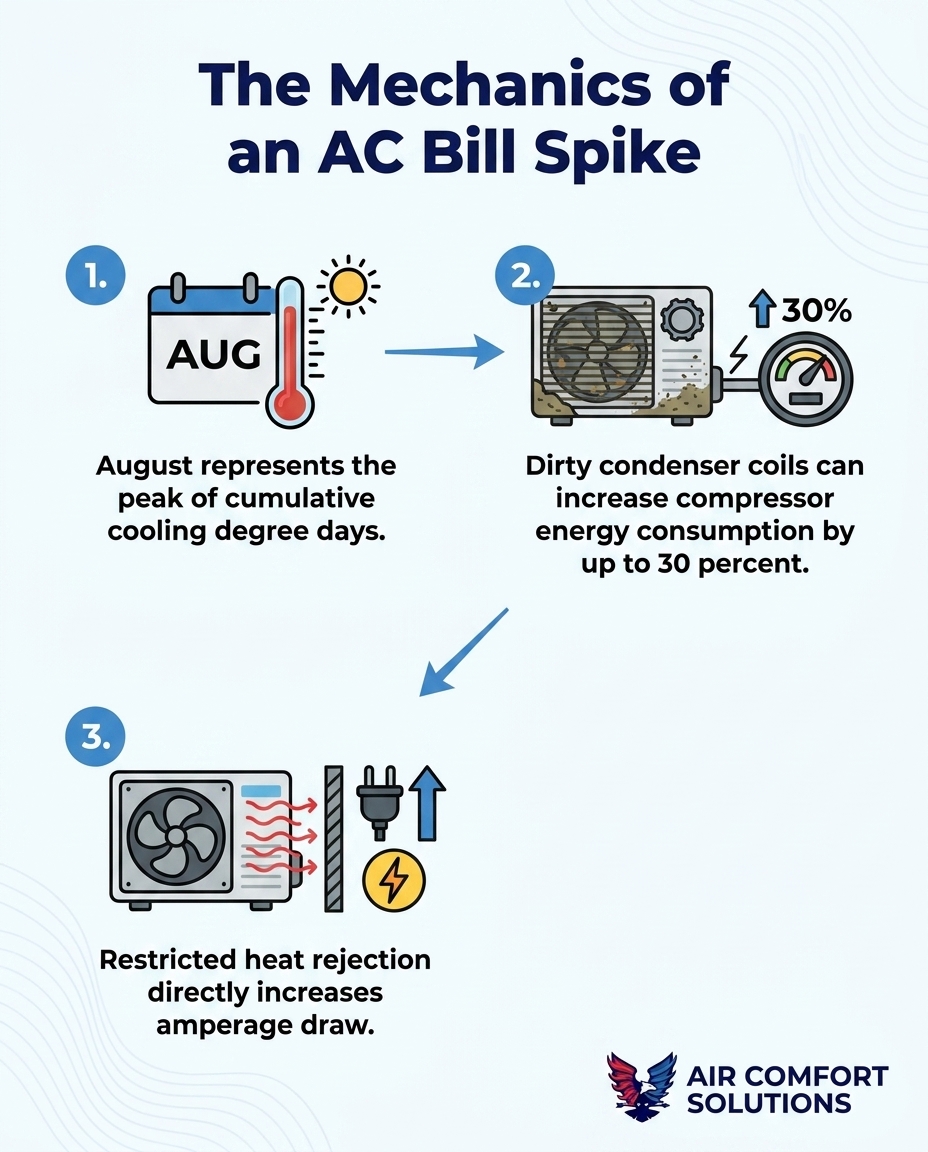
Mechanical failure does not happen in a vacuum; it is heavily influenced by the local climate. In our region, air conditioners must manage two completely different types of heat: sensible heat and latent heat.
Sensible heat is the actual temperature you read on a thermometer. Latent heat is the moisture trapped in the air—the humidity. Removing latent heat requires an enormous amount of mechanical energy. Before your air conditioner can actually lower the temperature of your living room, it first has to wring the heavy moisture out of the indoor air.
This is where Pinehurst TX weather creates a perfect storm for high utility bills. In our years of servicing air conditioners across Southeast Texas, our technicians at Air Comfort Solutions consistently see how the relentless late-summer humidity forces local cooling units into near-continuous operation just to dehumidify the home. When an air conditioner runs non-stop, it exponentially multiplies the financial penalty of any hidden inefficiency.
If your compressor is drawing 30 percent more amperage because of a dirty outdoor coil, and the local humidity is forcing that compressor to run for 16 hours a day instead of 10, the resulting electrical surge will be massive. Partnering with experienced Pinehurst HVAC experts ensures your system is calibrated to handle both the extreme temperatures and the heavy moisture loads of late summer without wasting power.
Your cooling system is a closed loop. The components do not operate in isolation, meaning a failure in one area immediately stresses the rest of the system. An unexplained August bill spike is often the result of multiple minor failures stacking on top of each other.
When airflow is restricted inside the home, it interacts disastrously with heat rejection failures outside. For example, if your indoor blower motor is struggling to push air through a clogged filter, the indoor coil gets too cold. At the exact same time, if your outdoor coil is dirty, the compressor is running too hot. This mechanical tug-of-war wastes massive amounts of electricity and pushes the equipment toward a total breakdown.
Understanding how dirty filters cause frozen evaporator coils perfectly illustrates this domino effect. A blocked filter starves the indoor coil of warm household air. The refrigerant inside the coil drops below freezing, turning the condensation into a solid block of ice.
Once the indoor coil freezes, liquid refrigerant can travel backward down the line and hit the outdoor compressor. Compressors are designed to pump vapor, not liquid. When liquid hits the compressor, it creates a massive mechanical strain, causing the electrical draw to spike violently before the system eventually locks itself out to prevent a catastrophic failure.
When faced with a skyrocketing utility statement and an air conditioner that runs constantly, many homeowners fear they need to replace the entire system. However, our team frequently finds that the root cause is often a correctable maintenance issue rather than a dead unit.
Working with a trusted local team like Air Comfort Solutions means getting honest, transparent diagnostics. We do not just want to sell you a new unit; we want to help you understand your system's actual performance data and fix the root causes of energy waste. A professional technician will measure the actual electrical draw of your components and compare them against the manufacturer's original specifications.
• High Compressor Amperage — Failing Part (Requires Replacement): Internal motor windings are shorting out, meaning the compressor is dying. — Correctable Issue (Requires Maintenance): The condenser coil is suffocating under dirt, forcing a healthy compressor to work too hard.
• Hard Starting / Buzzing — Failing Part (Requires Replacement): The compressor has seized mechanically and cannot turn over. — Correctable Issue (Requires Maintenance): The dual-run capacitor is weak and failing to deliver the required startup voltage.
• Continuous Running — Failing Part (Requires Replacement): The system is severely undersized for the square footage of the home. — Correctable Issue (Requires Maintenance): Low refrigerant charge or heavy dust is preventing efficient heat transfer.
By identifying exactly why the system is drawing too much power, a trained technician can often restore factory efficiency through deep cleaning, capacitor replacement, or precise refrigerant balancing, saving the heavy cost of premature replacement.
A bill that doubles in a single month usually points to a sudden mechanical restriction in your cooling system. When components like the condenser coil become heavily clogged with summer debris, the compressor has to draw significantly more amperage to push refrigerant through the lines. Additionally, if a part like a capacitor begins to fail, the system may short-cycle or struggle to start, drawing massive surges of power during every cycle.
Yes, a failing or struggling compressor will consume far more electricity than a healthy one. As the internal motor wears down or faces high pressure from trapped heat, it requires more electrical current (amps) to maintain its pumping speed. A technician can test this by clamping a multimeter onto the wires to see if the compressor is exceeding its rated amperage.
Even if your thermostat habits remain identical, cumulative end-of-season wear forces your system to run longer to achieve the same temperature. Dust buildup on blower wheels, degraded lubrication in motors, and clogged filters all reduce the system's efficiency. The equipment has to operate for 20 to 30 minutes per cycle instead of 15 minutes just to satisfy the thermostat, driving your usage up.
Absolutely. A dirty outdoor condenser coil acts like a thick wool blanket, trapping heat inside the system instead of releasing it into the yard. According to the Department of Energy, this restriction can increase the compressor's energy consumption by up to 30 percent, directly resulting in a surprisingly high utility statement.
High humidity forces your air conditioner to work twice as hard because it must remove heavy moisture from the air before it can effectively lower the room temperature. This latent heat removal requires the system to run for much longer cycles. When extended run times are combined with a dirty system, the electrical consumption multiplies rapidly.
The most frequent hidden culprits include heavily soiled outdoor condenser coils, weak electrical capacitors that cause hard starts, slow refrigerant leaks that reduce cooling capacity, and clogged indoor air filters. All of these issues share one common trait: they force the system to run longer and draw more electrical current to do the same amount of work.
A sudden spike in your August electric bill is rarely just a weather anomaly; it is almost always a clear symptom of a mechanical struggle. As families settle into the back-to-school transition and the heat of the season wears on, minor inefficiencies like dirty coils and restricted airflow compound, forcing your compressor to draw excessive amperage just to keep your home comfortable during August end-of-season cooling.
Do not accept a skyrocketing utility statement as an unavoidable cost of late summer. Addressing the root cause of the electrical surge now can prevent permanent damage to your compressor and restore your system's factory efficiency. Reach out to our team at Air Comfort Solutions to properly diagnose your equipment, clear away the accumulated seasonal wear, and ensure your home stays efficiently cooled without wasting another watt of power.


Zane came out and did an amazing job! Super friendly, honest and transparent about the work that needed to be done. This is my second time working with Air Comfort Solutions and they’re my go to for HVAC services. Highly recommend.
God's AMAZING grace sent us Robert and Zane. We have been without air in this Texas heat for six weeks and four days. We've had a few contractors give us quotes all trying to upsell when we're at a low point. But not the guys at Air Comfort Solutions. They came in assessed our situation, gave us honest feedback, and showed us the issues as they proceeded with the assessment for clear understanding. We highly recommend them for their professionalism, quality products, and fair pricing. We hands down support them for all the work they do 💯 %.
Robert and Zane gone above and beyond to make the process easy and affordable.
Would definitely recommend!!
I’m writing this review to let everyone know that Air Comfort Solutions is the company to work with. I know the owner ( Robert) for several years now. He has been taking care of my residential and business work orders. Robert is professional, knowledgeable and will save you money. I just want to thank Robert for great job you have been doing for me.