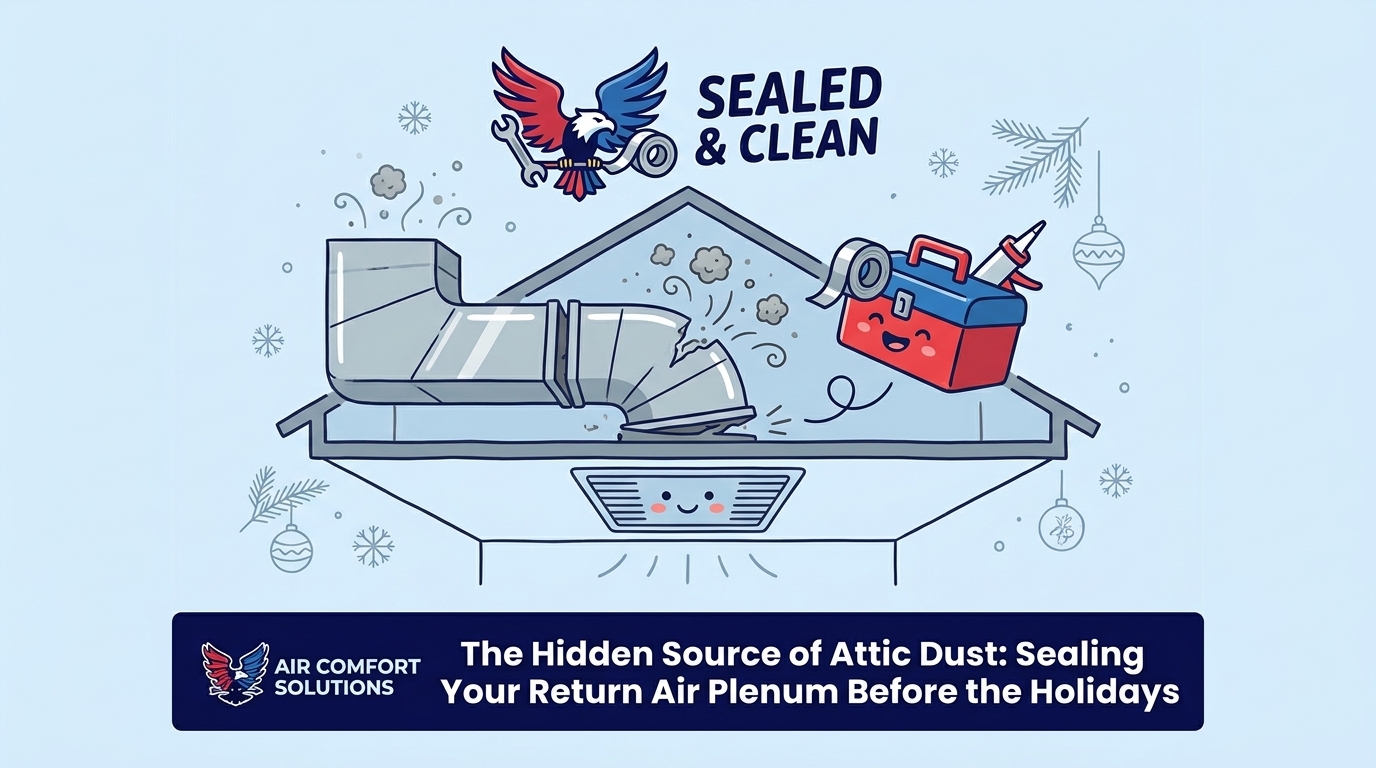
The Value of Sealing Your Return Air Plenum Before the Holidays
Most homeowners buy expensive filters to fix dusty air, not realizing a leaky return plenum in the attic is the real culprit. See why sealing it now saves your holiday gatherings.
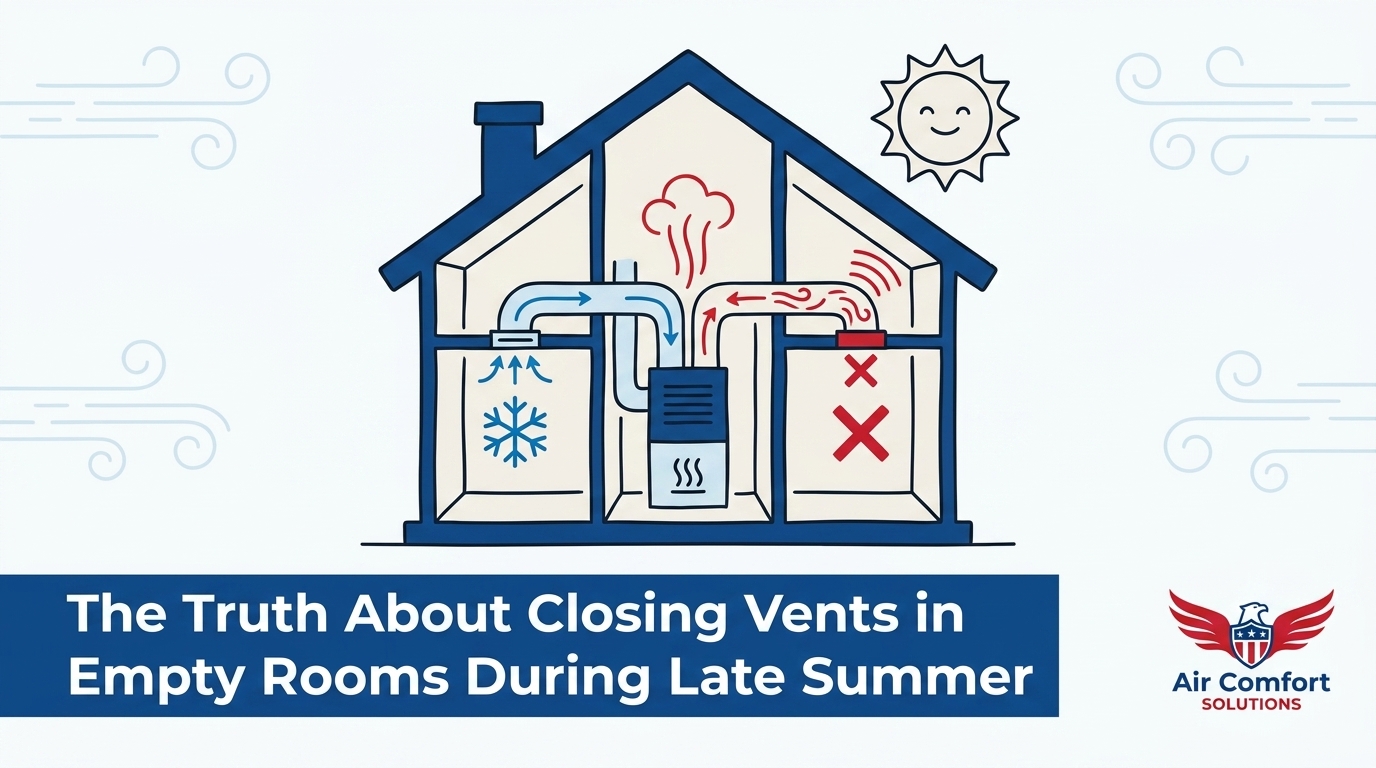
Closing vents in unused rooms doesn't save energy—it actually makes your system work harder. If you are searching for the truth about closing vents in empty rooms during late summer, you are navigating one of the most misunderstood aspects of home cooling. Many homeowners believe that shutting the registers in a guest bedroom, office, or dining room will redirect cold air to the living spaces that need it most, theoretically lowering utility bills. However, this common practice is one of the fastest ways to damage your HVAC equipment. If you need expert air conditioning services, we can help you optimize your home's airflow the right way.
This widespread myth stems from a fundamental misunderstanding of how central air conditioning systems are designed to operate. It seems logical to treat your home's ductwork like a plumbing system—if you turn off one faucet, the water pressure increases at the others. Unfortunately, air conditioning systems do not function like water pipes. When you close vents during the late summer / August peak heat, you inadvertently create dangerous conditions for the HVAC system.
Homeowners are often faced with a critical decision point: weighing theoretical energy savings against the very real risk of catastrophic blower motor failure. To understand why this energy-saving hack backfires so spectacularly, we have to look at the science of static pressure.
• Closing vents saves money by reducing the area the AC has to cool. — The Reality: The AC still produces the same amount of cold air, but now it struggles to distribute it, wasting energy.
• Shutting registers pushes more cold air into the master bedroom or living room. — The Reality: It creates severe backpressure in the ductwork, slowing down total airflow across the entire house.
• Closing off unused rooms gives the HVAC system a break. — The Reality: It forces the blower motor to work exponentially harder against increased resistance, leading to premature failure.
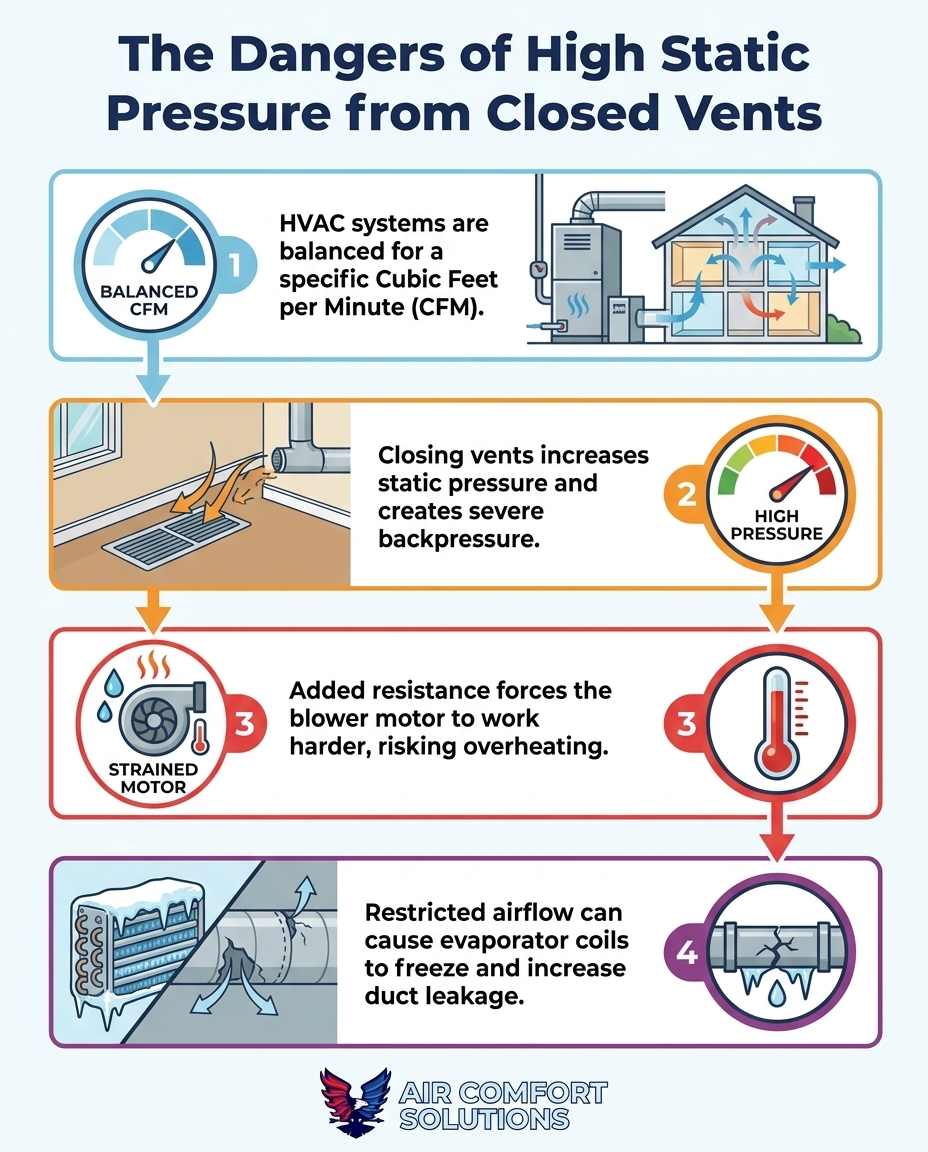
To grasp why closing vents is so harmful, it is helpful to understand the foundational physics of HVAC airflow. Central air conditioning systems are precisely engineered and balanced for a specific volume of air, measured in Cubic Feet per Minute (CFM). When an HVAC technician designs a system for a home, they calculate the exact CFM required to cool the total square footage efficiently, and they size the ductwork to accommodate that specific volume.
You can think of your home's ductwork as a closed-loop respiratory system. The system draws warm air from inside the house through the return vents, cools it by passing it over the evaporator coil, and then pushes that newly conditioned air back into the rooms through the supply vents. For this respiratory system to function properly, the intake must perfectly match the output. If the system is designed to push 1,200 CFM of air into the home, it must be able to distribute exactly 1,200 CFM of air through open registers.
The mechanical reality: The blower motor inside your indoor unit is calibrated to push air against a known, expected amount of resistance. The system does not "know" a vent is closed. It does not possess the ability to recognize that the guest bedroom is off-limits and magically dial down its output. Instead, it continues to try and push the exact same volume of air into a space that is now severely restricted. This restriction disrupts the delicate balance of the entire system, leading to high static pressure that stresses every mechanical component. If you are struggling with airflow imbalances, reaching out for professional HVAC services in Pinehurst is a much safer solution than closing registers.
Static pressure is the resistance to airflow within your ductwork. A certain amount of static pressure is normal and necessary—it is the force that allows air to reach the furthest rooms in your house. However, when static pressure exceeds the system's design limits, it becomes an invisible threat to your equipment.
Closing vents acts exactly like putting your thumb over the end of a running garden hose. When you block the flow of water, pressure builds up intensely behind your thumb. In your HVAC system, the closed vent acts as the thumb, and the ductwork acts as the hose. Because the blower motor is still trying to force the same amount of air through a suddenly smaller total opening, the backpressure inside the ducts skyrockets. This creates a state of high static pressure.
The mechanical strain this places on the blower motor is immense. The motor is forced to work exponentially harder to push air against this increased resistance. Modern systems often use variable-speed ECM (Electronically Commutated Motor) blowers, which are designed to ramp up their speed when they sense resistance in order to maintain proper airflow. If vents are closed, the motor will spin faster and faster, drawing more electricity and generating excessive heat. Eventually, this progression from motor strain to overheating results in premature, irreversible failure.
If high static pressure is actively stressing your system, your equipment will usually display warning signs before a complete breakdown occurs. Watch for these indicators:
• Unusual noises: Louder than normal humming, buzzing, or grinding noises emanating from the indoor air handler unit.
• Weak overall airflow: Surprisingly, closing vents often results in weak, anemic airflow coming from the vents that actually remain open, because the motor is struggling against the backpressure.
• Continuous operation: The system struggling to reach the set temperature on the thermostat despite running constantly throughout the day.
• Hot spots: Certain rooms feeling unusually warm and humid, indicating that the overall air circulation in the home has been severely compromised.
The danger of high static pressure is present year-round, but it becomes exponentially more hazardous during the peak cooling demand of August. During late-summer heatwaves, HVAC systems are already operating at or near their maximum capacity just to keep up with the outdoor temperatures. The equipment is running for longer cycles, drawing more power, and generating more internal heat.
This continuous operation leaves zero margin for error or added mechanical strain. When you close vents during the late summer / August peak heat, you are taking a system that is already running a marathon and forcing it to breathe through a straw. A blower motor operating under high static pressure generates excess heat, and because the system is running constantly to combat the summer weather, the motor has absolutely no downtime to cool off.
In Southeast Texas, the intense August heat forces systems to run almost continuously. The ambient temperature in the attic—where ductwork and air handlers are frequently located—can easily exceed 130 degrees. This extreme environment makes static pressure spikes especially dangerous due to the total lack of recovery time for the equipment. The heat from the attic combined with the internal heat of an overworked motor accelerates the risk of overheating and electrical burnout. A breakdown during this season is both highly uncomfortable for the household and entirely preventable simply by leaving all interior doors and registers open.
Blower motor failure is not the only consequence of closing vents. Disrupting the system's precise airflow balance creates a domino effect of secondary issues, demonstrating how interconnected every component of an HVAC system truly is. One of the most common and immediate results of high static pressure is a frozen evaporator coil.
Your air conditioner does not actually "make" cold air; it removes heat from the indoor air. The warm air from your home is blown over the freezing-cold evaporator coils, which absorb the heat. However, when you close vents and restrict the overall airflow, there is no longer enough warm air passing over those coils to facilitate this heat transfer. Without that constant supply of warm air, the temperature of the coils drops below freezing. The natural condensation that forms on the coils quickly turns to ice. This ice buildup further blocks airflow, eventually leading to a complete system shutdown. In fact, restricted airflow causes frozen evaporator coils more often than low refrigerant levels.
Another major consequence is increased duct leakage. Residential ductwork is assembled in sections, connected by seams and joints. While these joints are sealed, they are not designed to withstand extreme pressure. When high static pressure builds up because vents are closed, that compressed air looks for the path of least resistance. It forces its way out of tiny seams, cracks, and joints in the ductwork. Instead of cooling your living room, you end up pushing perfectly conditioned, expensive cold air straight into your sweltering attic or crawlspace. This completely negates any theoretical energy savings you hoped to achieve by closing the vents in the first place.
If you have unused rooms in your home and want to optimize your comfort and efficiency without risking severe equipment damage, there are proper, mechanically safe ways to achieve this. Air Comfort Solutions prefers providing transparent, myth-busting advice to save homeowners from costly, preventable repairs, rather than profiting from broken blower motors. Here are the safest alternatives to the vent-closing myth:
1. Keep all vents fully open and unblocked: The most crucial step is to ensure that every supply register and return grille in your home is fully open. Additionally, make sure that heavy furniture, rugs, or curtains are not blocking the airflow, as this creates the same high static pressure issues as manually closing the vent.
2. Invest in a multi-zone HVAC system: If you truly want room-by-room temperature control, the correct mechanical solution is a professionally designed dual-zone or multi-zone system. These systems use motorized dampers inside the ductwork, paired with advanced control boards and variable-speed equipment, to safely direct air where it is needed without causing dangerous backpressure.
3. Utilize ceiling fans: Ceiling fans do not lower the temperature of a room, but they create a wind-chill effect that makes the occupants feel cooler. Running fans in occupied rooms allows you to comfortably raise the thermostat setting a few degrees for the entire house, saving energy safely.
4. Optimize indoor air quality: Poor airflow often makes rooms feel stuffy or uncomfortable. Upgrading your indoor air quality solutions, such as installing better filtration or whole-home dehumidifiers, can make the existing air feel significantly cooler and more comfortable without restricting the HVAC system's output.
5. Schedule professional maintenance: If certain rooms are always too hot or too cold, the issue might be leaky ductwork, inadequate insulation, or a failing component. A professional evaluation in Pinehurst TX can identify the root cause of the temperature imbalance.
Ultimately, keeping your vents open is one of the simplest and most effective ways to protect your blower motor from devastating static pressure damage. The HVAC system in your home is a carefully balanced machine, and altering that balance always comes with consequences. The theoretical savings of closing vents in an unused guest room are vastly outweighed by the risk of system failure, frozen coils, and massive energy waste through duct leakage.
Homeowners should prioritize preventative care and overall system health over outdated energy-saving hacks that do more harm than good. By understanding how high static pressure affects your equipment, you can make informed decisions that extend the lifespan of your air conditioner and keep your home comfortable during the hottest months of the year. We encourage you to focus on proper, professional care for your equipment. To ensure your system is running at peak efficiency safely, learn more about our preventative AC maintenance options today.
Why is it bad to close AC vents?
Closing AC vents disrupts the precise airflow balance your system was designed to maintain. It creates severe backpressure inside the ductwork, which forces the blower motor to work much harder than intended. Over time, this added strain leads to overheating, frozen evaporator coils, and premature equipment failure.
Does closing vents in unused rooms save money?
No, closing vents in unused rooms does not save money. Your air conditioner continues to produce the same volume of cold air regardless of how many vents are open. Closing vents actually wastes money by increasing duct leakage and causing the system to run less efficiently, driving up your utility bills.
Can closing vents damage my AC?
Yes, closing vents can cause significant and expensive damage to your AC system. The resulting high static pressure can burn out the blower motor, which is one of the most vital components of the unit. Additionally, the restricted airflow can cause the evaporator coils to freeze over, which can ultimately destroy the compressor.
What causes high static pressure in HVAC systems?
High static pressure is caused by any restriction that prevents air from flowing freely through the ductwork. The most common causes include closed or blocked supply vents, extremely dirty air filters, undersized ductwork, and blocked return air grilles. Any of these issues force the system to push air against heavy resistance.
How many vents can I safely close in my home?
As a general rule, you should never close more than 10 percent of the vents in your home, but it is always safest to leave 100 percent of them fully open. Even closing just one or two vents in a smaller home can alter the static pressure enough to cause strain on the blower motor during peak summer heat.
Will closing vents redirect more air to other rooms?
While closing a vent might slightly increase the airflow out of the nearest open register, it does not efficiently redirect air to the rest of the house. Instead, the trapped air creates pressure that causes the ductwork to leak conditioned air into unconditioned spaces like attics or walls, meaning that air never reaches the rooms you want to cool.


Zane came out and did an amazing job! Super friendly, honest and transparent about the work that needed to be done. This is my second time working with Air Comfort Solutions and they’re my go to for HVAC services. Highly recommend.
God's AMAZING grace sent us Robert and Zane. We have been without air in this Texas heat for six weeks and four days. We've had a few contractors give us quotes all trying to upsell when we're at a low point. But not the guys at Air Comfort Solutions. They came in assessed our situation, gave us honest feedback, and showed us the issues as they proceeded with the assessment for clear understanding. We highly recommend them for their professionalism, quality products, and fair pricing. We hands down support them for all the work they do 💯 %.
Robert and Zane gone above and beyond to make the process easy and affordable.
Would definitely recommend!!
I’m writing this review to let everyone know that Air Comfort Solutions is the company to work with. I know the owner ( Robert) for several years now. He has been taking care of my residential and business work orders. Robert is professional, knowledgeable and will save you money. I just want to thank Robert for great job you have been doing for me.