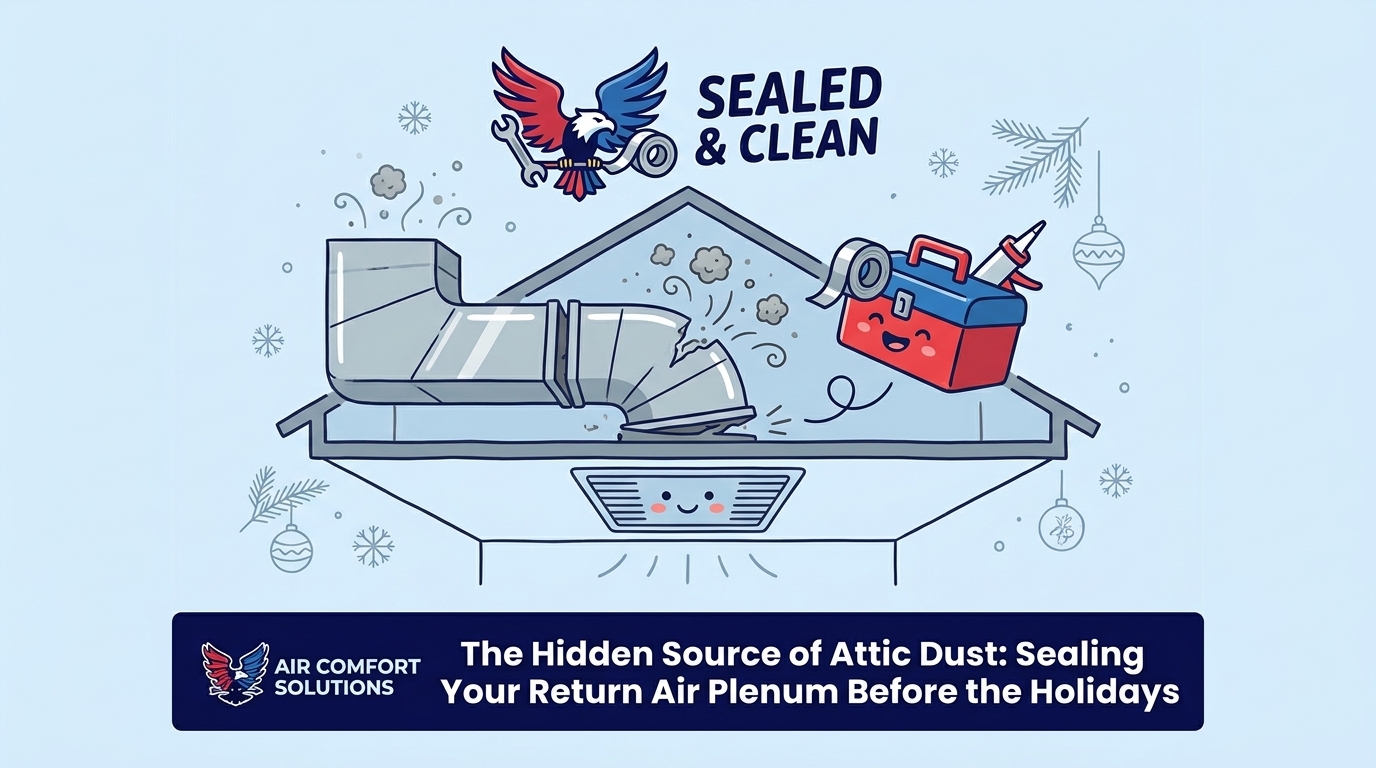
The Value of Sealing Your Return Air Plenum Before the Holidays
Most homeowners buy expensive filters to fix dusty air, not realizing a leaky return plenum in the attic is the real culprit. See why sealing it now saves your holiday gatherings.
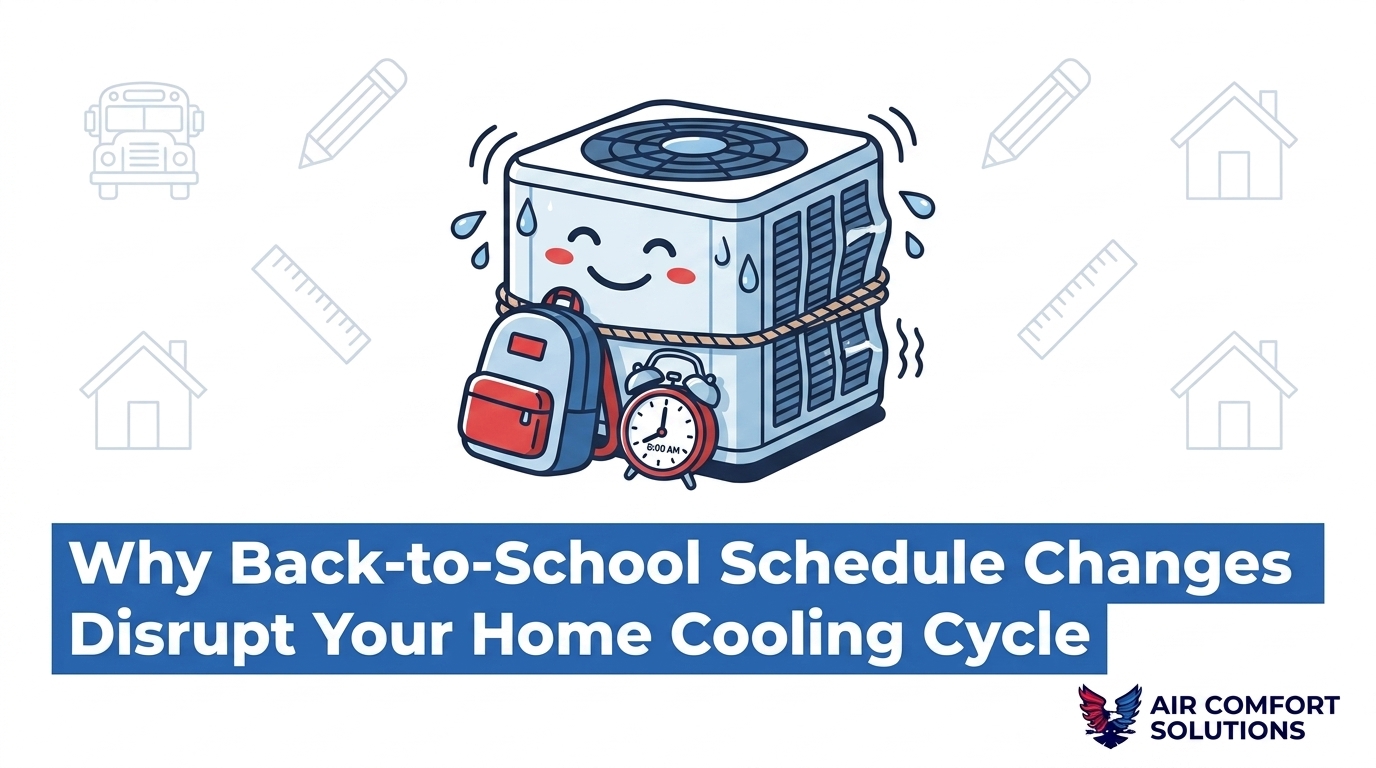
Are you wondering exactly how back-to-school schedule changes disrupt your home cooling cycle after walking through the front door into a wall of trapped, heavy heat? You are not alone. Our technicians at Air Comfort Solutions see this common scenario play out in homes across Pinehurst every August: the house is empty during the day, so you adjust the thermostat to save energy. But when the afternoon rolls around and the family returns, the indoor temperature is unbearable, and the air conditioner seems completely unable to catch up. The immediate instinct is to drop the thermostat setting even lower, but the house remains stubbornly warm for hours.
Before you resign yourself to sweating through the late afternoon, it is critical to understand that your cooling system is battling a massive backlog of heat and humidity. If your air conditioning system is struggling to catch up every single afternoon, it might be time to schedule a routine AC maintenance plan to ensure it is operating at peak capacity.
During the August back-to-school transition, our team notices households abruptly shift from a constant summer schedule to an empty-house routine. In an effort to be energy-conscious, many homeowners program their thermostats to rise significantly while everyone is at work and school. While the intention is good, our field experience shows this drastic shift creates what HVAC professionals call a cooling deficit.
A cooling deficit occurs when the heat energy inside your home accumulates faster than your air conditioning system can remove it once it finally turns back on. You are not just cooling the air; you are cooling the walls, the furniture, the carpets, and the cabinetry. All of these physical objects absorb heat throughout the day. When you finally ask your system to cool the house down at 3:30 PM, it has to extract all that stored thermal energy before the air actually feels comfortable.
• Thermal mass absorption: Your furniture and walls soak up heat all day long and slowly release it back into the room, fighting your AC's efforts.
• Solar heat gain: Afternoon sun beating through windows compounds the temperature rise right before you get home.
• System lag: An air conditioner is designed to maintain temperatures, not to drop them rapidly by large margins in a short window of time.
This creates a significant HVAC recovery time—the number of hours it takes for your system to overcome the deficit and return the home to your preferred set point. Understanding this recovery time is the first step toward fixing your afternoon comfort crisis.
To truly understand why your home feels so uncomfortable, we have to look at the physics of indoor climate control. As local HVAC professionals, we can tell you that cooling a home is not just about lowering the number on the thermostat. It is a two-part battle against both temperature and moisture. This is especially true given the climate realities of Pinehurst TX, where our late-summer extreme heat is paired with heavy, oppressive humidity.
If your home consistently feels sticky or smells slightly musty when you return in the afternoon, you may need to explore professional indoor air quality solutions to help manage the moisture load.
Your air conditioner processes two entirely different types of heat energy. Understanding the difference explains why a house can sometimes feel terrible even if the thermostat says it is 75 degrees.
• Sensible Heat — What It Is: The actual air temperature that can be measured with a standard thermometer. — How You Experience It: Feeling physically hot or cold; the number displayed on your thermostat screen. — How the AC Responds: The system blows cold air into the room to directly lower the ambient air temperature.
• Latent Heat — What It Is: The thermal energy trapped within moisture vapor in the air (humidity). — How You Experience It: Feeling sticky, clammy, or suffocated; sweat not evaporating from your skin. — How the AC Responds: The system runs air over the cold evaporator coil to condense and drain the moisture away.
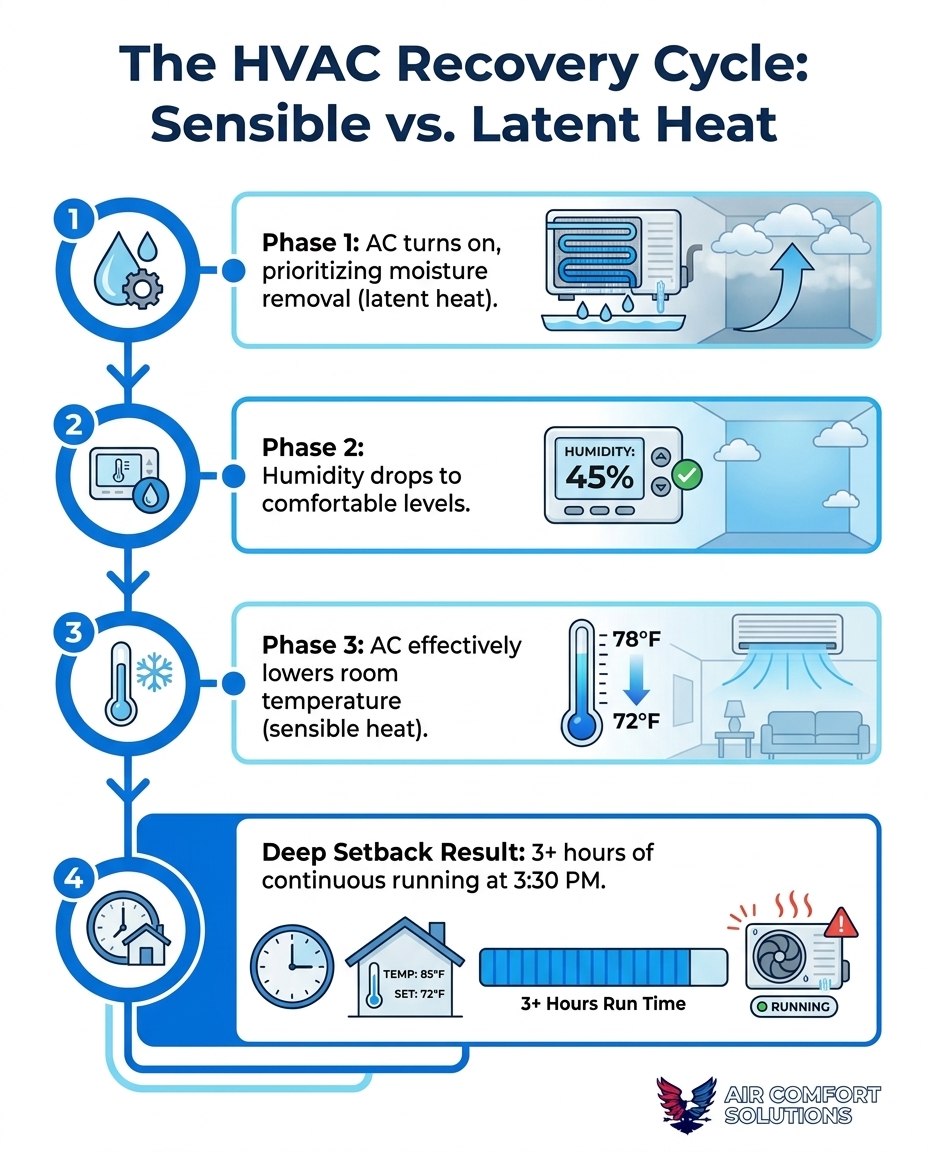
Here is the crucial mechanical reality: an air conditioner must remove latent heat before it can effectively lower sensible heat.
When you leave your house empty all day with the AC turned up, humidity slowly infiltrates the building. Moisture seeps in through microscopic cracks, open doors, and normal ventilation. Because the AC is not running frequently enough to dehumidify the space, this latent heat builds into a massive, invisible burden.
When your thermostat finally calls for cooling in the afternoon, the system turns on and begins pulling air across its indoor coils. But before the air temperature in the room can drop, the AC has to wring out all that accumulated moisture. It acts as a giant dehumidifier for the first hour or two. This is why you hear the system running at full blast, yet the house still feels heavy, sticky, and completely uncomfortable. The sensible temperature refuses to budge until the latent heat is conquered.
If you search for energy-saving tips online, you will almost certainly encounter generic advice from the Department of Energy suggesting a 7-to-10-degree thermostat setback for the eight hours you are away at work or school. In theory, allowing the house to warm up significantly reduces the amount of time the AC runs during the day.
However, our technicians at Air Comfort Solutions will be the first to tell you that this generic advice fundamentally fails in extreme humid climates. While a 10-degree setback might work perfectly in a dry, arid environment, attempting it during the humid late summer will cause your system to fall hopelessly behind. By the time the 3:30 PM peak afternoon heat load hits, your home has become a sauna.
Many homeowners tell us they believe that if they set the thermostat 10 degrees higher during the day, the AC will just run for a little while when they get home to fix it. This is a costly misconception we correct on service calls all the time. When you implement a deep setback in a humid climate, several negative consequences occur:
• Erased energy savings: The system is forced to run continuously at maximum capacity for hours to overcome the cooling deficit, often consuming more energy than it would have used to simply maintain a moderate temperature all day.
• Excessive system strain: Forcing a unit to run non-stop during the absolute hottest part of the day puts immense stress on the compressor, motors, and capacitors, leading to premature breakdowns.
• Prolonged discomfort: Because the system is battling both thermal mass and massive latent heat, you are left sweating in your own living room for hours.
Instead of forcing your system into a daily crisis, we recommend a smarter strategy. Maintaining a steady, slightly higher temperature is vastly more efficient than a drastic, sweeping temperature swing. If you are worried about your system's ability to handle these long run cycles, it is wise to learn about the best time of year to schedule your AC tune-up so you are prepared before the peak heat arrives.
The core of this cooling disruption is a matter of terrible timing. It is a pattern we see often on afternoon service calls: the exact moment your family needs maximum indoor comfort perfectly aligns with the absolute worst conditions for your air conditioner to operate.
The Problem: The school bell rings, the bus drops the kids off, and everyone rushes through the front door right as the 3:30 PM peak afternoon heat load reaches its absolute zenith. The outdoor ambient temperature is at its highest, the sun is directly baking the roof, and the indoor humidity has peaked from sitting empty all day.
The Cause: Your cooling system is suddenly tasked with an impossible math problem. It must overcome the peak outdoor heat, fight the accumulated indoor humidity, cool down the hot furniture, and deal with a sudden influx of human activity. Every person who walks inside brings a body temperature of 98.6 degrees. Doors are opened and closed, letting in waves of hot air. Kids open the refrigerator to find snacks, the oven might be turned on for an early dinner, and electronics are powered up. You are adding massive new heat loads to a system that is already drowning in a cooling deficit.
The Solution: You cannot change the school schedule, and you cannot change the weather. But you can change how you prepare the house for this daily collision. By bridging the gap between energy efficiency and realistic recovery times, you can eliminate the afternoon sweat session. If your system still fails to cool the house even when properly programmed, it is time to call for professional cooling services to diagnose underlying airflow or refrigerant issues.
Even a perfectly sized, brand-new air conditioner takes time to move heat. In extreme late-summer conditions, a healthy AC can generally drop the indoor temperature by about one degree per hour. If you let the house heat up by eight degrees during the day, you are looking at an eight-hour recovery time lag. The system simply cannot catch up fast enough to provide immediate comfort when you walk through the door.
As a local family-owned business, Air Comfort Solutions knows firsthand that Southeast Texas heat behaves very differently than national averages. We live and work through the same August back-to-school transition as you do. To achieve actual comfort without wasting energy, we highly recommend a localized, realistic approach to programming your thermostat.
Here is the exact strategy our Pinehurst AC experts recommend for managing the school-day schedule:
1. Implement a narrow setback range: Ignore the advice to raise your thermostat by 10 degrees. In our humid climate, limit your daytime setback to no more than 3 to 4 degrees above your ideal comfort setting. If you like the house at 72 degrees when you are home, do not set it higher than 75 or 76 degrees when you leave. This keeps the AC running just enough to prevent massive humidity buildup.
2. Schedule an early recovery phase: Do not wait until 3:30 PM to tell the thermostat to cool down. Program the recovery phase to begin 60 to 90 minutes before anyone arrives home. This gives the system a head start to remove the latent heat and begin lowering the sensible heat before the doors start opening.
3. Utilize smart thermostat learning features: If you have a Wi-Fi-enabled smart thermostat, turn on its "smart recovery" or "early start" feature. These devices learn your home's unique thermal profile. If you tell the thermostat you want it to be 72 degrees by 3:30 PM, it will automatically calculate exactly when it needs to turn on to hit that target based on the current weather.
4. Prioritize unhindered airflow: A well-maintained system recovers vastly faster than a neglected one. Ensure all interior doors remain open during the day to allow return vents to pull humid air from every room. Check your air filters monthly; a clogged filter chokes the blower motor and drastically extends your recovery time lag.
By adopting this narrower setback strategy, you keep the latent heat at bay. The system runs in shorter, more manageable cycles during the day, rather than straining itself to death in a frantic three-hour marathon every afternoon.
Sudden thermostat adjustments demand immediate cooling during peak afternoon heat, which overloads the system. The AC must first remove hours of accumulated humidity before it can begin lowering the actual temperature. Additionally, the influx of people opening doors and turning on electronics adds new heat to an already struggling system.
A properly sized AC lowers the temperature by about one degree per hour in extreme heat. If you utilize deep setbacks of 7 to 10 degrees, it can require three or more hours of continuous running to recover. This is why attempting to cool a hot house rapidly in the late afternoon almost always fails.
A slight setback of 3 to 4 degrees is optimal for balancing efficiency and comfort. Leaving it at a single temperature all day prevents humidity buildup entirely, but it does use slightly more energy. However, a massive temperature swing is worse, as it forces the system to run inefficiently during the hottest part of the day.
It saves money in dry climates, but in humid areas, the prolonged afternoon recovery cycle can negate those savings. Extreme setbacks force the system to work at its maximum capacity during the hottest hours, which drives up utility costs and accelerates wear and tear on the equipment.
It is battling peak outdoor temperatures, solar heat gain from the sun, and the backlog of indoor humidity from sitting empty. Continuous running is completely normal during this recovery phase. However, if the system runs constantly but the temperature never drops, that indicates a potential mechanical or maintenance issue.
Figuring out exactly how back-to-school schedule changes disrupt your home cooling cycle is the key to reclaiming your comfort. In our experience, afternoon relief requires the right scheduling strategy, not just aggressively mashing the down button on your thermostat. By adopting a narrower setback range during the August back-to-school transition, you can keep humidity in check and ensure your home is welcoming when the front door opens.
If you have optimized your programmable thermostat and your house still feels like an oven at 4:00 PM, your equipment may be suffering from dirty coils, low refrigerant, or restricted airflow. Do not spend another afternoon sweating in your own living room. Reach out to secure a routine AC maintenance plan so our experts can diagnose the delay and restore your home's cooling power today.


Zane came out and did an amazing job! Super friendly, honest and transparent about the work that needed to be done. This is my second time working with Air Comfort Solutions and they’re my go to for HVAC services. Highly recommend.
God's AMAZING grace sent us Robert and Zane. We have been without air in this Texas heat for six weeks and four days. We've had a few contractors give us quotes all trying to upsell when we're at a low point. But not the guys at Air Comfort Solutions. They came in assessed our situation, gave us honest feedback, and showed us the issues as they proceeded with the assessment for clear understanding. We highly recommend them for their professionalism, quality products, and fair pricing. We hands down support them for all the work they do 💯 %.
Robert and Zane gone above and beyond to make the process easy and affordable.
Would definitely recommend!!
I’m writing this review to let everyone know that Air Comfort Solutions is the company to work with. I know the owner ( Robert) for several years now. He has been taking care of my residential and business work orders. Robert is professional, knowledgeable and will save you money. I just want to thank Robert for great job you have been doing for me.