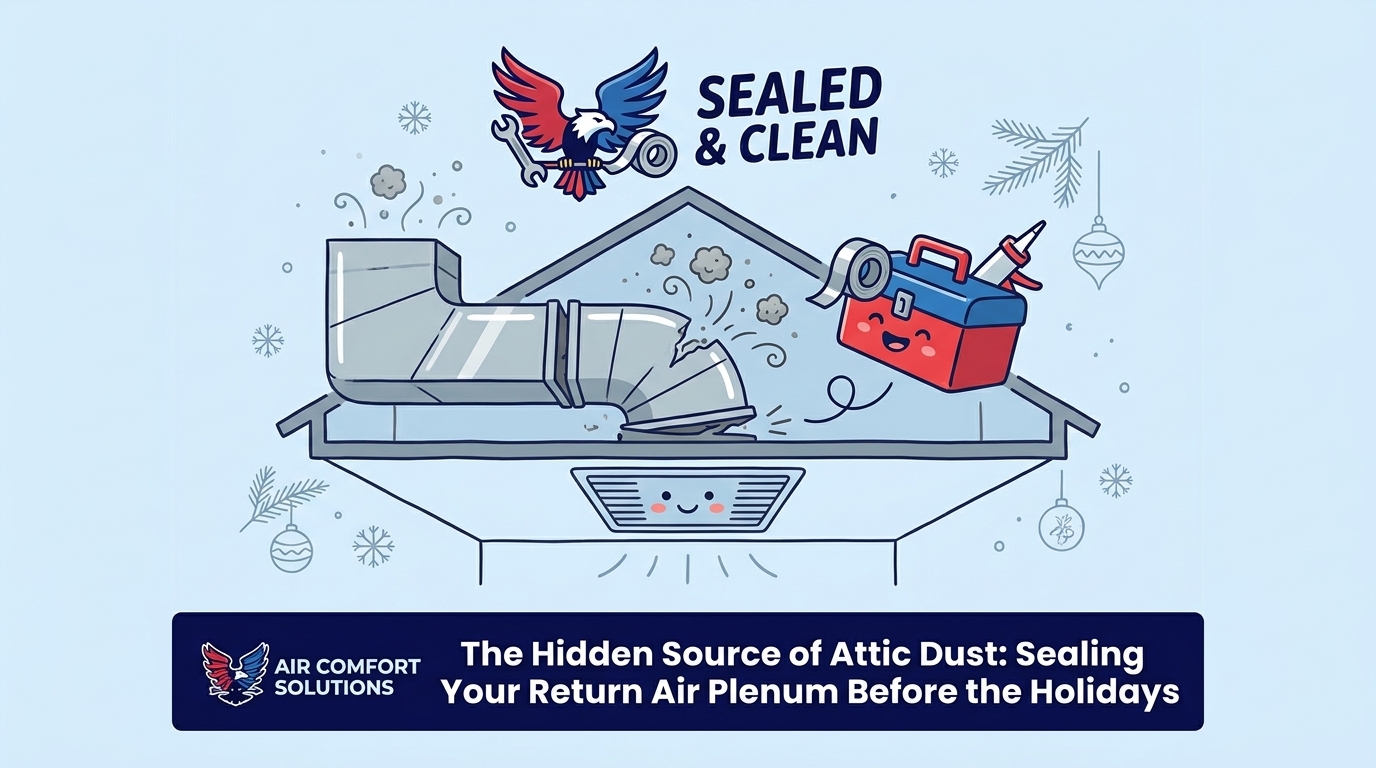
The Value of Sealing Your Return Air Plenum Before the Holidays
Most homeowners buy expensive filters to fix dusty air, not realizing a leaky return plenum in the attic is the real culprit. See why sealing it now saves your holiday gatherings.
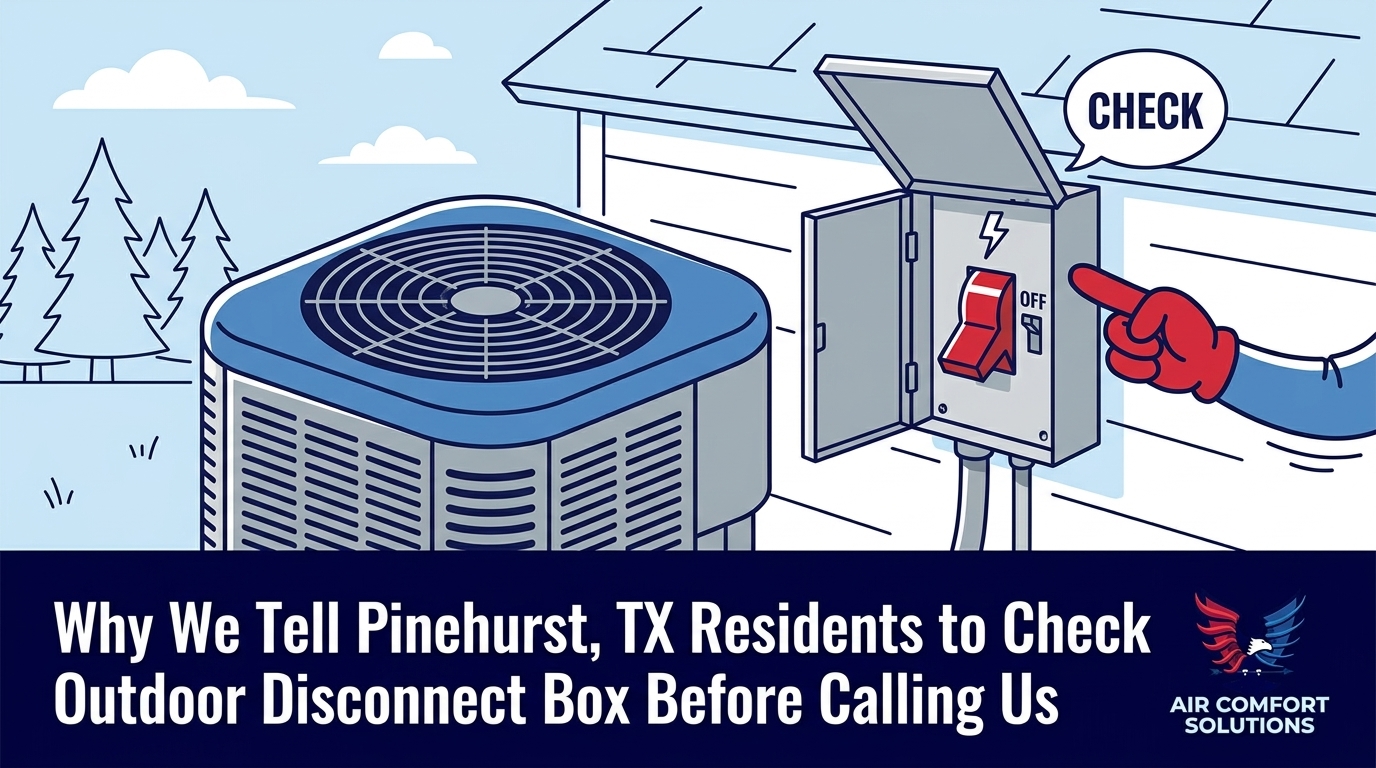
Your indoor vents are blowing air, but the house is getting warmer by the minute. You walk outside into the intense heat and realize your AC condenser is sitting completely silent. When this happens, panic usually sets in. But before you reach for the phone, you should know why we tell Pinehurst residents to check their outdoor disconnect box before calling us. In our years of dispatching technicians throughout the area, our team has seen countless "dead AC" calls that turned out to be a simple flipped switch. A completely dead outdoor unit during a July peak summer heatwave is incredibly stressful, especially when the indoor fan continues to blow warm air through your ductwork, tricking you into thinking the system is running.
This creates an immediate decision point. Do you schedule an emergency repair right this second, or do you take two minutes to perform a safe, exterior visual inspection? Many homeowners do not realize that a "dead" condenser is often just a tripped safety mechanism located right next to the unit itself. The system is designed to shut down to protect its most expensive components from electrical damage.
We want to provide the reassurance that professional HVAC services are always ready and available if you need them. However, a simple visual check might restore your cooling instantly. Taking a quick look at the exterior safety switch can save you time, money, and unnecessary stress while you wait for AC repair and service.
One of the most confusing parts of this specific failure is the indoor fan. Because your indoor air handler and your outdoor condenser operate on separate electrical circuits, the indoor blower will often keep running even if the outdoor unit loses power. The thermostat simply tells the indoor fan to circulate air. Without the outdoor compressor running to remove the heat, you just end up blowing hot, humid air through your home. Before assuming the entire system has failed, checking the localized power supply is your best first step.
To understand why this happens, you need to know what you are looking for. The outdoor disconnect box is a localized safety switch designed to cut power specifically to the AC condenser. It acts as the final electrical checkpoint between your home's main power panel and the heavy machinery sitting on the concrete pad outside.
The National Electrical Code (NEC) requires this box to be installed within sight of the AC unit. This is a strict safety regulation designed to protect technicians. When a professional is working on the high-voltage components of your system, they must be able to physically cut the power and see that the switch remains off while their hands are inside the machine. If the power switch were only located inside the house, someone could accidentally flip the breaker back on while the technician is still working.
Based on the hundreds of systems our team has serviced in Pinehurst TX, you will typically see this box mounted on the exterior brick or siding of your home, usually within a few feet of the condenser unit. It is almost always a grey metal box, sometimes featuring a small hinged door or a visible lever on the side. Its sole job is to interrupt the electrical circuit before the voltage reaches the heavy machinery.
• Main Electrical Panel — Location: Inside the home or garage — Primary Purpose: Protects the entire house circuitry from overloads.
• Dedicated AC Breaker — Location: Inside the main panel — Primary Purpose: Protects the specific wire running from the panel to the outside box.
• Outdoor Disconnect Box — Location: Outside, near the condenser — Primary Purpose: Provides a localized shut-off point for technician safety and equipment protection.
Understanding the difference between these components helps you pinpoint exactly where the power interruption occurred. The disconnect box is the final gatekeeper before the electricity enters the condenser.
You might wonder why this localized switch suddenly decides to cut power. The answer usually comes down to extreme weather and heavy electrical strain. In our experience working on local HVAC systems, extreme heat and high humidity force AC condensers to run nearly continuously during a July peak summer heatwave. The system draws massive amounts of power just to maintain a livable temperature inside your home.
Pinehurst's intense summer heatwaves create the exact conditions that maximize electrical strain on residential HVAC systems. When an air conditioner turns on, the compressor requires a massive surge of electricity to overcome the pressure of the refrigerant and start spinning. This is known as the startup load. During startup, AC compressors pull significantly higher amps than their standard running load. If the outdoor temperatures are soaring, the compressor has to work even harder to start up against the high pressure in the system.
This sudden spike in electrical demand can easily overwhelm the circuit. When the amps exceed the safety rating, the disconnect switch or the internal fuses will trip as a protective measure. It sacrifices the connection to save the compressor from burning out.
A single tripped disconnect on a 105-degree afternoon might just be a fluke caused by a temporary power grid surge or a particularly hard startup. However, our technicians often see that repeated tripping points to a much deeper underlying electrical strain. One of the most frequent culprits is a failing run capacitor. The capacitor acts like a battery that provides an extra jolt of energy to help the compressor start. When it weakens, the compressor pulls more electricity directly from the grid, causing the circuit to overload. If you notice this happening repeatedly, you are likely seeing the common signs of a failing AC capacitor, which requires immediate professional attention.
If your condenser is silent while the indoor fan blows warm air, you can perform a safe visual inspection to see if the localized power has been interrupted. As local HVAC professionals, our team strongly encourages homeowners in Pinehurst TX to take these simple steps before assuming the worst.
1. Locate the grey box: Walk outside to your condenser pad and look at the exterior wall of your home. You should see a grey metal box mounted to the siding or brick, with a thick flexible conduit wire running from the box to the AC unit.
2. Check the external switch position: Some modern disconnect boxes feature an external lever or switch on the side. Look closely at the markings. If the switch has been flipped to the "OFF" position, a power surge or physical bump may have disengaged it.
3. Inspect the pull-out block: Many standard disconnect boxes use a pull-out block instead of an external switch. This block is housed under a small metal cover. You can lift the hinged cover to look inside. Verify that the plastic pull-out block is properly seated. Sometimes, these blocks can become slightly dislodged. Ensure it is firmly pushed in and that the "ON" indicator is facing right-side up.
4. Check the main indoor electrical panel: If the outdoor box looks completely normal, go back inside your home. Locate your main electrical breaker box. Find the dedicated double-pole breaker labeled "AC" or "Condenser." Check to see if this breaker has tripped to the middle, neutral position. If it has, firmly push it all the way to "OFF" and then snap it back to "ON."
These four simple visual checks take less than two minutes and can often solve the mystery of a silent condenser without requiring a service vehicle to visit your home.
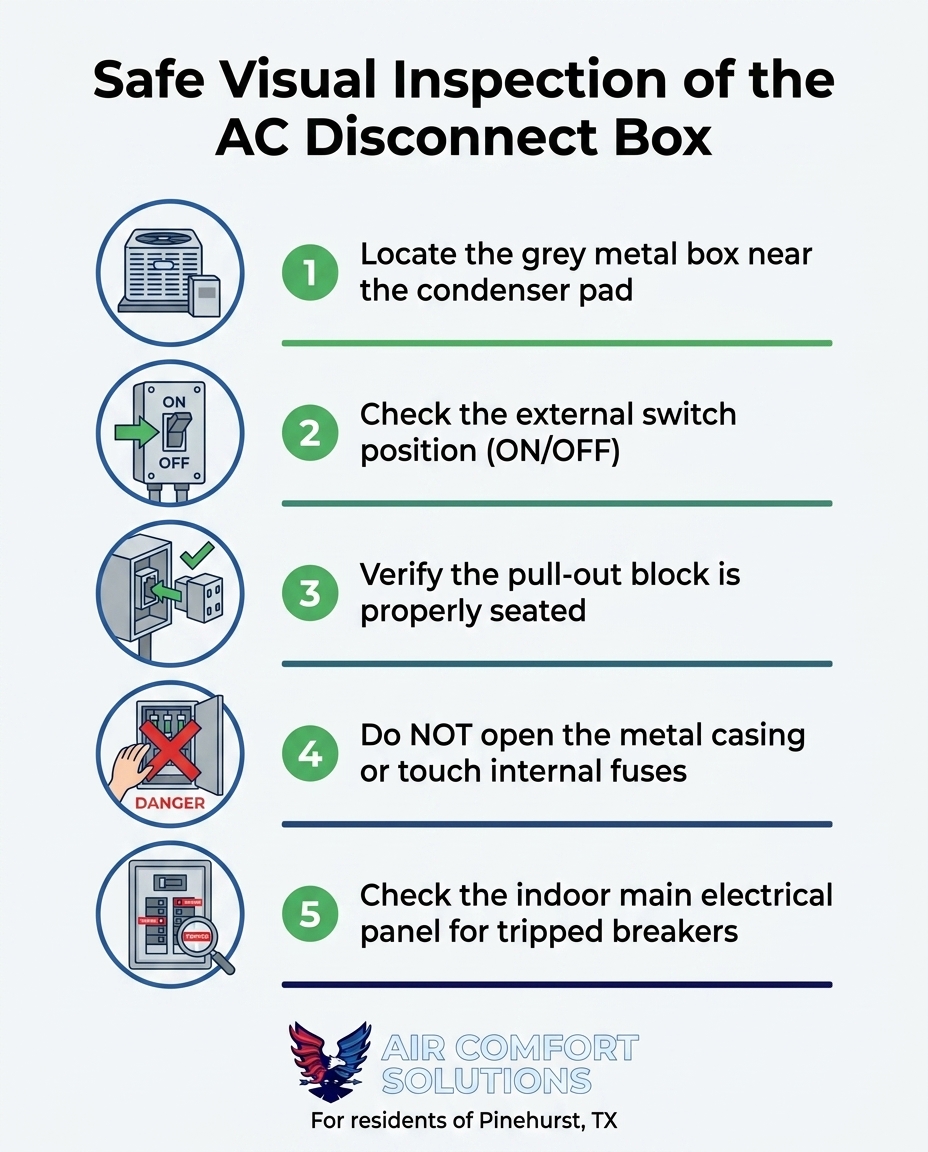
While we want you to check the obvious switches, we must establish strict safety boundaries. A homeowner's role ends at the visual inspection of the exterior switch or the main indoor breaker. You must never attempt to perform electrical repairs on your HVAC system.
Our licensed technicians strictly warn against opening the metal casing, touching the internal cartridge fuses, or attempting to bypass the disconnect mechanism in any way. The electricity flowing through that box is not like a standard wall outlet. These are 240-volt electrical components that carry severe, life-threatening risks. Handling high-voltage equipment requires proper training, insulated tools, and a licensed professional.
To put this into perspective, a standard indoor light switch operates on 120 volts. Your AC condenser requires double that amount, drawing a massive current to spin the heavy compressor motor. The metal box outside is designed to contain that voltage safely. If you start pulling out fuses with pliers or poking around with a screwdriver during a July peak summer afternoon, you risk severe electrical shock or creating a catastrophic short circuit that destroys the entire air conditioner.
Reiterate this rule in your household: if simply flipping the exterior switch or resetting the indoor breaker does not restore power to the unit, the DIY portion of the troubleshooting is officially over. Never force a switch to stay on if it immediately trips again. That is the system doing its job to protect you from an electrical fire.
You might think it is strange for an HVAC company to actively tell you how to avoid calling them. The truth is, many companies will happily dispatch a technician, drive to your home, and charge a full emergency trip fee just to flip a switch or push a dislodged pull-block back into place. We do not believe that is the right way to do business.
Having served this community for years, our team at Air Comfort Solutions prioritizes community trust by empowering homeowners with safe DIY checks to avoid unnecessary fees. We prefer to teach you these simple, safe troubleshooting steps first. If your system shut down because of a minor power fluctuation, we want you to be able to resolve it safely and get your house cooling again immediately.
Saving you from an unnecessary service visit builds long-term community trust. We know that if we treat you fairly and save you money today, you will remember us when you actually need a major repair or a full system replacement down the road. Our Pinehurst TX cooling experts are your reliable neighbors. We prioritize your comfort and safety over handing you a quick, unnecessary invoice for something you could have safely checked yourself.
If you have performed the visual inspection and the disconnect is properly engaged, but the condenser still will not turn on, a professional diagnostic is absolutely required. The simple fixes have been ruled out, and the issue now lies within the complex electrical components or the sealed refrigerant system.
Furthermore, if you reset the breaker or the disconnect switch and it immediately trips again, stop touching it. A breaker that trips repeatedly immediately after being reset indicates a dangerous electrical short, grounded wiring, or a failing, locked-up compressor. Forcing power back into a failing system will only cause more expensive damage.
When our Air Comfort Solutions technicians arrive during a July peak summer heatwave, we rely on years of hands-on experience rather than guessing at the problem. We will safely test the incoming voltage using professional multimeters. We will inspect the internal cartridge fuses inside the disconnect box to see if they have blown. We will evaluate the compressor's health, test the run capacitor, and check the contactor for pitting or burn marks.
The best way to prevent these sudden electrical failures is to stay ahead of the wear and tear. Regular check-ups through a preventative AC maintenance plan can catch these electrical strains before they cause a mid-summer breakdown. A technician can identify a weak capacitor or a loose electrical connection in the spring, replacing it long before it has the chance to trip your disconnect box on the hottest day of the year. If your AC is dead and the simple visual checks haven't worked, we are ready to find the real problem and fix it right.
Where is the AC disconnect box located?
The AC disconnect box is typically located on the exterior wall of your home, within sight of the outdoor condenser unit. It is a grey metal box mounted to the siding or brick, connected to the AC unit by a thick flexible wire conduit. The National Electrical Code requires it to be easily accessible for technicians working on the equipment.
How do I know if my AC disconnect is tripped?
You can determine if the disconnect is tripped by performing a quick visual inspection of the box. If it has an external lever, check if it is in the "OFF" position. If it uses a pull-out block under a metal flap, look to see if the block is dislodged, loose, or inserted upside down. If the outdoor unit is silent while the indoor fan runs, a tripped disconnect is a strong possibility.
Is it safe to check the outside AC switch?
It is completely safe to visually inspect the outside of the box and check the position of an external switch. However, it is highly dangerous to open the metal casing, touch the internal fuses, or attempt any wiring repairs. Homeowners should limit their troubleshooting to visual checks and leave internal panel access to licensed professionals.
Why does my AC disconnect keep tripping?
A disconnect that repeatedly trips is usually a sign of a severe electrical overload or a failing component. The most common causes are a weak run capacitor, a failing compressor that is drawing too many amps on startup, or a dangerous electrical short in the wiring. If it trips more than once, leave it off and call a professional immediately.
What does an AC disconnect switch do?
The disconnect switch provides a localized, physical shut-off point for the high-voltage electricity running to your AC condenser. Its primary purpose is safety, allowing a technician to cut the power right next to the machine so they can work on the internal components without the risk of someone turning the power back on from inside the house.
Can a tripped disconnect box cause my indoor fan to keep running?
Yes, a tripped outdoor disconnect box will cause the outdoor condenser to shut down while the indoor fan continues to run. This happens because the indoor air handler and the outdoor condenser operate on two completely separate electrical circuits. The thermostat will continue telling the indoor fan to circulate air, even though the outdoor unit has lost power and stopped cooling.


Zane came out and did an amazing job! Super friendly, honest and transparent about the work that needed to be done. This is my second time working with Air Comfort Solutions and they’re my go to for HVAC services. Highly recommend.
God's AMAZING grace sent us Robert and Zane. We have been without air in this Texas heat for six weeks and four days. We've had a few contractors give us quotes all trying to upsell when we're at a low point. But not the guys at Air Comfort Solutions. They came in assessed our situation, gave us honest feedback, and showed us the issues as they proceeded with the assessment for clear understanding. We highly recommend them for their professionalism, quality products, and fair pricing. We hands down support them for all the work they do 💯 %.
Robert and Zane gone above and beyond to make the process easy and affordable.
Would definitely recommend!!
I’m writing this review to let everyone know that Air Comfort Solutions is the company to work with. I know the owner ( Robert) for several years now. He has been taking care of my residential and business work orders. Robert is professional, knowledgeable and will save you money. I just want to thank Robert for great job you have been doing for me.