The Value of Sealing Your Return Air Plenum Before the Holidays
Most homeowners buy expensive filters to fix dusty air, not realizing a leaky return plenum in the attic is the real culprit. See why sealing it now saves your holiday gatherings.
Your air conditioning likely ran nearly nonstop through July and August, yet certain rooms still felt stiflingly warm—which is exactly why September is the Ideal Time to Address Ductwork Leaks Ignored All Summer. At Air Comfort Solutions, we've found that when a cooling system struggles to maintain a consistent temperature despite operating constantly, the root cause often lies out of sight. The hidden culprit we see in many local homes is unsealed ductwork, quietly leaking expensively conditioned air directly into the attic before it ever reaches your living spaces. While you undoubtedly felt the frustrating symptoms of this problem during the peak of summer, attempting comprehensive attic repairs in the middle of July is practically impossible. Early fall provides the first realistic, safe window for our technicians to actually solve the root cause of the issue.
If you are looking to upgrade your air conditioning system or explore professional indoor air quality solutions, tackling attic air leaks is the critical first step.
Top reasons our team recommends early fall as the optimal time for duct sealing:
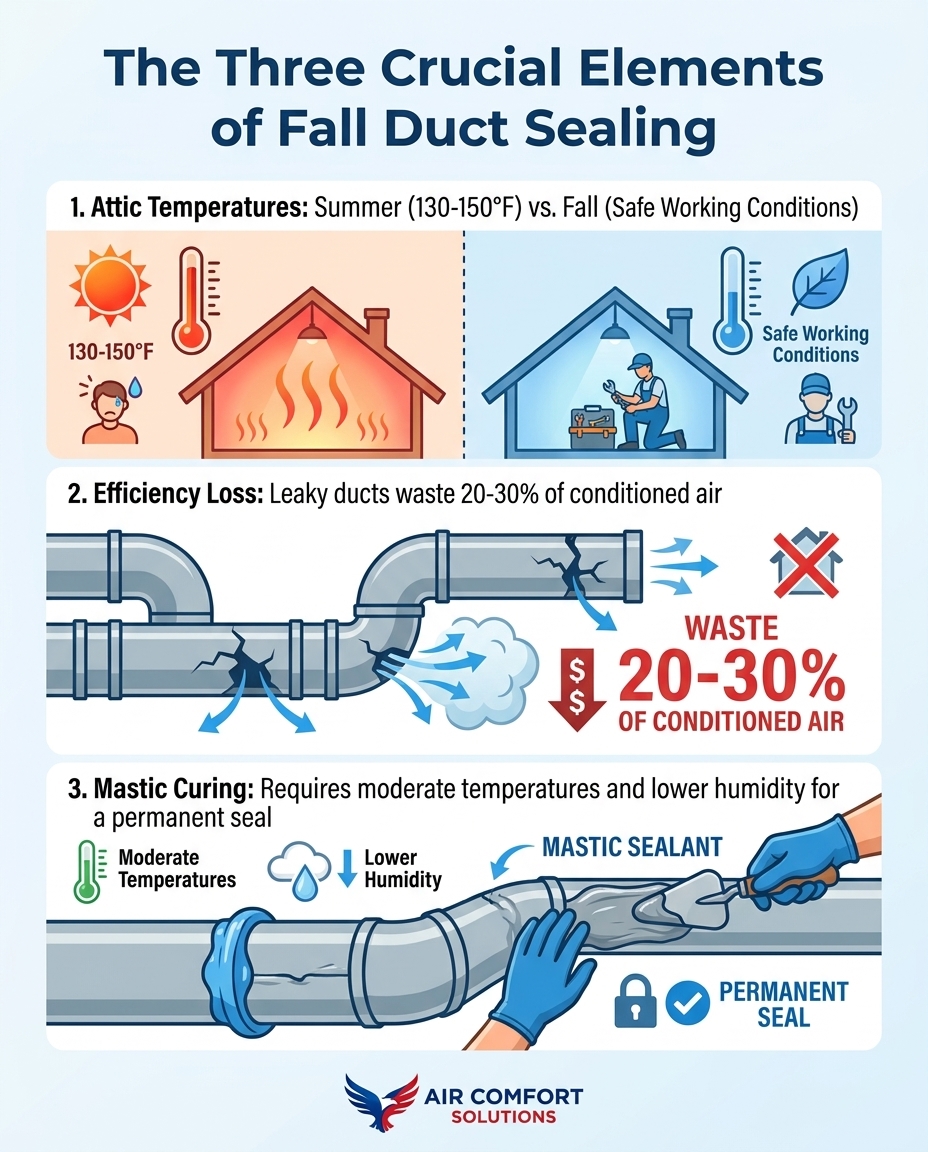
• Safe attic temperatures: Technicians can safely spend the hours required for meticulous inspection and sealing.
• Optimal curing conditions: Professional mastic sealant requires moderate heat and lower humidity to cure into a permanent, flexible bond.
• Pre-heating season efficiency: Sealing leaks now ensures your furnace won't waste expensive heated air once winter arrives.
• Easier scheduling: Booking specialized attic work is much easier during the fall shoulder season before emergency winter heating calls begin.
Understanding exactly how compromised ductwork impacts a home requires looking at the physics of air distribution. An HVAC system is a closed loop, carefully balanced to supply a specific volume of air to the house and return that exact same volume back to the equipment. When leaks exist in the supply ducts, that pressurized, conditioned air is forced out into the unconditioned attic space. When leaks exist in the return ducts, the system experiences a vacuum effect, pulling contaminated, unconditioned attic air directly into the airstream and distributing it throughout the home.
The Department of Energy and ENERGY STAR report that leaky ducts can reduce heating and cooling efficiency by up to 20 to 30 percent. In our experience working on homes throughout the Pinehurst area, this massive loss means that for a significant portion of your cooling budget, energy is wasted cooling the attic instead of the living room. Because a significant portion of the conditioned air never reaches the vents, the thermostat registers that the house is still warm. This forces the HVAC blower motor and the outdoor compressor to work overtime, engaging in exceptionally long cooling cycles. Over the course of a single summer, this compounded stress accelerates mechanical wear and tear, significantly shortening the lifespan of critical system components.
The vacuum effect created by return duct leaks introduces a host of secondary problems. When your system pulls air from the attic, it is drawing in extreme heat, heavy moisture, fiberglass insulation particles, and decades of accumulated dust. We frequently identify this intrusion as the underlying cause of high humidity inside your house even with the AC running. The air conditioner is designed to dehumidify the air as it cools, but a constant influx of humid attic air easily overwhelms the system's dehumidification capacity. The result is a home that feels clammy, smells musty, and requires constant dusting, all while the HVAC equipment struggles to keep up.
To understand why we treat duct sealing as a seasonal project, you have to look at the extreme environmental conditions found directly above your ceiling. Building science data—and our technicians' daily experiences—consistently show that unventilated or poorly ventilated attics absorb a massive amount of solar radiation. The intense summer heat and high humidity of Southeast Texas turn these spaces into 130+ degree ovens from June through August. In many Pinehurst TX area homes, afternoon attic temperatures can easily spike to 150 degrees Fahrenheit during peak summer months.
The human safety factor:
Operating in a 140-degree environment is incredibly dangerous. Heat exhaustion and heat stroke are severe risks for technicians attempting to work in these conditions. Comprehensive duct sealing is not a quick process. It is a meticulous, detail-oriented task that requires a professional to crawl through tight spaces, move heavy insulation aside, inspect every single seam, joint, and connection, and carefully apply sealing materials.
• Ambient Temperature — Peak Summer (July/August): 130°F - 150°F — Early Fall (September/October): 85°F - 95°F
• Technician Safety — Peak Summer (July/August): Hazardous; severe heat exhaustion risk — Early Fall (September/October): Safe for prolonged, detailed work
• Work Pace — Peak Summer (July/August): Rushed due to extreme heat exposure — Early Fall (September/October): Deliberate, thorough, and meticulous
• Material Performance — Peak Summer (July/August): Sealants dry too fast, risking failure — Early Fall (September/October): Optimal curing time for permanent bonds
You cannot rush quality duct sealing. When an environment is actively dangerous, technicians can only spend a few minutes at a time in the space before needing to retreat and cool down. This makes extensive summer duct repairs highly impractical. The relief of September's cooler temperatures finally allows our professionals to spend the necessary, uninterrupted time in the attic to locate and permanently seal every hidden leak.
The materials used to permanently seal ductwork are highly sensitive to extreme environmental conditions. While many homeowners assume standard cloth-backed "duct tape" is the solution, our HVAC professionals know that standard tape quickly degrades, dries out, and falls off when exposed to temperature fluctuations. The professional standard we use for permanently sealing leaks is duct mastic—a thick, paste-like material that is painted over seams and joints, often reinforced with fiberglass mesh.
The chemistry of mastic curing:
Mastic sealant cures through the evaporation of water. For the polymers in the mastic to cross-link and form a durable, flexible, airtight seal, this evaporation must happen at a controlled rate. When mastic is applied in a 140-degree attic, the extreme heat causes the moisture to flash-off and evaporate far too quickly. Instead of forming a flexible bond, the mastic can shrink rapidly, crack, and fail to adhere properly to the galvanized metal or flexible ducting.
Conversely, extremely high humidity prevents the mastic from curing at all, leaving it wet and susceptible to being blown out by the air pressure inside the ducts. September provides the "Goldilocks" conditions for mastic application. The lower humidity and moderate temperatures create the optimal environment for the sealant to cure at the correct speed, ensuring a permanent, airtight seal that will last for the remaining life of the ductwork.
While the frustration of summer cooling losses often prompts homeowners to think about their ductwork, the impending winter makes taking action urgent. Ductwork is a shared delivery system for both the air conditioner and the furnace. The exact same leaks that allowed cool air to escape into the attic in August will allow expensive, heated air to escape in December.
During the September pre-heating season transition, sealing these leaks ensures your furnace can operate at peak efficiency from the very first cold snap. When a furnace activates, the goal is to rapidly heat the living space so the system can cycle off. If 20 percent of that heat is bleeding into a freezing attic, the furnace has to run significantly longer to satisfy the thermostat. By sealing the delivery system now, you guarantee that every unit of heat generated by the furnace actually makes it into your home, providing faster comfort and reducing overall energy consumption.
There is also a strategic advantage to booking specialized attic services during the fall transition. Once the first major cold front arrives, HVAC companies are flooded with emergency "no-heat" calls and furnace breakdowns. Scheduling proactive, time-intensive attic work becomes much more difficult during peak winter demand. We always recommend integrating comprehensive duct inspection and sealing into a routine HVAC maintenance plan during the fall shoulder season. This ensures your entire system is optimized, sealed, and ready long before severe weather strikes.
Because ductwork is completely hidden beneath thick layers of attic insulation, locating and repairing leaks requires a licensed professional and is never a DIY weekend project. Our technicians at Air Comfort Solutions rely on specialized diagnostic tools, professional training, and a deep understanding of airflow dynamics. We use equipment like blower doors, manometers, and thermal imaging cameras to pinpoint exactly where pressure is being lost, even when the leaks are buried under blown-in fiberglass or cellulose.
How our professionals handle the sealing process:
1. Diagnostic Testing: Measuring total duct leakage to establish a baseline and identify the severity of the pressure loss.
2. Surface Preparation: Carefully removing insulation around joints and thoroughly cleaning the metal surfaces of decades of dust and oxidation so the mastic can adhere.
3. Mechanical Fastening: Reconnecting separated duct runs using specialized sheet metal screws and tensioning ties to ensure structural integrity before sealing.
4. Mastic Application: Painting a thick, continuous layer of reinforced mastic over all seams, joints, and connections to create an airtight, permanent barrier.
This level of meticulous detail is only possible when our technicians can safely operate in the attic environment. Our team at Air Comfort Solutions leverages deep local expertise in Texas climate challenges, ensuring homeowners get thorough, safe ductwork repairs when attic conditions finally allow for precise sealing work. As your local Pinehurst AC services provider, we understand exactly how regional weather patterns dictate the timing of these critical home performance upgrades.
Cooler fall temperatures provide the perfect, brief opportunity to fix the duct leaks that likely plagued your cooling system all summer long. Ignoring the problem only guarantees that you will face the exact same efficiency losses and comfort issues when you switch on your heating system. A safe, meticulous repair completed by our team right now guarantees a more comfortable, efficient, and evenly heated home this winter. Take advantage of this ideal weather window to explore professional indoor air quality and duct sealing solutions before the freezing temperatures arrive.
When is the best time to seal ductwork?
Early fall or early spring are the best times to seal ductwork. During these moderate seasons, attic temperatures are safe enough for technicians to perform meticulous work, and the weather provides the ideal conditions for professional mastic sealant to cure properly.
Why should I seal my air ducts in the fall?
Sealing ducts in the fall resolves the cooling inefficiencies you experienced all summer while simultaneously preparing your home for winter. It ensures that the expensive heated air produced by your furnace actually reaches your living spaces rather than escaping into a cold attic.
How do attic temperatures affect HVAC repairs?
Extreme attic temperatures directly impact both technician safety and material performance. In the peak of summer, attics can exceed 150 degrees, making prolonged repair work hazardous and causing professional sealants to dry too rapidly and crack.
Can leaking ducts cause high humidity?
Yes, leaking return ducts pull unconditioned, moisture-heavy air from the attic directly into your HVAC system. This constant influx of humid air overwhelms the air conditioner's ability to dehumidify the home, leading to a clammy indoor environment.
What happens if you leave leaking ductwork unsealed?
Leaving ductwork unsealed forces your HVAC equipment to run longer cycles to compensate for the lost air. This wastes a significant amount of energy, increases wear and tear on the blower motor and compressor, and introduces unwanted dust and allergens into your home.
Is professional duct sealing worth the investment?
Professional duct sealing is one of the most effective ways to improve overall home efficiency. By stopping the loss of 20 to 30 percent of your conditioned air, it reduces strain on the HVAC equipment, extends the system's lifespan, and drastically improves indoor comfort.


Zane came out and did an amazing job! Super friendly, honest and transparent about the work that needed to be done. This is my second time working with Air Comfort Solutions and they’re my go to for HVAC services. Highly recommend.
God's AMAZING grace sent us Robert and Zane. We have been without air in this Texas heat for six weeks and four days. We've had a few contractors give us quotes all trying to upsell when we're at a low point. But not the guys at Air Comfort Solutions. They came in assessed our situation, gave us honest feedback, and showed us the issues as they proceeded with the assessment for clear understanding. We highly recommend them for their professionalism, quality products, and fair pricing. We hands down support them for all the work they do 💯 %.
Robert and Zane gone above and beyond to make the process easy and affordable.
Would definitely recommend!!
I’m writing this review to let everyone know that Air Comfort Solutions is the company to work with. I know the owner ( Robert) for several years now. He has been taking care of my residential and business work orders. Robert is professional, knowledgeable and will save you money. I just want to thank Robert for great job you have been doing for me.