Comparing UV Light Purifiers to Media Filters for Fall Virus Protection
Deciding between biological neutralization and particulate capture? See the exact differences between UV lights and media filters to protect your indoor air this fall.

You walk past your wall control, and the screen clearly reads 72 degrees, but you find yourself reaching for a sweater because the hallway feels noticeably colder. If you are wondering why we calibrate thermostats during the shift from cooling to heating, this exact scenario is the primary reason. Over time, the internal sensors that measure your home's ambient air begin to lose their precision. You set a specific target, but the actual room environment no longer matches the digital display.
This hidden disconnect is known as thermostat temperature drift. It is a subtle, gradual loss of sensor accuracy that occurs after months of heavy operational demand. During the peak of summer, your cooling equipment runs almost continuously, forcing the thermostat to constantly process electrical signals and minor temperature fluctuations. By the time the weather begins to cool, that overworked sensor is often slightly out of sync with reality. The system still turns on and off, but it is operating based on flawed data.
Because your entire HVAC system relies on this single device to dictate its cycles, a drifting sensor compromises both efficiency and comfort. Addressing this issue during the September fall-prep transition is a critical decision point. Taking care of calibration before you switch your equipment over to heating mode prevents erratic performance, ensures even temperatures across your living spaces, and stops minor sensor wear from escalating into a larger mechanical problem.
To understand why a thermostat loses its accuracy, you have to look at the physical components inside the housing. Modern digital thermostats rely on a component called a thermistor—a highly sensitive resistor whose electrical resistance changes based on the surrounding air temperature. Older mechanical models use bimetallic coils that expand and contract. Regardless of the technology, these components are subject to material fatigue.
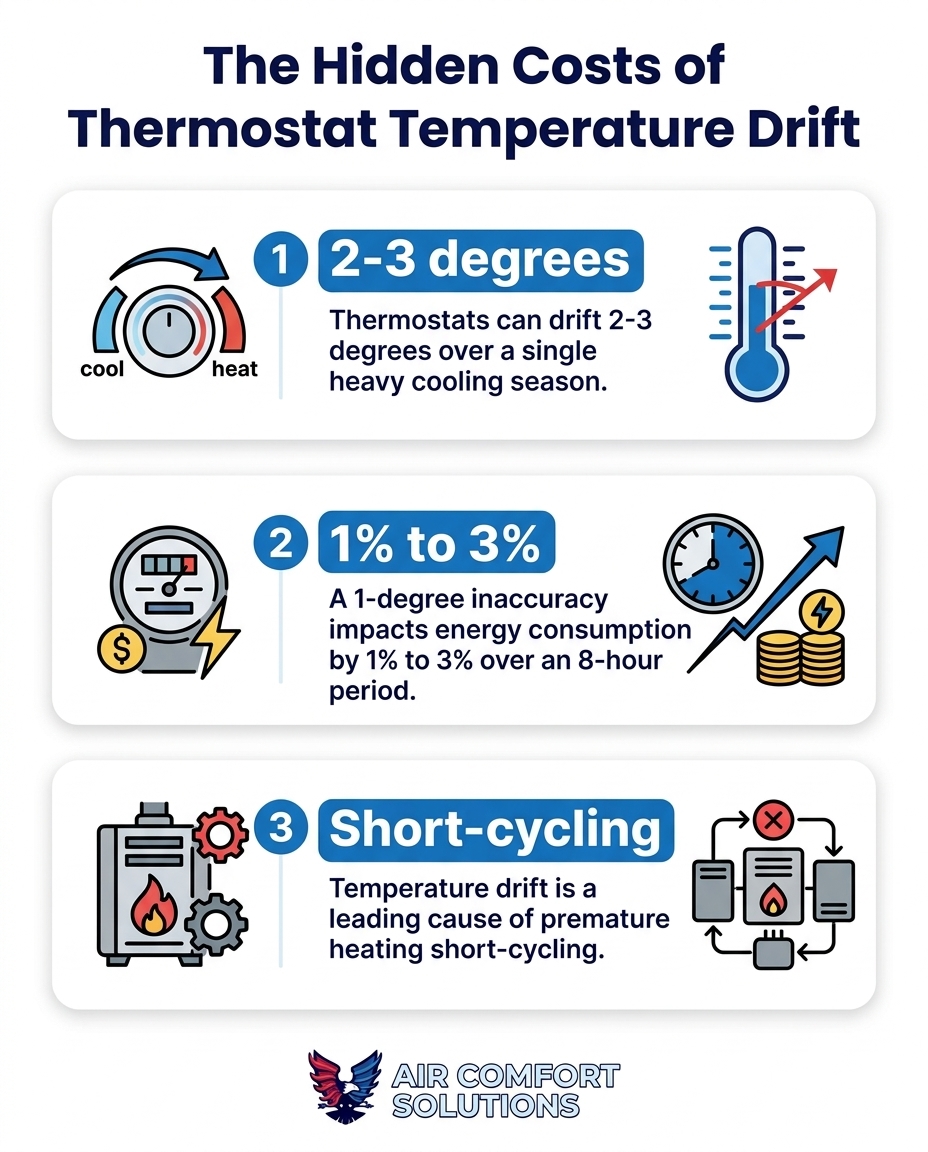
A typical pattern we see is a 2-3 degree temperature drift developing over the course of a single, demanding season. When a thermistor experiences thousands of micro-cycles, its baseline resistance can shift. The thermostat's microprocessor still reads the electrical signal perfectly, but the signal itself no longer accurately represents the true ambient heat in the room. The device essentially becomes "blind" to the actual climate of your home.
The industry standard for accuracy: Organizations like ASHRAE (The American Society of Heating, Refrigerating and Air-Conditioning Engineers) set strict standards for indoor environmental quality and sensor accuracy. According to these guidelines, even a minor drift compromises the fundamental purpose of climate control. Because this drift happens incrementally—usually a fraction of a degree at a time—it remains completely invisible to the homeowner. You only notice the problem when you are forced to switch operating modes from cooling to heating, and the furnace suddenly feels like it is severely underperforming.
• Properly Calibrated — System Behavior: Cycles match target settings exactly — Impact on Comfort: Even, consistent room temperatures
• 1-Degree Drift — System Behavior: Slightly extended or shortened cycles — Impact on Comfort: Minor drafts, barely noticeable
• 2-3 Degree Drift — System Behavior: Erratic cycling, premature shut-offs — Impact on Comfort: Distinct hot and cold spots in the home
Correcting this mechanical shift requires specialized adjustments, which is why recalibration is a standard inclusion in any comprehensive routine HVAC maintenance plan.
The problem: By the end of August, your thermostat has endured thousands of hours of continuous electrical and thermal stress. This heavy operational load directly degrades the sensitivity of the internal components, setting the stage for poor heating performance.
The cause: Constant cycling to combat severe heat causes micro-fluctuations in the thermistor's electrical resistance. Every time the air conditioner kicks on, a small amount of voltage passes through the thermostat's internal relays. Over a long summer, this constant electrical activity generates minute amounts of heat within the device itself. If the sensor begins reading its own internal heat rather than the room's air, a 2-3 degree temperature drift is the inevitable result. Furthermore, airborne dust particles naturally circulate through your home and settle on the delicate sensor nodes, acting as a microscopic layer of insulation that slows down the thermostat's reaction time.
The solution: Intervening during the September fall-prep transition resets the baseline. Clearing the accumulated wear-and-tear from the summer months ensures the device is mechanically ready to handle the entirely different demands of the heating cycle, a protocol thoroughly detailed in our Texas AC maintenance plan guide.
Summer cooling does not just manage temperature; it manages moisture. However, residual indoor humidity can still accumulate inside the small, unventilated plastic housing of your wall control. Trapped moisture affects internal thermistors by subtly altering their electrical conductivity. When moisture mixes with household dust, it creates a sticky film over the sensor.
• Delayed response times: The sensor takes longer to register that the room has reached the target temperature.
• False readings: Moisture can cause the sensor to read the air as cooler than it actually is.
• Corrosion risks: Prolonged humidity exposure can degrade the delicate electrical contacts on the mounting plate.
Managing this residual humidity and cleaning the sensor housing is a vital step before firing up the furnace. If the sensor is coated in summer grime, your winter heating cycles will be inherently flawed.
One of the most damaging consequences of leaving a thermostat uncalibrated is a mechanical phenomenon known as short-cycling. Short-cycling occurs when the heating system turns on, runs for a very brief period, and then abruptly shuts off before completing a full, productive heating cycle. This rapid on-and-off behavior is incredibly hard on the equipment.
A 2-3 degree temperature drift is frequently the root cause of this issue. When you turn the heat on for the first time, the furnace begins pushing warm air into the room. If the thermostat is drifting and reading the room as warmer than it actually is, it will prematurely signal the furnace to shut down. Five minutes later, as the actual room temperature drops rapidly, the thermostat panics and signals the furnace to start again. This tricks the system into an endless loop of incomplete cycles.
The mechanical wear of short-cycling includes:
1. Blower motor strain: The highest amount of electrical draw and physical stress occurs during the startup phase. Starting the motor ten times an hour instead of three drastically reduces its lifespan.
2. Heat exchanger stress: Rapid heating and cooling cycles cause the metal in a furnace heat exchanger to expand and contract too quickly, increasing the risk of stress cracks.
3. Ignition failure: Igniters and flame sensors wear out exponentially faster when forced to fire continuously.
Proper calibration prevents this erratic behavior. By ensuring the thermostat reads the room accurately, the system is allowed to run for a full, smooth cycle, evenly distributing warm air. This holds true whether you use a traditional furnace or rely on heat pump systems to warm your home.
Beyond physical wear and tear on the equipment, temperature drift has a profound impact on your monthly energy consumption. A thermostat that is out of calibration forces the system to overwork, leading to hidden, compounding energy waste that you only discover when the utility bill arrives.
According to data from the Department of Energy, adjusting or correcting a thermostat by just a single degree impacts overall energy consumption by 1% to 3% over an eight-hour period. When you multiply that 1% to 3% penalty by a 2-3 degree temperature drift, and then stretch that over a 24-hour day for an entire season, the resulting energy waste is substantial. The system burns through fuel or electricity to hit a target temperature that the sensor is misinterpreting.
This inefficiency is especially problematic in the specific climate of Pinehurst, TX. The region experiences intense, prolonged summer heat, which heavily degrades the sensor over several months. Then, the area transitions into unpredictable fall weather, characterized by rapid temperature swings. You might need mild cooling in the afternoon and robust heating by midnight. Navigating these sharp swings demands a highly responsive, highly accurate thermostat sensor. If the device is lagging or drifting, it will constantly overshoot or undershoot the necessary temperature, wasting energy on both ends of the spectrum.
An accurately calibrated sensor acts as your first line of defense against seasonal energy spikes. By addressing this during the September fall-prep transition, you lock in the precise control needed to manage unpredictable weather efficiently.
The problem: Many homeowners assume that a quick dusting and a fresh set of AA batteries are all a thermostat needs for the winter. While changing batteries is good practice, a basic visual inspection does absolutely nothing to correct a 2-3 degree temperature drift within the sensor itself.
The cause: Mechanical calibration is a technical diagnostic process, not a surface-level cleaning. The internal thermistor or bimetallic coil operates on precise electrical resistance and tension. Adjusting these components requires specialized knowledge to measure the actual ambient temperature against what the microprocessor is reporting.
The solution: Professional calibration utilizes highly sensitive digital psychrometers and multimeters. A licensed technician measures the exact temperature and humidity of the air directly next to the thermostat housing. They then access the thermostat's internal installer menu—or adjust the physical calibration screw on older models—to input an exact temperature offset. Air Comfort Solutions relies on precise diagnostic tools and comprehensive seasonal maintenance protocols to prevent temperature drift and guarantee sensor accuracy. This ensures the baseline is perfectly matched to the room's true climate.
• Tools Used — DIY Visual Inspection: Canned air, microfiber cloth, new batteries — Professional Calibration: Digital psychrometer, multimeter, installer codes
• What It Fixes — DIY Visual Inspection: Blank screens, surface dust buildup — Professional Calibration: Internal sensor drift, false temperature readings
• Impact on System — DIY Visual Inspection: Keeps the interface powered on — Professional Calibration: Restores true heating efficiency and cycle length
It is important to view professional calibration as a necessary preventative measure, not an optional add-on. Because modern heating systems are highly complex, they rely entirely on accurate data to function safely and efficiently. Accurate diagnostics protect the longevity of the entire heating system. Without a proper baseline, you risk putting unnecessary strain on blower motors and heat exchangers right as the coldest weather arrives.
Understanding the physical mechanics of temperature drift empowers you to make informed, proactive maintenance decisions. A thermostat that has spent the entire summer managing intense cooling cycles will inevitably lose a degree or two of accuracy. Left unaddressed, this minor drift cascades into short-cycling, uneven room temperatures, and wasted energy during the winter.
Addressing sensor inaccuracies during the September fall-prep transition ensures that your heating system will deliver smooth, efficient cycles the moment you need it. By investing in precise, professional recalibration as part of a routine HVAC maintenance plan, you eliminate the hidden disconnect between your wall control and your home's actual climate, guaranteeing reliable comfort for the season ahead.
Why is my thermostat reading the wrong temperature after summer?
Months of continuous electrical and thermal stress during the cooling season can cause the internal sensor to lose its baseline accuracy. This results in a 2-3 degree temperature drift, where the thermostat misinterprets the actual room temperature.
Does a thermostat need to be calibrated for winter?
Yes, professional calibration is a critical pre-heating step. Calibrating the thermostat ensures that the heating system receives accurate temperature data, preventing erratic performance and wasted energy when switching from cooling to heating.
What causes thermostat temperature drift?
Temperature drift is caused by a combination of constant electrical cycling, micro-fluctuations in the thermistor, residual indoor humidity, and dust accumulation. Over time, these factors degrade the sensor's ability to read ambient air precisely.
How do I know if my thermostat is reading the wrong temperature?
The most obvious sign is a noticeable disconnect between the temperature displayed on the screen and how the room actually feels. You may also notice the heating system running very short cycles or struggling to keep the house consistently warm.
Can a 2-degree thermostat inaccuracy cause short cycling?
Absolutely. Even a minor 2-3 degree drift can trick the thermostat into thinking the target temperature has been reached prematurely. This causes the heating system to shut off too early and turn back on minutes later, causing severe mechanical wear.
How often should a digital thermostat be professionally calibrated?
A digital thermostat should be checked and calibrated annually, ideally during the September fall-prep transition. A licensed professional will use digital psychrometers to match the sensor's baseline to the true ambient temperature of the room.


Zane came out and did an amazing job! Super friendly, honest and transparent about the work that needed to be done. This is my second time working with Air Comfort Solutions and they’re my go to for HVAC services. Highly recommend.
God's AMAZING grace sent us Robert and Zane. We have been without air in this Texas heat for six weeks and four days. We've had a few contractors give us quotes all trying to upsell when we're at a low point. But not the guys at Air Comfort Solutions. They came in assessed our situation, gave us honest feedback, and showed us the issues as they proceeded with the assessment for clear understanding. We highly recommend them for their professionalism, quality products, and fair pricing. We hands down support them for all the work they do 💯 %.
Robert and Zane gone above and beyond to make the process easy and affordable.
Would definitely recommend!!
I’m writing this review to let everyone know that Air Comfort Solutions is the company to work with. I know the owner ( Robert) for several years now. He has been taking care of my residential and business work orders. Robert is professional, knowledgeable and will save you money. I just want to thank Robert for great job you have been doing for me.