The Value of Sealing Your Return Air Plenum Before the Holidays
Most homeowners buy expensive filters to fix dusty air, not realizing a leaky return plenum in the attic is the real culprit. See why sealing it now saves your holiday gatherings.

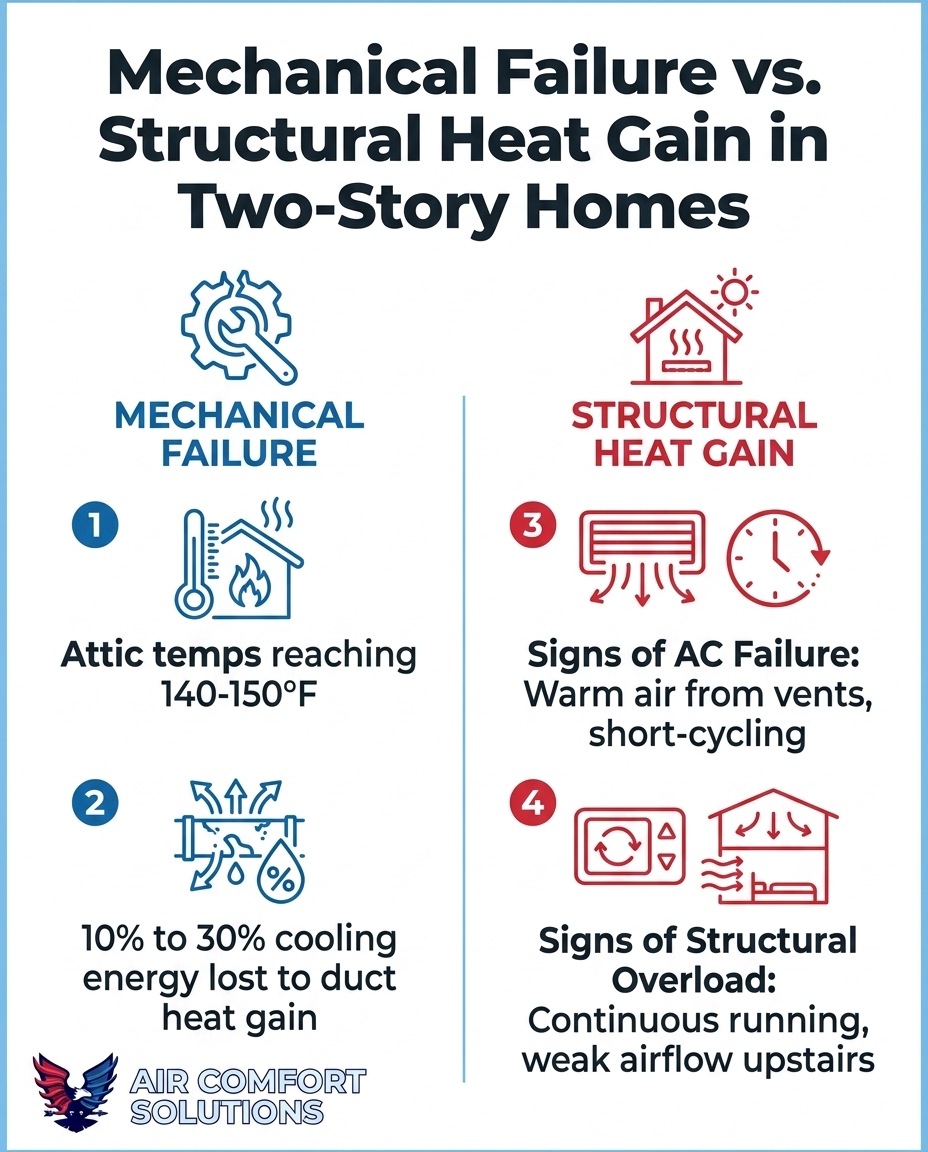
Unconditioned attics can easily reach 140 to 150 degrees Fahrenheit during peak summer, meaning a massive amount of cooling energy is lost before it ever reaches a vent. If you are trying to figure out why your two-story home in The Woodlands suddenly feels hotter upstairs in August, that brutal attic temperature is often the primary suspect. At Air Comfort Solutions, our team often fields frantic calls from homeowners experiencing a wave of panic when they walk upstairs on a late summer afternoon, feeling like they have stepped into an oven despite the air conditioner running constantly. The immediate fear is that the cooling system has suffered a catastrophic failure.
However, a hot second story does not always mean your equipment is broken. The core decision point you face is determining whether this sudden heat is a sign of a failing air conditioning unit or a structural heat-gain issue that is simply overwhelming your equipment. Understanding the physics of heat stratification, combined with the vulnerability of ductwork routed through a baking attic, is the key to solving this frustrating comfort issue.
Whether you need comprehensive air conditioning services or are looking for a reliable AC repair company in The Woodlands to diagnose the issue, understanding the root cause is the first step toward restoring comfort to your entire home.
To understand why your upstairs feels unbearable right now, we have to look at how homes absorb and retain heat over time. This process is known as cumulative thermal loading. Throughout the early summer, your home's building materials—the bricks, the roof decking, the framing, and the insulation—absorb intense solar radiation during the day and release it at night. Early in the season, the overnight temperatures drop enough to let the house "reset" its thermal mass.
By late summer, that dynamic changes completely. The ambient outdoor temperatures refuse to drop significantly overnight. With extreme heat indexes and 95-plus degree ambient temperatures dominating the Southeast Texas climate, our technicians see residential HVAC systems forced to run at maximum capacity continuously. The house never gets a chance to cool down, meaning it starts every morning already holding onto residual heat from the day before.
Natural heat stratification makes this even worse. Basic physics dictates that heat rises, pushing the warmest air in your home toward the second floor. When the ambient outdoor temperatures stay high around the clock, this natural stratification is amplified. What feels like a "sudden" problem is rarely sudden at all; it is simply the tipping point of weeks of continuous thermal stress on your home's exterior envelope.
August acts as the breaking point for many two-story homes because of the prolonged lack of cooling relief over the preceding months. By the time late summer arrives, the building materials are fully saturated with heat.
This saturation drastically changes the indoor cooling load compared to early June. In June, your air conditioner is primarily cooling the air inside the home. By August, your air conditioner is fighting to cool the air while simultaneously battling the radiant heat pushing through the ceiling, walls, and ductwork. The system is working twice as hard to achieve the exact same thermostat setting, which is why the upstairs suddenly struggles to stay comfortable.
The Problem: You have cold air blowing downstairs, but the air coming out of the upstairs vents feels weak, lukewarm, or barely noticeable.
The Cause: The primary structural cause of upstairs heat is conductive heat gain through the ductwork. According to Department of Energy data—a reality our crews at Air Comfort Solutions see firsthand every day in Pinehurst and The Woodlands—ducts located in unconditioned spaces like attics lose 10% to 30% of their cooling energy to conductive heat gain. Think about the journey your conditioned air takes. Your air conditioner produces air that is roughly 55 degrees. That freezing cold air then has to travel through thin, flexible ductwork routed through an attic that is baking at 140 degrees or more.
As the air travels through that hostile environment, the extreme heat transfers through the duct material, warming the air inside. By the time it finally pushes out of the upstairs ceiling registers, that 55-degree air might have warmed up to 65 or 70 degrees. Furthermore, minor duct leaks do more than just spill cold air into the attic. Because the blower motor creates pressure changes, those small leaks can actually draw extreme heat and raw moisture from the attic space directly into your duct system.
The Solution: Having a professional evaluate, seal, and properly insulate your ductwork prevents this massive energy loss. Sealing these leaks is also a critical step in preventing the humid attic air from being pulled into your living space, which is a leading cause of high humidity inside your house even with the AC running.
Specific residential architecture plays a massive role in how airflow and heat retention behave inside a home. In our region, many homes were built with expansive second floors, high ceilings, and large windows that invite solar heat gain. Our team's deep local expertise and years of hands-on experience with specific two-story residential architecture in The Woodlands and Pinehurst means we understand exactly how these homes were originally zoned and insulated—and where those original designs fall short against today's extreme weather.
One major architectural flaw in older local homes is aging or compressed attic insulation. Over decades, blown-in fiberglass or cellulose insulation settles and compresses, losing its thermal resistance (R-value). When the insulation degrades, it fails to block the intense radiant heat baking the attic floor. That heat transfers directly through the sheetrock and into the second-floor ceiling, turning the upstairs rooms into a radiant heater.
The way a home is zoned determines how well it can fight off natural heat stratification.
• Single-Zone Systems: Homes with a single thermostat located on the first floor face the biggest challenges. The thermostat only reads the temperature downstairs. Because cold air falls, the downstairs reaches the target temperature quickly, shutting the system off before the upstairs ever receives enough airflow to cool down.
• Dual-Zone Systems: Homes with dedicated upstairs and downstairs systems (or a properly designed zoning system with automated dampers) fare much better. The upstairs thermostat can command cooling independently, fighting the specific heat load of the second floor without freezing out the downstairs.
Single-zone systems struggle disproportionately during peak late-summer heat because they are simply not designed to manage two drastically different thermal environments simultaneously.
When the upstairs feels like a sauna, homeowners need to know if they are dealing with a broken machine or an overwhelmed house. Identifying the root cause prevents unnecessary parts replacement and points you toward the actual solution.
• Air Temperature at Vents — Signs of Mechanical Failure: Warm or room-temperature air blowing from all vents (upstairs and down). — Signs of Structural Overload: Cold air blowing downstairs, but lukewarm or weak air blowing upstairs.
• System Run Time — Signs of Mechanical Failure: Short-cycling (turning on and off rapidly every few minutes). — Signs of Structural Overload: Running continuously for hours without ever reaching the set temperature.
• Unusual Noises — Signs of Mechanical Failure: Grinding, squealing, or loud banging coming from the outdoor unit. — Signs of Structural Overload: Normal operating sounds, just running much longer than usual.
• Airflow Volume — Signs of Mechanical Failure: Zero airflow or extremely weak airflow across the entire house. — Signs of Structural Overload: Strong airflow downstairs, noticeably weaker airflow upstairs.
The critical takeaway: Continuous running without cooling the upstairs often points to duct heat gain or insulation issues rather than a dead compressor. The system is doing exactly what it was built to do—producing cold air—but the house is losing that cold air to the attic environment before it can cool the second floor. In our experience, staying ahead of these issues and ensuring your equipment can handle the heavy late-summer workload requires a routine AC maintenance plan to keep the blower motor and coils operating at peak efficiency.
While upgrading attic insulation is a well-known strategy, attic air sealing is frequently overlooked. The barrier between your 140-degree attic and your air-conditioned living space degrades over time. Homes are full of hidden thermal bypasses—gaps around recessed lighting fixtures, unsealed attic hatches, plumbing stacks, and duct penetrations.
Why air sealing matters:
• Stops heat bleed: These gaps allow extreme attic air to bleed directly into the second floor, fighting your air conditioner constantly.
• Prevents pressure imbalances: When doors are closed upstairs, pressure imbalances can literally suck hot attic air down through the walls and ceiling fixtures.
• Protects the home environment: Sealing these leaks prevents attic dust, fiberglass particles, and outdoor contaminants from entering the living space, which is a highly effective way of improving your indoor air quality solutions.
Upgrading attic insulation is often as critical as servicing the AC unit for second-floor comfort. Insulation slows the transfer of radiant heat, while air sealing stops the physical movement of hot air. Together, they create a protective envelope that allows your cooling system to finally catch up.
Not every cooling issue requires an immediate service call, but knowing where to draw the line is important for your safety and the longevity of your equipment. Homeowners should always start with basic, safe troubleshooting.
First steps for homeowners:
1. Check the air filter: A severely clogged filter chokes off airflow to the entire house, which impacts the upstairs rooms first because they are furthest from the blower motor.
2. Inspect the vents: Ensure all supply and return vents upstairs are open, unblocked by furniture, and free of heavy dust buildup.
3. Check the thermostat settings: Verify the system is set to "Cool" and the fan is set to "Auto."
If these basic steps do not resolve the issue, it is time to call in the professionals at Air Comfort Solutions. Inspecting ductwork in a 140-degree attic is physically dangerous and can lead to severe heat exhaustion. Furthermore, testing refrigerant levels, measuring electrical draws, and diagnosing blower motor performance requires a licensed HVAC professional.
What a professional diagnostic entails:
• Duct integrity testing: Inspecting the attic ductwork for tears, disconnections, and degraded insulation wraps.
• Temperature drop measurements: Checking the exact temperature of the air entering the return versus the air leaving the supply vents to verify cooling capacity.
• Insulation assessment: Measuring the depth and condition of the attic insulation to see if radiant heat is bypassing the thermal barrier.
• Airflow balancing: Evaluating whether dampers need to be adjusted to push more volume to the second floor.
A hot upstairs in late summer is a highly frustrating, but entirely solvable problem. Whether the root cause is a failing blower motor, massive duct heat gain in a baking attic, or degraded insulation allowing radiant heat to penetrate the ceiling, there is a clear path to restoring comfort.
Because cumulative thermal loading hits its peak in August, pushing your equipment to its absolute limits, ignoring the problem will only lead to higher utility bills and potential system burnout. As kids head back to school and the late-summer heat lingers, the team at Air Comfort Solutions highly encourages homeowners in The Woodlands and Pinehurst to seek a professional evaluation to pinpoint the exact cause of their heat stratification and duct heat gain. By consulting with local experts who understand the specific architectural and climate challenges of the area, you can finally cool down your second floor and protect your HVAC investment for years to come.
Why is the second floor of my house so hot in summer?
Heat naturally rises due to stratification, but the main culprit is usually your hot attic pressing down on the second floor. During peak summer, a 140-degree attic radiates intense heat through the ceiling and heats up the ductwork carrying your cold air. This combination of rising heat from downstairs and radiant heat from above traps the second floor in a pocket of extreme warmth.
How do I cool down the upstairs of my two-story house?
The most effective approach involves addressing both the equipment and the home's thermal boundary. Ensure your air filters are clean and vents are fully open to maximize airflow. For a permanent solution, a professional can seal leaky ductwork, upgrade attic insulation to block radiant heat, or install a zoning system to direct more cooling capacity upstairs.
Is it normal for upstairs to be hotter than downstairs?
A slight temperature difference of one or two degrees is normal due to natural heat rising. However, if the upstairs is five to ten degrees hotter than the downstairs, it indicates a structural or mechanical problem. Significant temperature swings usually point to inadequate attic insulation, severe duct heat gain, or an improperly sized HVAC system.
Why is my AC running but not cooling upstairs?
If the AC is running continuously and cooling the downstairs but failing upstairs, the system is likely losing its cold air to the attic environment. Cold air traveling through poorly insulated or leaky ductwork in a hot attic warms up significantly before reaching the upstairs vents. It may also indicate a failing blower motor that lacks the power to push air to the furthest reaches of the house.
Can adding attic insulation help cool my second floor?
Yes, upgrading attic insulation is one of the most effective ways to lower upstairs temperatures. Insulation acts as a thick thermal barrier, preventing the 140-degree attic heat from transferring through the ceiling sheetrock into your bedrooms. When combined with proper air sealing, it drastically reduces the cooling load on your air conditioner.
How much cooling energy is lost when ducts run through a hot attic?
Ducts located in unconditioned spaces like hot attics can lose 10% to 30% of the energy used to cool the air. This massive loss occurs through conductive heat gain as the cold air travels through thin duct walls surrounded by extreme heat. Sealing and insulating these ducts ensures the cold air actually reaches your living space instead of being wasted in the attic.


Zane came out and did an amazing job! Super friendly, honest and transparent about the work that needed to be done. This is my second time working with Air Comfort Solutions and they’re my go to for HVAC services. Highly recommend.
God's AMAZING grace sent us Robert and Zane. We have been without air in this Texas heat for six weeks and four days. We've had a few contractors give us quotes all trying to upsell when we're at a low point. But not the guys at Air Comfort Solutions. They came in assessed our situation, gave us honest feedback, and showed us the issues as they proceeded with the assessment for clear understanding. We highly recommend them for their professionalism, quality products, and fair pricing. We hands down support them for all the work they do 💯 %.
Robert and Zane gone above and beyond to make the process easy and affordable.
Would definitely recommend!!
I’m writing this review to let everyone know that Air Comfort Solutions is the company to work with. I know the owner ( Robert) for several years now. He has been taking care of my residential and business work orders. Robert is professional, knowledgeable and will save you money. I just want to thank Robert for great job you have been doing for me.