How Refrigerant Leaks Happen and How They Are Repaired in Pinehurst, TX
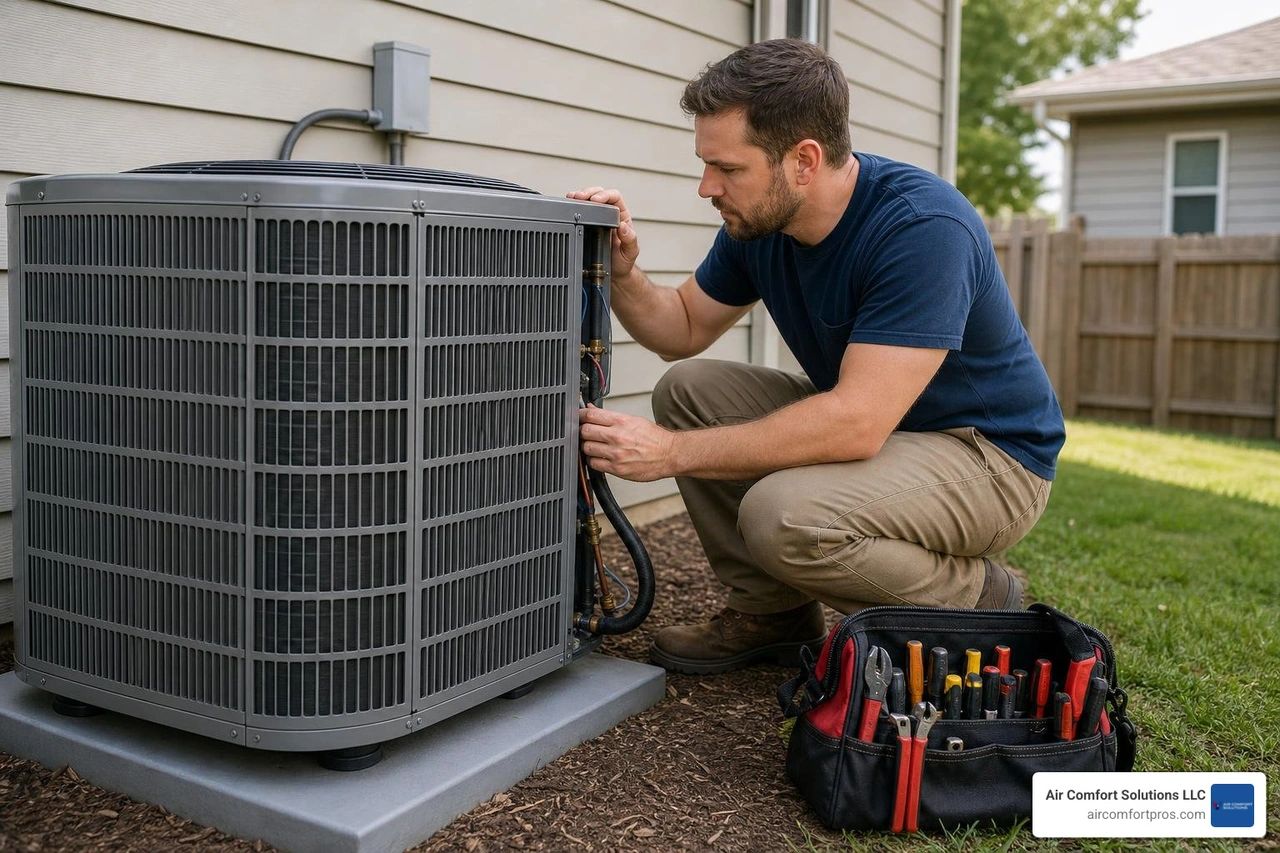
How refrigerant leaks happen and how they are repaired is one of the most urgent questions homeowners in Pinehurst face when their AC suddenly stops cooling during a brutal North Harris County summer. Here is a quick answer before we go deeper:
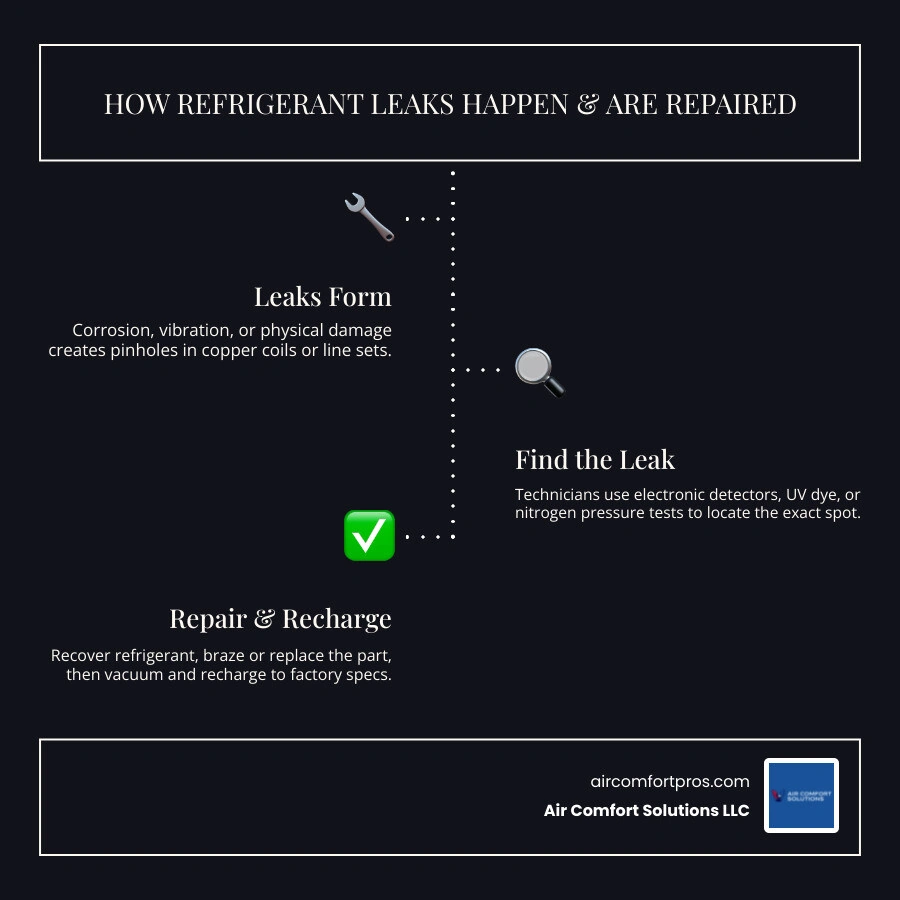
Refrigerant leaks happen when:
- Formicary corrosion eats microscopic pinholes into copper evaporator coil tubing
- Constant vibration from the compressor wears copper lines against nearby components
- Physical damage from yard equipment or debris strikes the outdoor unit
- Poor installation leaves weak brazed joints or loose fittings that fail over time
Refrigerant leaks are repaired by:
- Locating the exact leak using electronic detectors, UV dye, or a nitrogen pressure test
- Safely recovering remaining refrigerant, then brazing or replacing the damaged component
- Pulling a deep vacuum and recharging the system to the factory-specified weight
Your AC runs on a closed-loop system — refrigerant is never consumed, so if your charge is low, there is a physical hole somewhere letting it out. Ignoring it strains your compressor, raises your energy bills, and can eventually destroy the entire system.
I'm Robert Patterson, and in this guide I'll walk you through exactly what causes leaks, how professionals find and fix them, and how to know when a repair makes more sense than a full replacement.
How refrigerant leaks happen and how they are repaired terms explained:
Why Your AC Needs Refrigerant to Cool Your Pinehurst Home
To understand how leaks disrupt your home's comfort, it helps to look at how your air conditioner actually functions. Many homeowners mistakenly believe that an AC consumes refrigerant the way a car burns gasoline. In reality, your air conditioning system is a completely sealed, closed-loop system. The refrigerant inside is a heat-transfer medium designed to cycle endlessly between your indoor and outdoor units without ever dissipating or wearing out.
This heat transfer process relies on pressure changes. Indoors, the refrigerant flows through the evaporator coil under low pressure, transforming into a cold gas that absorbs heat from your indoor air. The system's blower fan pushes this newly cooled air through your ductwork. Meanwhile, the hot refrigerant gas travels outdoors to the compressor, which pumps up the pressure and temperature. As it passes through the outdoor condenser coil, a fan releases the absorbed heat into the Texas air, and the refrigerant condenses back into a liquid to repeat the cycle.
When a leak develops, the delicate balance of this closed-loop system is ruined. If you are noticing that your vents are blowing lukewarm air, you may want to read about Why Is My AC Blowing Warm Air to see if a low charge is the culprit.
As the refrigerant level drops, several physical symptoms begin to manifest:
- Frozen Evaporator Coils: Because there is less refrigerant to absorb heat, the remaining liquid runs exceptionally cold. This causes the moisture on your indoor evaporator coil to rapidly freeze into a block of ice, blocking airflow entirely.
- High Indoor Humidity: A system low on refrigerant cannot drop the coil temperature to its optimal dehumidification point. Your home will begin to feel sticky and humid, with relative humidity levels often climbing past 60%.
- Constant Running Without Cooling: If you are asking yourself, "Why Is My AC Running But Not Cooling," a slow refrigerant leak is one of the most common answers. The system will run non-stop trying to reach your thermostat's set temperature, driving up your energy bills.
For a deeper look at these warning signs, check out our guide on Low Refrigerant Signs in Your AC System.
Understanding How Refrigerant Leaks Happen and How They Are Repaired

Refrigerant leaks do not happen without a physical cause. Because the system operates under high pressure—especially modern R-410A systems, which run at pressures up to 60% higher than older R-22 units—even a microscopic structural weakness can quickly turn into a major leak. Understanding these mechanical failures is key to diagnosing the Most Common AC Repairs and What Causes Them.
The Science Behind How Refrigerant Leaks Happen and How They Are Repaired
The leading chemical cause of refrigerant leaks in residential AC systems is formicary corrosion. This occurs when the copper tubing in your indoor evaporator coil reacts with moisture and volatile organic compounds (VOCs) found in household air.
Common household items like cleaning sprays, hairsprays, air fresheners, cosmetics, and even off-gassing from new building materials release organic acids into your indoor air. When these acids mix with the condensation on your cold evaporator coil, they create a highly corrosive environment. Over time, this chemical reaction eats away at the copper walls, tunneling microscopic, ant-nest-like pathways through the metal. A pit as shallow as 0.003 inches is all it takes to breach the copper tubing, resulting in slow, persistent pinhole leaks that are completely invisible to the naked eye.
Beyond chemical corrosion, physical forces are constantly at work. Your outdoor condenser unit operates under heavy vibration, running for thousands of hours every single summer. If the copper linesets or internal capillary tubes are allowed to rub against other metal parts, brackets, or high-voltage wires, the friction will eventually wear a hole right through the metal. Physical damage from weed whackers, lawnmowers throwing stray rocks, or heavy storms can also split linesets or crush the delicate aluminum fins on your outdoor coil.
Common Locations for AC Leaks
Refrigerant leaks do not occur uniformly across a system. Technicians focus their searches on several high-probability zones:
- The Evaporator Coil: Roughly 90% of all residential AC refrigerant leaks occur in the copper tubing of the indoor evaporator coil. This is primarily due to the constant presence of condensation paired with indoor VOC exposure, making it the epicenter of formicary corrosion.
- Schrader Cores and Service Ports: Much like the valve stem on a car tire, Schrader valves allow technicians to connect gauges to measure system pressures. Over time, the internal rubber seals can dry out, crack, or stick open after service tools are disconnected, leading to slow leaks.
- Brazed Joints and Fittings: During installation, technicians use high-temperature torch brazing to connect the copper lineset between your indoor and outdoor units. If a joint was poorly brazed, or if thermal expansion and contraction stress the connection over time, microscopic cracks can develop.
- The Condenser Coil: While less common than evaporator leaks, the outdoor condenser coil can leak due to physical impacts, galvanic corrosion (where dissimilar metals like steel and aluminum touch without proper isolation), or abrasive dirt buildup.
The 3-Step Professional Process for Fixing Refrigerant Leaks
When your system exhibits signs of low refrigerant, it is critical to call in a professional immediately. Running an undercharged system starves your compressor motor of the cooling it needs to survive, turning a repairable leak into a catastrophic system failure. If your home is struggling to stay cool, check out Signs Your AC Needs Repair in Houston Area Heat.
Here is the precise, three-step process we use to locate, repair, and restore your system to perfect working order.
Step 1: Advanced Leak Detection Methods
A professional leak search is a systematic process. Because refrigerants are heavier than air, our technicians always start scanning from the highest points of the system and work their way down. We employ several diagnostic tools depending on the size and location of the suspected leak.
- Electronic Leak Detectors (Sniffers): These highly sensitive devices draw air through a probe to detect halogenated gases. Heated diode or infrared (IR) sensors can identify leaks as small as 0.1 ounces per year. Technicians must move the probe slowly—about 3 inches per second—to prevent pushing the leaking gas away before the sensor can register it.
- Soap Bubble Test: The oldest and most reliable method for pinpointing an exact leak site. Once an electronic detector flags a general area, we apply a specialized, high-viscosity soap solution to the copper joints. If a leak is present, escaping gas will immediately blow distinct, visible bubbles.
- Nitrogen Pressure Test: If a leak is incredibly small or hidden within a wall cavity, we will recover the remaining refrigerant and pressurize the system with dry nitrogen gas to a high pressure (typically 150 to 250 PSI). We then monitor the system with digital manifold gauges over 15 to 30 minutes to see if the pressure drops, confirming a leak exists.
- UV Fluorescent Dye: Injecting a specialized dye into the refrigerant system allows it to circulate. Under a UV light, any leak site will glow brightly. However, this is used cautiously, as some manufacturers void equipment warranties if unauthorized additives are introduced.
| Detection Method | Best Used For | Pros | Cons |
|---|
| Electronic Sniffer | Rapidly scanning large areas, coils, and joints | Extremely sensitive, fast | Can give false positives from household chemicals |
| Soap Bubbles | Pinpointing exact locations of known leaks | Inexpensive, 100% accurate visual confirmation | Cannot find hidden leaks inside walls or deep in coils |
| Nitrogen Pressure | Confirming micro-leaks or testing new repairs | Highly reliable, dry gas removes moisture | Requires completely emptying the system first |
| UV Fluorescent Dye | Finding tiny, intermittent leaks over time | Great for hard-to-find micro-leaks | Can void manufacturer warranties; messy |
Step 2: Safe Refrigerant Recovery and Physical Repair
Once the leak is located, the physical repair can begin. Under EPA Section 608 regulations, it is illegal to intentionally vent refrigerant into the atmosphere.
First, we connect a specialized EPA-certified recovery machine and recovery tank to safely pump out every ounce of remaining gas.
With the system completely empty, we execute the physical repair:
- Brazing Copper Lines: If the leak is on a lineset joint or a accessible copper tube, we use an oxy-acetylene torch to braze the joint at temperatures exceeding 1,200°F, sealing the breach with high-strength silver-alloy solder.
- Replacing Schrader Cores: If the leak is at a service port, we use a specialized core removal tool to swap out the faulty valve core without losing system pressure.
- Component Replacement: If the leak is located in the middle of a heavily corroded evaporator coil, patching it is a temporary band-aid at best. In these cases, we physically cut out the old coil and slide in a brand-new, factory-matched replacement.
Step 3: System Evacuation and Recharging by Weight
Once the system is sealed, we cannot simply dump new refrigerant in. Introducing air or moisture into a refrigeration circuit creates highly destructive hydrochloric and hydrofluoric acids when mixed with compressor oil.
We connect a heavy-duty industrial vacuum pump to evacuate all air, nitrogen, and moisture from the lines. We monitor this process using a digital micron gauge, targeting a deep vacuum of 500 microns or below. Once reached, we perform a vacuum decay test to ensure the system holds this deep vacuum, proving there are no remaining leaks and that the system is entirely dry.
Finally, we recharge the system. Rather than guessing the charge based on pressure readings—which fluctuate wildly with outdoor temperatures—we place the refrigerant cylinder on a highly accurate digital scale. We charge the system by weight to the exact ounce specified on the manufacturer's nameplate on your outdoor unit. This ensures peak efficiency and protects your equipment. To understand why getting this charge exact is so critical, read about How Improper Refrigerant Charge Reduces Your AC Lifespan.
Repair vs. Replace: Making the Right Decision for Your Home
Discovering a refrigerant leak often presents homeowners with a tough decision: should you pay to repair the existing unit, or invest in a brand-new system?
A great rule of thumb to guide your decision is the 50% rule. If the cost of repairing your leak (including recovery, parts, labor, and new refrigerant) exceeds 50% of the price of a brand-new, high-efficiency system, replacement is almost always the smarter financial move. If you are weighing your options in the Tomball area, our specialized guide on how to Troubleshoot AC Refrigerant Leaks in Tomball can provide localized clarity.
System Age and Refrigerant Type (R-22 vs. R-410A vs. R-454B)
The type of refrigerant your system uses plays a massive role in this decision.
- Older R-22 Systems (Phased Out): Production and import of R-22 (commonly known as Freon) was completely banned in January 2020. Because the remaining supply is extremely scarce, recharging an R-22 system is incredibly expensive. If your system was built before 2010 and leaks R-22, repairing it is rarely logical. Investing in a modern system is far more cost-effective.
- R-410A Systems (The Current Transition): While R-410A is the standard in most homes today, it is currently being phased down under the federal AIM Act to make way for lower Global Warming Potential (GWP) alternatives. Close to 50% of R-410A systems that leak start doing so before the 5-year mark. If your R-410A system is under warranty, replacing the leaking coil is highly recommended. If it is over 10 to 12 years old and out of warranty, replacement is often wiser.
- R-454B and Next-Gen Refrigerants: Starting in recent years, manufacturers have transitioned to next-generation refrigerants like R-454B. These systems are highly efficient and future-proof. You can learn more about this transition by reading R410A vs R454B Refrigerant What You Need to Know and How AC Refrigerant Changes Affect Homeowners.
The Danger of the "Topping Off" Trap
Some budget-conscious contractors might offer to simply "top off" or "recharge" your system with fresh refrigerant without finding or fixing the leak. This is known in the industry as a "gas and go" service, and it is a dangerous trap for several reasons:
- It Wastes Money: Because your system is leaking, that expensive chemical will simply escape back into the atmosphere. A leak can drain a fresh charge in a matter of weeks or even days, leaving you right back where you started.
- It Destroys the Compressor: Refrigerant carries the lubricating oil that keeps your compressor motor running smoothly. When refrigerant leaks out, oil is lost too. Running a system low on charge causes the compressor to overheat, eventually leading to a complete, catastrophic motor burnout.
- It is Environmentally Irresponsible: Intentionally allowing high-GWP greenhouse gases to escape into the environment is highly damaging. True professionals prioritize finding and sealing the root cause of the leak.
EPA Section 608 Regulations and Compliance for Homeowners
Refrigerant management is heavily regulated by the Environmental Protection Agency (EPA) under Section 608 of the Clean Air Act. These laws are designed to minimize emissions of ozone-depleting substances and high-GWP greenhouse gases.
While individual residential systems (which typically hold between 6 and 12 pounds of refrigerant) are exempt from some of the strict mandatory leak-calculation reporting rules that apply to commercial systems, the overarching laws still apply:
- Mandatory Certification: Anyone who purchases, handles, or works on a refrigerant circuit must hold an active EPA Section 608 certification. Attempting a DIY repair is a federal violation.
- Lowered Thresholds: As of recent regulatory updates, the EPA lowered the threshold for strict refrigerant management from 50 pounds down to 15 pounds. This brings many larger residential heat pumps and light commercial systems under federal compliance mandates.
- Fines for Noncompliance: Violating EPA Section 608 regulations—such as intentionally venting gas or performing uncertified repairs—carries severe civil penalties of up to $44,539 per day per violation.
- Recordkeeping: Technicians must document all recovered refrigerant, repairs, and added charge, keeping these records on file for a minimum of three years.
Frequently Asked Questions About AC Refrigerant Leaks
FAQ 1: Can I just add more refrigerant to my AC without fixing the leak?
Physically, yes, a technician can add gas to your system. However, doing so without fixing the leak is a terrible practice. Because your AC is a sealed, closed-loop system, any added refrigerant will inevitably leak out again. This temporary band-aid starves your compressor of oil, leading to premature compressor failure, and harms the environment. Always insist on a proper leak search and physical repair.
FAQ 2: How do I know if my AC has a refrigerant leak?
Look out for these common warning signs:
- Warm or lukewarm air blowing from your supply vents.
- A physical block of ice forming on your indoor evaporator coil or the copper lines outside.
- Hissing (indicating a high-pressure gas leak) or bubbling/gurgling sounds (indicating a liquid-state leak) coming from your equipment.
- A sudden, inexplicable spike in your monthly electric bills as your system runs constantly.
- Indoor humidity levels climbing above 60%, making your home feel sticky.
FAQ 3: How Refrigerant Leaks Happen and How They Are Repaired in Modern Systems
Modern high-efficiency AC systems are built to meet strict SEER standards. To maximize heat transfer, manufacturers use copper and aluminum tubing with much thinner walls than older, heavily-built systems. Unfortunately, these thinner metals are far more susceptible to formicary corrosion and vibration wear.
To repair these modern systems, technicians must use highly precise electronic sniffers to find microscopic pinholes, safely recover the gas, and either perform high-temperature brazing or replace the entire thin-walled coil assembly before pulling a deep vacuum to 500 microns.
Conclusion
A refrigerant leak can feel overwhelming during a hot Texas summer, but understanding how refrigerant leaks happen and how they are repaired gives you the knowledge to make smart, long-term decisions for your home. Your AC should never need its refrigerant "refilled" under normal operating conditions. If your system is low, there is a physical hole that must be located and sealed by a certified professional.
At Air Comfort Solutions LLC, we bring over 35 years of local experience serving families across Pinehurst, TX, and the north side of Harris County. Our certified, non-commissioned technicians focus on honest diagnostics, upfront pricing, and root-cause repairs that keep your home comfortable for years to come.
If you suspect your system is losing its charge, do not wait for your compressor to fail. Learn more about our comprehensive AC Service Houston options, or take action today to restore your home's cool comfort:
Schedule AC Repair with Air Comfort Solutions LLC
How Refrigerant Leaks Happen and How They Are Repaired in Pinehurst, TX
How refrigerant leaks happen and how they are repaired is one of the most urgent questions homeowners in Pinehurst face when their AC suddenly stops cooling during a brutal North Harris County summer. Here is a quick answer before we go deeper:
Refrigerant leaks happen when:
- Formicary corrosion eats microscopic pinholes into copper evaporator coil tubing
- Constant vibration from the compressor wears copper lines against nearby components
- Physical damage from yard equipment or debris strikes the outdoor unit
- Poor installation leaves weak brazed joints or loose fittings that fail over time
Refrigerant leaks are repaired by:
- Locating the exact leak using electronic detectors, UV dye, or a nitrogen pressure test
- Safely recovering remaining refrigerant, then brazing or replacing the damaged component
- Pulling a deep vacuum and recharging the system to the factory-specified weight
Your AC runs on a closed-loop system — refrigerant is never consumed, so if your charge is low, there is a physical hole somewhere letting it out. Ignoring it strains your compressor, raises your energy bills, and can eventually destroy the entire system.
I'm Robert Patterson, and in this guide I'll walk you through exactly what causes leaks, how professionals find and fix them, and how to know when a repair makes more sense than a full replacement.
How refrigerant leaks happen and how they are repaired terms explained:
Why Your AC Needs Refrigerant to Cool Your Pinehurst Home
To understand how leaks disrupt your home's comfort, it helps to look at how your air conditioner actually functions. Many homeowners mistakenly believe that an AC consumes refrigerant the way a car burns gasoline. In reality, your air conditioning system is a completely sealed, closed-loop system. The refrigerant inside is a heat-transfer medium designed to cycle endlessly between your indoor and outdoor units without ever dissipating or wearing out.
This heat transfer process relies on pressure changes. Indoors, the refrigerant flows through the evaporator coil under low pressure, transforming into a cold gas that absorbs heat from your indoor air. The system's blower fan pushes this newly cooled air through your ductwork. Meanwhile, the hot refrigerant gas travels outdoors to the compressor, which pumps up the pressure and temperature. As it passes through the outdoor condenser coil, a fan releases the absorbed heat into the Texas air, and the refrigerant condenses back into a liquid to repeat the cycle.
When a leak develops, the delicate balance of this closed-loop system is ruined. If you are noticing that your vents are blowing lukewarm air, you may want to read about Why Is My AC Blowing Warm Air to see if a low charge is the culprit.
As the refrigerant level drops, several physical symptoms begin to manifest:
- Frozen Evaporator Coils: Because there is less refrigerant to absorb heat, the remaining liquid runs exceptionally cold. This causes the moisture on your indoor evaporator coil to rapidly freeze into a block of ice, blocking airflow entirely.
- High Indoor Humidity: A system low on refrigerant cannot drop the coil temperature to its optimal dehumidification point. Your home will begin to feel sticky and humid, with relative humidity levels often climbing past 60%.
- Constant Running Without Cooling: If you are asking yourself, "Why Is My AC Running But Not Cooling," a slow refrigerant leak is one of the most common answers. The system will run non-stop trying to reach your thermostat's set temperature, driving up your energy bills.
For a deeper look at these warning signs, check out our guide on Low Refrigerant Signs in Your AC System.
Understanding How Refrigerant Leaks Happen and How They Are Repaired
Refrigerant leaks do not happen without a physical cause. Because the system operates under high pressure—especially modern R-410A systems, which run at pressures up to 60% higher than older R-22 units—even a microscopic structural weakness can quickly turn into a major leak. Understanding these mechanical failures is key to diagnosing the Most Common AC Repairs and What Causes Them.
The Science Behind How Refrigerant Leaks Happen and How They Are Repaired
The leading chemical cause of refrigerant leaks in residential AC systems is formicary corrosion. This occurs when the copper tubing in your indoor evaporator coil reacts with moisture and volatile organic compounds (VOCs) found in household air.
Common household items like cleaning sprays, hairsprays, air fresheners, cosmetics, and even off-gassing from new building materials release organic acids into your indoor air. When these acids mix with the condensation on your cold evaporator coil, they create a highly corrosive environment. Over time, this chemical reaction eats away at the copper walls, tunneling microscopic, ant-nest-like pathways through the metal. A pit as shallow as 0.003 inches is all it takes to breach the copper tubing, resulting in slow, persistent pinhole leaks that are completely invisible to the naked eye.
Beyond chemical corrosion, physical forces are constantly at work. Your outdoor condenser unit operates under heavy vibration, running for thousands of hours every single summer. If the copper linesets or internal capillary tubes are allowed to rub against other metal parts, brackets, or high-voltage wires, the friction will eventually wear a hole right through the metal. Physical damage from weed whackers, lawnmowers throwing stray rocks, or heavy storms can also split linesets or crush the delicate aluminum fins on your outdoor coil.
Common Locations for AC Leaks
Refrigerant leaks do not occur uniformly across a system. Technicians focus their searches on several high-probability zones:
- The Evaporator Coil: Roughly 90% of all residential AC refrigerant leaks occur in the copper tubing of the indoor evaporator coil. This is primarily due to the constant presence of condensation paired with indoor VOC exposure, making it the epicenter of formicary corrosion.
- Schrader Cores and Service Ports: Much like the valve stem on a car tire, Schrader valves allow technicians to connect gauges to measure system pressures. Over time, the internal rubber seals can dry out, crack, or stick open after service tools are disconnected, leading to slow leaks.
- Brazed Joints and Fittings: During installation, technicians use high-temperature torch brazing to connect the copper lineset between your indoor and outdoor units. If a joint was poorly brazed, or if thermal expansion and contraction stress the connection over time, microscopic cracks can develop.
- The Condenser Coil: While less common than evaporator leaks, the outdoor condenser coil can leak due to physical impacts, galvanic corrosion (where dissimilar metals like steel and aluminum touch without proper isolation), or abrasive dirt buildup.
The 3-Step Professional Process for Fixing Refrigerant Leaks
When your system exhibits signs of low refrigerant, it is critical to call in a professional immediately. Running an undercharged system starves your compressor motor of the cooling it needs to survive, turning a repairable leak into a catastrophic system failure. If your home is struggling to stay cool, check out Signs Your AC Needs Repair in Houston Area Heat.
Here is the precise, three-step process we use to locate, repair, and restore your system to perfect working order.
Step 1: Advanced Leak Detection Methods
A professional leak search is a systematic process. Because refrigerants are heavier than air, our technicians always start scanning from the highest points of the system and work their way down. We employ several diagnostic tools depending on the size and location of the suspected leak.
- Electronic Leak Detectors (Sniffers): These highly sensitive devices draw air through a probe to detect halogenated gases. Heated diode or infrared (IR) sensors can identify leaks as small as 0.1 ounces per year. Technicians must move the probe slowly—about 3 inches per second—to prevent pushing the leaking gas away before the sensor can register it.
- Soap Bubble Test: The oldest and most reliable method for pinpointing an exact leak site. Once an electronic detector flags a general area, we apply a specialized, high-viscosity soap solution to the copper joints. If a leak is present, escaping gas will immediately blow distinct, visible bubbles.
- Nitrogen Pressure Test: If a leak is incredibly small or hidden within a wall cavity, we will recover the remaining refrigerant and pressurize the system with dry nitrogen gas to a high pressure (typically 150 to 250 PSI). We then monitor the system with digital manifold gauges over 15 to 30 minutes to see if the pressure drops, confirming a leak exists.
- UV Fluorescent Dye: Injecting a specialized dye into the refrigerant system allows it to circulate. Under a UV light, any leak site will glow brightly. However, this is used cautiously, as some manufacturers void equipment warranties if unauthorized additives are introduced.
| Detection Method | Best Used For | Pros | Cons |
|---|
| Electronic Sniffer | Rapidly scanning large areas, coils, and joints | Extremely sensitive, fast | Can give false positives from household chemicals |
| Soap Bubbles | Pinpointing exact locations of known leaks | Inexpensive, 100% accurate visual confirmation | Cannot find hidden leaks inside walls or deep in coils |
| Nitrogen Pressure | Confirming micro-leaks or testing new repairs | Highly reliable, dry gas removes moisture | Requires completely emptying the system first |
| UV Fluorescent Dye | Finding tiny, intermittent leaks over time | Great for hard-to-find micro-leaks | Can void manufacturer warranties; messy |
Step 2: Safe Refrigerant Recovery and Physical Repair
Once the leak is located, the physical repair can begin. Under EPA Section 608 regulations, it is illegal to intentionally vent refrigerant into the atmosphere.
First, we connect a specialized EPA-certified recovery machine and recovery tank to safely pump out every ounce of remaining gas.
With the system completely empty, we execute the physical repair:
- Brazing Copper Lines: If the leak is on a lineset joint or a accessible copper tube, we use an oxy-acetylene torch to braze the joint at temperatures exceeding 1,200°F, sealing the breach with high-strength silver-alloy solder.
- Replacing Schrader Cores: If the leak is at a service port, we use a specialized core removal tool to swap out the faulty valve core without losing system pressure.
- Component Replacement: If the leak is located in the middle of a heavily corroded evaporator coil, patching it is a temporary band-aid at best. In these cases, we physically cut out the old coil and slide in a brand-new, factory-matched replacement.
Step 3: System Evacuation and Recharging by Weight
Once the system is sealed, we cannot simply dump new refrigerant in. Introducing air or moisture into a refrigeration circuit creates highly destructive hydrochloric and hydrofluoric acids when mixed with compressor oil.
We connect a heavy-duty industrial vacuum pump to evacuate all air, nitrogen, and moisture from the lines. We monitor this process using a digital micron gauge, targeting a deep vacuum of 500 microns or below. Once reached, we perform a vacuum decay test to ensure the system holds this deep vacuum, proving there are no remaining leaks and that the system is entirely dry.
Finally, we recharge the system. Rather than guessing the charge based on pressure readings—which fluctuate wildly with outdoor temperatures—we place the refrigerant cylinder on a highly accurate digital scale. We charge the system by weight to the exact ounce specified on the manufacturer's nameplate on your outdoor unit. This ensures peak efficiency and protects your equipment. To understand why getting this charge exact is so critical, read about How Improper Refrigerant Charge Reduces Your AC Lifespan.
Repair vs. Replace: Making the Right Decision for Your Home
Discovering a refrigerant leak often presents homeowners with a tough decision: should you pay to repair the existing unit, or invest in a brand-new system?
A great rule of thumb to guide your decision is the 50% rule. If the cost of repairing your leak (including recovery, parts, labor, and new refrigerant) exceeds 50% of the price of a brand-new, high-efficiency system, replacement is almost always the smarter financial move. If you are weighing your options in the Tomball area, our specialized guide on how to Troubleshoot AC Refrigerant Leaks in Tomball can provide localized clarity.
System Age and Refrigerant Type (R-22 vs. R-410A vs. R-454B)
The type of refrigerant your system uses plays a massive role in this decision.
- Older R-22 Systems (Phased Out): Production and import of R-22 (commonly known as Freon) was completely banned in January 2020. Because the remaining supply is extremely scarce, recharging an R-22 system is incredibly expensive. If your system was built before 2010 and leaks R-22, repairing it is rarely logical. Investing in a modern system is far more cost-effective.
- R-410A Systems (The Current Transition): While R-410A is the standard in most homes today, it is currently being phased down under the federal AIM Act to make way for lower Global Warming Potential (GWP) alternatives. Close to 50% of R-410A systems that leak start doing so before the 5-year mark. If your R-410A system is under warranty, replacing the leaking coil is highly recommended. If it is over 10 to 12 years old and out of warranty, replacement is often wiser.
- R-454B and Next-Gen Refrigerants: Starting in recent years, manufacturers have transitioned to next-generation refrigerants like R-454B. These systems are highly efficient and future-proof. You can learn more about this transition by reading R410A vs R454B Refrigerant What You Need to Know and How AC Refrigerant Changes Affect Homeowners.
The Danger of the "Topping Off" Trap
Some budget-conscious contractors might offer to simply "top off" or "recharge" your system with fresh refrigerant without finding or fixing the leak. This is known in the industry as a "gas and go" service, and it is a dangerous trap for several reasons:
- It Wastes Money: Because your system is leaking, that expensive chemical will simply escape back into the atmosphere. A leak can drain a fresh charge in a matter of weeks or even days, leaving you right back where you started.
- It Destroys the Compressor: Refrigerant carries the lubricating oil that keeps your compressor motor running smoothly. When refrigerant leaks out, oil is lost too. Running a system low on charge causes the compressor to overheat, eventually leading to a complete, catastrophic motor burnout.
- It is Environmentally Irresponsible: Intentionally allowing high-GWP greenhouse gases to escape into the environment is highly damaging. True professionals prioritize finding and sealing the root cause of the leak.
EPA Section 608 Regulations and Compliance for Homeowners
Refrigerant management is heavily regulated by the Environmental Protection Agency (EPA) under Section 608 of the Clean Air Act. These laws are designed to minimize emissions of ozone-depleting substances and high-GWP greenhouse gases.
While individual residential systems (which typically hold between 6 and 12 pounds of refrigerant) are exempt from some of the strict mandatory leak-calculation reporting rules that apply to commercial systems, the overarching laws still apply:
- Mandatory Certification: Anyone who purchases, handles, or works on a refrigerant circuit must hold an active EPA Section 608 certification. Attempting a DIY repair is a federal violation.
- Lowered Thresholds: As of recent regulatory updates, the EPA lowered the threshold for strict refrigerant management from 50 pounds down to 15 pounds. This brings many larger residential heat pumps and light commercial systems under federal compliance mandates.
- Fines for Noncompliance: Violating EPA Section 608 regulations—such as intentionally venting gas or performing uncertified repairs—carries severe civil penalties of up to $44,539 per day per violation.
- Recordkeeping: Technicians must document all recovered refrigerant, repairs, and added charge, keeping these records on file for a minimum of three years.
Frequently Asked Questions About AC Refrigerant Leaks
FAQ 1: Can I just add more refrigerant to my AC without fixing the leak?
Physically, yes, a technician can add gas to your system. However, doing so without fixing the leak is a terrible practice. Because your AC is a sealed, closed-loop system, any added refrigerant will inevitably leak out again. This temporary band-aid starves your compressor of oil, leading to premature compressor failure, and harms the environment. Always insist on a proper leak search and physical repair.
FAQ 2: How do I know if my AC has a refrigerant leak?
Look out for these common warning signs:
- Warm or lukewarm air blowing from your supply vents.
- A physical block of ice forming on your indoor evaporator coil or the copper lines outside.
- Hissing (indicating a high-pressure gas leak) or bubbling/gurgling sounds (indicating a liquid-state leak) coming from your equipment.
- A sudden, inexplicable spike in your monthly electric bills as your system runs constantly.
- Indoor humidity levels climbing above 60%, making your home feel sticky.
FAQ 3: How Refrigerant Leaks Happen and How They Are Repaired in Modern Systems
Modern high-efficiency AC systems are built to meet strict SEER standards. To maximize heat transfer, manufacturers use copper and aluminum tubing with much thinner walls than older, heavily-built systems. Unfortunately, these thinner metals are far more susceptible to formicary corrosion and vibration wear.
To repair these modern systems, technicians must use highly precise electronic sniffers to find microscopic pinholes, safely recover the gas, and either perform high-temperature brazing or replace the entire thin-walled coil assembly before pulling a deep vacuum to 500 microns.
Conclusion
A refrigerant leak can feel overwhelming during a hot Texas summer, but understanding how refrigerant leaks happen and how they are repaired gives you the knowledge to make smart, long-term decisions for your home. Your AC should never need its refrigerant "refilled" under normal operating conditions. If your system is low, there is a physical hole that must be located and sealed by a certified professional.
At Air Comfort Solutions LLC, we bring over 35 years of local experience serving families across Pinehurst, TX, and the north side of Harris County. Our certified, non-commissioned technicians focus on honest diagnostics, upfront pricing, and root-cause repairs that keep your home comfortable for years to come.
If you suspect your system is losing its charge, do not wait for your compressor to fail. Learn more about our comprehensive AC Service Houston options, or take action today to restore your home's cool comfort:
Schedule AC Repair with Air Comfort Solutions LLC
How Refrigerant Leaks Happen and How They Are Repaired in Pinehurst, TX
How refrigerant leaks happen and how they are repaired is one of the most urgent questions homeowners in Pinehurst face when their AC suddenly stops cooling during a brutal North Harris County summer. Here is a quick answer before we go deeper:
Refrigerant leaks happen when:
- Formicary corrosion eats microscopic pinholes into copper evaporator coil tubing
- Constant vibration from the compressor wears copper lines against nearby components
- Physical damage from yard equipment or debris strikes the outdoor unit
- Poor installation leaves weak brazed joints or loose fittings that fail over time
Refrigerant leaks are repaired by:
- Locating the exact leak using electronic detectors, UV dye, or a nitrogen pressure test
- Safely recovering remaining refrigerant, then brazing or replacing the damaged component
- Pulling a deep vacuum and recharging the system to the factory-specified weight
Your AC runs on a closed-loop system — refrigerant is never consumed, so if your charge is low, there is a physical hole somewhere letting it out. Ignoring it strains your compressor, raises your energy bills, and can eventually destroy the entire system.
I'm Robert Patterson, and in this guide I'll walk you through exactly what causes leaks, how professionals find and fix them, and how to know when a repair makes more sense than a full replacement.
How refrigerant leaks happen and how they are repaired terms explained:
Why Your AC Needs Refrigerant to Cool Your Pinehurst Home
To understand how leaks disrupt your home's comfort, it helps to look at how your air conditioner actually functions. Many homeowners mistakenly believe that an AC consumes refrigerant the way a car burns gasoline. In reality, your air conditioning system is a completely sealed, closed-loop system. The refrigerant inside is a heat-transfer medium designed to cycle endlessly between your indoor and outdoor units without ever dissipating or wearing out.
This heat transfer process relies on pressure changes. Indoors, the refrigerant flows through the evaporator coil under low pressure, transforming into a cold gas that absorbs heat from your indoor air. The system's blower fan pushes this newly cooled air through your ductwork. Meanwhile, the hot refrigerant gas travels outdoors to the compressor, which pumps up the pressure and temperature. As it passes through the outdoor condenser coil, a fan releases the absorbed heat into the Texas air, and the refrigerant condenses back into a liquid to repeat the cycle.
When a leak develops, the delicate balance of this closed-loop system is ruined. If you are noticing that your vents are blowing lukewarm air, you may want to read about Why Is My AC Blowing Warm Air to see if a low charge is the culprit.
As the refrigerant level drops, several physical symptoms begin to manifest:
- Frozen Evaporator Coils: Because there is less refrigerant to absorb heat, the remaining liquid runs exceptionally cold. This causes the moisture on your indoor evaporator coil to rapidly freeze into a block of ice, blocking airflow entirely.
- High Indoor Humidity: A system low on refrigerant cannot drop the coil temperature to its optimal dehumidification point. Your home will begin to feel sticky and humid, with relative humidity levels often climbing past 60%.
- Constant Running Without Cooling: If you are asking yourself, "Why Is My AC Running But Not Cooling," a slow refrigerant leak is one of the most common answers. The system will run non-stop trying to reach your thermostat's set temperature, driving up your energy bills.
For a deeper look at these warning signs, check out our guide on Low Refrigerant Signs in Your AC System.
Understanding How Refrigerant Leaks Happen and How They Are Repaired
Refrigerant leaks do not happen without a physical cause. Because the system operates under high pressure—especially modern R-410A systems, which run at pressures up to 60% higher than older R-22 units—even a microscopic structural weakness can quickly turn into a major leak. Understanding these mechanical failures is key to diagnosing the Most Common AC Repairs and What Causes Them.
The Science Behind How Refrigerant Leaks Happen and How They Are Repaired
The leading chemical cause of refrigerant leaks in residential AC systems is formicary corrosion. This occurs when the copper tubing in your indoor evaporator coil reacts with moisture and volatile organic compounds (VOCs) found in household air.
Common household items like cleaning sprays, hairsprays, air fresheners, cosmetics, and even off-gassing from new building materials release organic acids into your indoor air. When these acids mix with the condensation on your cold evaporator coil, they create a highly corrosive environment. Over time, this chemical reaction eats away at the copper walls, tunneling microscopic, ant-nest-like pathways through the metal. A pit as shallow as 0.003 inches is all it takes to breach the copper tubing, resulting in slow, persistent pinhole leaks that are completely invisible to the naked eye.
Beyond chemical corrosion, physical forces are constantly at work. Your outdoor condenser unit operates under heavy vibration, running for thousands of hours every single summer. If the copper linesets or internal capillary tubes are allowed to rub against other metal parts, brackets, or high-voltage wires, the friction will eventually wear a hole right through the metal. Physical damage from weed whackers, lawnmowers throwing stray rocks, or heavy storms can also split linesets or crush the delicate aluminum fins on your outdoor coil.
Common Locations for AC Leaks
Refrigerant leaks do not occur uniformly across a system. Technicians focus their searches on several high-probability zones:
- The Evaporator Coil: Roughly 90% of all residential AC refrigerant leaks occur in the copper tubing of the indoor evaporator coil. This is primarily due to the constant presence of condensation paired with indoor VOC exposure, making it the epicenter of formicary corrosion.
- Schrader Cores and Service Ports: Much like the valve stem on a car tire, Schrader valves allow technicians to connect gauges to measure system pressures. Over time, the internal rubber seals can dry out, crack, or stick open after service tools are disconnected, leading to slow leaks.
- Brazed Joints and Fittings: During installation, technicians use high-temperature torch brazing to connect the copper lineset between your indoor and outdoor units. If a joint was poorly brazed, or if thermal expansion and contraction stress the connection over time, microscopic cracks can develop.
- The Condenser Coil: While less common than evaporator leaks, the outdoor condenser coil can leak due to physical impacts, galvanic corrosion (where dissimilar metals like steel and aluminum touch without proper isolation), or abrasive dirt buildup.
The 3-Step Professional Process for Fixing Refrigerant Leaks
When your system exhibits signs of low refrigerant, it is critical to call in a professional immediately. Running an undercharged system starves your compressor motor of the cooling it needs to survive, turning a repairable leak into a catastrophic system failure. If your home is struggling to stay cool, check out Signs Your AC Needs Repair in Houston Area Heat.
Here is the precise, three-step process we use to locate, repair, and restore your system to perfect working order.
Step 1: Advanced Leak Detection Methods
A professional leak search is a systematic process. Because refrigerants are heavier than air, our technicians always start scanning from the highest points of the system and work their way down. We employ several diagnostic tools depending on the size and location of the suspected leak.
- Electronic Leak Detectors (Sniffers): These highly sensitive devices draw air through a probe to detect halogenated gases. Heated diode or infrared (IR) sensors can identify leaks as small as 0.1 ounces per year. Technicians must move the probe slowly—about 3 inches per second—to prevent pushing the leaking gas away before the sensor can register it.
- Soap Bubble Test: The oldest and most reliable method for pinpointing an exact leak site. Once an electronic detector flags a general area, we apply a specialized, high-viscosity soap solution to the copper joints. If a leak is present, escaping gas will immediately blow distinct, visible bubbles.
- Nitrogen Pressure Test: If a leak is incredibly small or hidden within a wall cavity, we will recover the remaining refrigerant and pressurize the system with dry nitrogen gas to a high pressure (typically 150 to 250 PSI). We then monitor the system with digital manifold gauges over 15 to 30 minutes to see if the pressure drops, confirming a leak exists.
- UV Fluorescent Dye: Injecting a specialized dye into the refrigerant system allows it to circulate. Under a UV light, any leak site will glow brightly. However, this is used cautiously, as some manufacturers void equipment warranties if unauthorized additives are introduced.
| Detection Method | Best Used For | Pros | Cons |
|---|
| Electronic Sniffer | Rapidly scanning large areas, coils, and joints | Extremely sensitive, fast | Can give false positives from household chemicals |
| Soap Bubbles | Pinpointing exact locations of known leaks | Inexpensive, 100% accurate visual confirmation | Cannot find hidden leaks inside walls or deep in coils |
| Nitrogen Pressure | Confirming micro-leaks or testing new repairs | Highly reliable, dry gas removes moisture | Requires completely emptying the system first |
| UV Fluorescent Dye | Finding tiny, intermittent leaks over time | Great for hard-to-find micro-leaks | Can void manufacturer warranties; messy |
Step 2: Safe Refrigerant Recovery and Physical Repair
Once the leak is located, the physical repair can begin. Under EPA Section 608 regulations, it is illegal to intentionally vent refrigerant into the atmosphere.
First, we connect a specialized EPA-certified recovery machine and recovery tank to safely pump out every ounce of remaining gas.
With the system completely empty, we execute the physical repair:
- Brazing Copper Lines: If the leak is on a lineset joint or a accessible copper tube, we use an oxy-acetylene torch to braze the joint at temperatures exceeding 1,200°F, sealing the breach with high-strength silver-alloy solder.
- Replacing Schrader Cores: If the leak is at a service port, we use a specialized core removal tool to swap out the faulty valve core without losing system pressure.
- Component Replacement: If the leak is located in the middle of a heavily corroded evaporator coil, patching it is a temporary band-aid at best. In these cases, we physically cut out the old coil and slide in a brand-new, factory-matched replacement.
Step 3: System Evacuation and Recharging by Weight
Once the system is sealed, we cannot simply dump new refrigerant in. Introducing air or moisture into a refrigeration circuit creates highly destructive hydrochloric and hydrofluoric acids when mixed with compressor oil.
We connect a heavy-duty industrial vacuum pump to evacuate all air, nitrogen, and moisture from the lines. We monitor this process using a digital micron gauge, targeting a deep vacuum of 500 microns or below. Once reached, we perform a vacuum decay test to ensure the system holds this deep vacuum, proving there are no remaining leaks and that the system is entirely dry.
Finally, we recharge the system. Rather than guessing the charge based on pressure readings—which fluctuate wildly with outdoor temperatures—we place the refrigerant cylinder on a highly accurate digital scale. We charge the system by weight to the exact ounce specified on the manufacturer's nameplate on your outdoor unit. This ensures peak efficiency and protects your equipment. To understand why getting this charge exact is so critical, read about How Improper Refrigerant Charge Reduces Your AC Lifespan.
Repair vs. Replace: Making the Right Decision for Your Home
Discovering a refrigerant leak often presents homeowners with a tough decision: should you pay to repair the existing unit, or invest in a brand-new system?
A great rule of thumb to guide your decision is the 50% rule. If the cost of repairing your leak (including recovery, parts, labor, and new refrigerant) exceeds 50% of the price of a brand-new, high-efficiency system, replacement is almost always the smarter financial move. If you are weighing your options in the Tomball area, our specialized guide on how to Troubleshoot AC Refrigerant Leaks in Tomball can provide localized clarity.
System Age and Refrigerant Type (R-22 vs. R-410A vs. R-454B)
The type of refrigerant your system uses plays a massive role in this decision.
- Older R-22 Systems (Phased Out): Production and import of R-22 (commonly known as Freon) was completely banned in January 2020. Because the remaining supply is extremely scarce, recharging an R-22 system is incredibly expensive. If your system was built before 2010 and leaks R-22, repairing it is rarely logical. Investing in a modern system is far more cost-effective.
- R-410A Systems (The Current Transition): While R-410A is the standard in most homes today, it is currently being phased down under the federal AIM Act to make way for lower Global Warming Potential (GWP) alternatives. Close to 50% of R-410A systems that leak start doing so before the 5-year mark. If your R-410A system is under warranty, replacing the leaking coil is highly recommended. If it is over 10 to 12 years old and out of warranty, replacement is often wiser.
- R-454B and Next-Gen Refrigerants: Starting in recent years, manufacturers have transitioned to next-generation refrigerants like R-454B. These systems are highly efficient and future-proof. You can learn more about this transition by reading R410A vs R454B Refrigerant What You Need to Know and How AC Refrigerant Changes Affect Homeowners.
The Danger of the "Topping Off" Trap
Some budget-conscious contractors might offer to simply "top off" or "recharge" your system with fresh refrigerant without finding or fixing the leak. This is known in the industry as a "gas and go" service, and it is a dangerous trap for several reasons:
- It Wastes Money: Because your system is leaking, that expensive chemical will simply escape back into the atmosphere. A leak can drain a fresh charge in a matter of weeks or even days, leaving you right back where you started.
- It Destroys the Compressor: Refrigerant carries the lubricating oil that keeps your compressor motor running smoothly. When refrigerant leaks out, oil is lost too. Running a system low on charge causes the compressor to overheat, eventually leading to a complete, catastrophic motor burnout.
- It is Environmentally Irresponsible: Intentionally allowing high-GWP greenhouse gases to escape into the environment is highly damaging. True professionals prioritize finding and sealing the root cause of the leak.
EPA Section 608 Regulations and Compliance for Homeowners
Refrigerant management is heavily regulated by the Environmental Protection Agency (EPA) under Section 608 of the Clean Air Act. These laws are designed to minimize emissions of ozone-depleting substances and high-GWP greenhouse gases.
While individual residential systems (which typically hold between 6 and 12 pounds of refrigerant) are exempt from some of the strict mandatory leak-calculation reporting rules that apply to commercial systems, the overarching laws still apply:
- Mandatory Certification: Anyone who purchases, handles, or works on a refrigerant circuit must hold an active EPA Section 608 certification. Attempting a DIY repair is a federal violation.
- Lowered Thresholds: As of recent regulatory updates, the EPA lowered the threshold for strict refrigerant management from 50 pounds down to 15 pounds. This brings many larger residential heat pumps and light commercial systems under federal compliance mandates.
- Fines for Noncompliance: Violating EPA Section 608 regulations—such as intentionally venting gas or performing uncertified repairs—carries severe civil penalties of up to $44,539 per day per violation.
- Recordkeeping: Technicians must document all recovered refrigerant, repairs, and added charge, keeping these records on file for a minimum of three years.
Frequently Asked Questions About AC Refrigerant Leaks
FAQ 1: Can I just add more refrigerant to my AC without fixing the leak?
Physically, yes, a technician can add gas to your system. However, doing so without fixing the leak is a terrible practice. Because your AC is a sealed, closed-loop system, any added refrigerant will inevitably leak out again. This temporary band-aid starves your compressor of oil, leading to premature compressor failure, and harms the environment. Always insist on a proper leak search and physical repair.
FAQ 2: How do I know if my AC has a refrigerant leak?
Look out for these common warning signs:
- Warm or lukewarm air blowing from your supply vents.
- A physical block of ice forming on your indoor evaporator coil or the copper lines outside.
- Hissing (indicating a high-pressure gas leak) or bubbling/gurgling sounds (indicating a liquid-state leak) coming from your equipment.
- A sudden, inexplicable spike in your monthly electric bills as your system runs constantly.
- Indoor humidity levels climbing above 60%, making your home feel sticky.
FAQ 3: How Refrigerant Leaks Happen and How They Are Repaired in Modern Systems
Modern high-efficiency AC systems are built to meet strict SEER standards. To maximize heat transfer, manufacturers use copper and aluminum tubing with much thinner walls than older, heavily-built systems. Unfortunately, these thinner metals are far more susceptible to formicary corrosion and vibration wear.
To repair these modern systems, technicians must use highly precise electronic sniffers to find microscopic pinholes, safely recover the gas, and either perform high-temperature brazing or replace the entire thin-walled coil assembly before pulling a deep vacuum to 500 microns.
Conclusion
A refrigerant leak can feel overwhelming during a hot Texas summer, but understanding how refrigerant leaks happen and how they are repaired gives you the knowledge to make smart, long-term decisions for your home. Your AC should never need its refrigerant "refilled" under normal operating conditions. If your system is low, there is a physical hole that must be located and sealed by a certified professional.
At Air Comfort Solutions LLC, we bring over 35 years of local experience serving families across Pinehurst, TX, and the north side of Harris County. Our certified, non-commissioned technicians focus on honest diagnostics, upfront pricing, and root-cause repairs that keep your home comfortable for years to come.
If you suspect your system is losing its charge, do not wait for your compressor to fail. Learn more about our comprehensive AC Service Houston options, or take action today to restore your home's cool comfort:
Schedule AC Repair with Air Comfort Solutions LLC
How Refrigerant Leaks Happen and How They Are Repaired in Pinehurst, TX
How refrigerant leaks happen and how they are repaired is one of the most urgent questions homeowners in Pinehurst face when their AC suddenly stops cooling during a brutal North Harris County summer. Here is a quick answer before we go deeper:
Refrigerant leaks happen when:
- Formicary corrosion eats microscopic pinholes into copper evaporator coil tubing
- Constant vibration from the compressor wears copper lines against nearby components
- Physical damage from yard equipment or debris strikes the outdoor unit
- Poor installation leaves weak brazed joints or loose fittings that fail over time
Refrigerant leaks are repaired by:
- Locating the exact leak using electronic detectors, UV dye, or a nitrogen pressure test
- Safely recovering remaining refrigerant, then brazing or replacing the damaged component
- Pulling a deep vacuum and recharging the system to the factory-specified weight
Your AC runs on a closed-loop system — refrigerant is never consumed, so if your charge is low, there is a physical hole somewhere letting it out. Ignoring it strains your compressor, raises your energy bills, and can eventually destroy the entire system.
I'm Robert Patterson, and in this guide I'll walk you through exactly what causes leaks, how professionals find and fix them, and how to know when a repair makes more sense than a full replacement.
How refrigerant leaks happen and how they are repaired terms explained:
Why Your AC Needs Refrigerant to Cool Your Pinehurst Home
To understand how leaks disrupt your home's comfort, it helps to look at how your air conditioner actually functions. Many homeowners mistakenly believe that an AC consumes refrigerant the way a car burns gasoline. In reality, your air conditioning system is a completely sealed, closed-loop system. The refrigerant inside is a heat-transfer medium designed to cycle endlessly between your indoor and outdoor units without ever dissipating or wearing out.
This heat transfer process relies on pressure changes. Indoors, the refrigerant flows through the evaporator coil under low pressure, transforming into a cold gas that absorbs heat from your indoor air. The system's blower fan pushes this newly cooled air through your ductwork. Meanwhile, the hot refrigerant gas travels outdoors to the compressor, which pumps up the pressure and temperature. As it passes through the outdoor condenser coil, a fan releases the absorbed heat into the Texas air, and the refrigerant condenses back into a liquid to repeat the cycle.
When a leak develops, the delicate balance of this closed-loop system is ruined. If you are noticing that your vents are blowing lukewarm air, you may want to read about Why Is My AC Blowing Warm Air to see if a low charge is the culprit.
As the refrigerant level drops, several physical symptoms begin to manifest:
- Frozen Evaporator Coils: Because there is less refrigerant to absorb heat, the remaining liquid runs exceptionally cold. This causes the moisture on your indoor evaporator coil to rapidly freeze into a block of ice, blocking airflow entirely.
- High Indoor Humidity: A system low on refrigerant cannot drop the coil temperature to its optimal dehumidification point. Your home will begin to feel sticky and humid, with relative humidity levels often climbing past 60%.
- Constant Running Without Cooling: If you are asking yourself, "Why Is My AC Running But Not Cooling," a slow refrigerant leak is one of the most common answers. The system will run non-stop trying to reach your thermostat's set temperature, driving up your energy bills.
For a deeper look at these warning signs, check out our guide on Low Refrigerant Signs in Your AC System.
Understanding How Refrigerant Leaks Happen and How They Are Repaired
Refrigerant leaks do not happen without a physical cause. Because the system operates under high pressure—especially modern R-410A systems, which run at pressures up to 60% higher than older R-22 units—even a microscopic structural weakness can quickly turn into a major leak. Understanding these mechanical failures is key to diagnosing the Most Common AC Repairs and What Causes Them.
The Science Behind How Refrigerant Leaks Happen and How They Are Repaired
The leading chemical cause of refrigerant leaks in residential AC systems is formicary corrosion. This occurs when the copper tubing in your indoor evaporator coil reacts with moisture and volatile organic compounds (VOCs) found in household air.
Common household items like cleaning sprays, hairsprays, air fresheners, cosmetics, and even off-gassing from new building materials release organic acids into your indoor air. When these acids mix with the condensation on your cold evaporator coil, they create a highly corrosive environment. Over time, this chemical reaction eats away at the copper walls, tunneling microscopic, ant-nest-like pathways through the metal. A pit as shallow as 0.003 inches is all it takes to breach the copper tubing, resulting in slow, persistent pinhole leaks that are completely invisible to the naked eye.
Beyond chemical corrosion, physical forces are constantly at work. Your outdoor condenser unit operates under heavy vibration, running for thousands of hours every single summer. If the copper linesets or internal capillary tubes are allowed to rub against other metal parts, brackets, or high-voltage wires, the friction will eventually wear a hole right through the metal. Physical damage from weed whackers, lawnmowers throwing stray rocks, or heavy storms can also split linesets or crush the delicate aluminum fins on your outdoor coil.
Common Locations for AC Leaks
Refrigerant leaks do not occur uniformly across a system. Technicians focus their searches on several high-probability zones:
- The Evaporator Coil: Roughly 90% of all residential AC refrigerant leaks occur in the copper tubing of the indoor evaporator coil. This is primarily due to the constant presence of condensation paired with indoor VOC exposure, making it the epicenter of formicary corrosion.
- Schrader Cores and Service Ports: Much like the valve stem on a car tire, Schrader valves allow technicians to connect gauges to measure system pressures. Over time, the internal rubber seals can dry out, crack, or stick open after service tools are disconnected, leading to slow leaks.
- Brazed Joints and Fittings: During installation, technicians use high-temperature torch brazing to connect the copper lineset between your indoor and outdoor units. If a joint was poorly brazed, or if thermal expansion and contraction stress the connection over time, microscopic cracks can develop.
- The Condenser Coil: While less common than evaporator leaks, the outdoor condenser coil can leak due to physical impacts, galvanic corrosion (where dissimilar metals like steel and aluminum touch without proper isolation), or abrasive dirt buildup.
The 3-Step Professional Process for Fixing Refrigerant Leaks
When your system exhibits signs of low refrigerant, it is critical to call in a professional immediately. Running an undercharged system starves your compressor motor of the cooling it needs to survive, turning a repairable leak into a catastrophic system failure. If your home is struggling to stay cool, check out Signs Your AC Needs Repair in Houston Area Heat.
Here is the precise, three-step process we use to locate, repair, and restore your system to perfect working order.
Step 1: Advanced Leak Detection Methods
A professional leak search is a systematic process. Because refrigerants are heavier than air, our technicians always start scanning from the highest points of the system and work their way down. We employ several diagnostic tools depending on the size and location of the suspected leak.
- Electronic Leak Detectors (Sniffers): These highly sensitive devices draw air through a probe to detect halogenated gases. Heated diode or infrared (IR) sensors can identify leaks as small as 0.1 ounces per year. Technicians must move the probe slowly—about 3 inches per second—to prevent pushing the leaking gas away before the sensor can register it.
- Soap Bubble Test: The oldest and most reliable method for pinpointing an exact leak site. Once an electronic detector flags a general area, we apply a specialized, high-viscosity soap solution to the copper joints. If a leak is present, escaping gas will immediately blow distinct, visible bubbles.
- Nitrogen Pressure Test: If a leak is incredibly small or hidden within a wall cavity, we will recover the remaining refrigerant and pressurize the system with dry nitrogen gas to a high pressure (typically 150 to 250 PSI). We then monitor the system with digital manifold gauges over 15 to 30 minutes to see if the pressure drops, confirming a leak exists.
- UV Fluorescent Dye: Injecting a specialized dye into the refrigerant system allows it to circulate. Under a UV light, any leak site will glow brightly. However, this is used cautiously, as some manufacturers void equipment warranties if unauthorized additives are introduced.
| Detection Method | Best Used For | Pros | Cons |
|---|
| Electronic Sniffer | Rapidly scanning large areas, coils, and joints | Extremely sensitive, fast | Can give false positives from household chemicals |
| Soap Bubbles | Pinpointing exact locations of known leaks | Inexpensive, 100% accurate visual confirmation | Cannot find hidden leaks inside walls or deep in coils |
| Nitrogen Pressure | Confirming micro-leaks or testing new repairs | Highly reliable, dry gas removes moisture | Requires completely emptying the system first |
| UV Fluorescent Dye | Finding tiny, intermittent leaks over time | Great for hard-to-find micro-leaks | Can void manufacturer warranties; messy |
Step 2: Safe Refrigerant Recovery and Physical Repair
Once the leak is located, the physical repair can begin. Under EPA Section 608 regulations, it is illegal to intentionally vent refrigerant into the atmosphere.
First, we connect a specialized EPA-certified recovery machine and recovery tank to safely pump out every ounce of remaining gas.
With the system completely empty, we execute the physical repair:
- Brazing Copper Lines: If the leak is on a lineset joint or a accessible copper tube, we use an oxy-acetylene torch to braze the joint at temperatures exceeding 1,200°F, sealing the breach with high-strength silver-alloy solder.
- Replacing Schrader Cores: If the leak is at a service port, we use a specialized core removal tool to swap out the faulty valve core without losing system pressure.
- Component Replacement: If the leak is located in the middle of a heavily corroded evaporator coil, patching it is a temporary band-aid at best. In these cases, we physically cut out the old coil and slide in a brand-new, factory-matched replacement.
Step 3: System Evacuation and Recharging by Weight
Once the system is sealed, we cannot simply dump new refrigerant in. Introducing air or moisture into a refrigeration circuit creates highly destructive hydrochloric and hydrofluoric acids when mixed with compressor oil.
We connect a heavy-duty industrial vacuum pump to evacuate all air, nitrogen, and moisture from the lines. We monitor this process using a digital micron gauge, targeting a deep vacuum of 500 microns or below. Once reached, we perform a vacuum decay test to ensure the system holds this deep vacuum, proving there are no remaining leaks and that the system is entirely dry.
Finally, we recharge the system. Rather than guessing the charge based on pressure readings—which fluctuate wildly with outdoor temperatures—we place the refrigerant cylinder on a highly accurate digital scale. We charge the system by weight to the exact ounce specified on the manufacturer's nameplate on your outdoor unit. This ensures peak efficiency and protects your equipment. To understand why getting this charge exact is so critical, read about How Improper Refrigerant Charge Reduces Your AC Lifespan.
Repair vs. Replace: Making the Right Decision for Your Home
Discovering a refrigerant leak often presents homeowners with a tough decision: should you pay to repair the existing unit, or invest in a brand-new system?
A great rule of thumb to guide your decision is the 50% rule. If the cost of repairing your leak (including recovery, parts, labor, and new refrigerant) exceeds 50% of the price of a brand-new, high-efficiency system, replacement is almost always the smarter financial move. If you are weighing your options in the Tomball area, our specialized guide on how to Troubleshoot AC Refrigerant Leaks in Tomball can provide localized clarity.
System Age and Refrigerant Type (R-22 vs. R-410A vs. R-454B)
The type of refrigerant your system uses plays a massive role in this decision.
- Older R-22 Systems (Phased Out): Production and import of R-22 (commonly known as Freon) was completely banned in January 2020. Because the remaining supply is extremely scarce, recharging an R-22 system is incredibly expensive. If your system was built before 2010 and leaks R-22, repairing it is rarely logical. Investing in a modern system is far more cost-effective.
- R-410A Systems (The Current Transition): While R-410A is the standard in most homes today, it is currently being phased down under the federal AIM Act to make way for lower Global Warming Potential (GWP) alternatives. Close to 50% of R-410A systems that leak start doing so before the 5-year mark. If your R-410A system is under warranty, replacing the leaking coil is highly recommended. If it is over 10 to 12 years old and out of warranty, replacement is often wiser.
- R-454B and Next-Gen Refrigerants: Starting in recent years, manufacturers have transitioned to next-generation refrigerants like R-454B. These systems are highly efficient and future-proof. You can learn more about this transition by reading R410A vs R454B Refrigerant What You Need to Know and How AC Refrigerant Changes Affect Homeowners.
The Danger of the "Topping Off" Trap
Some budget-conscious contractors might offer to simply "top off" or "recharge" your system with fresh refrigerant without finding or fixing the leak. This is known in the industry as a "gas and go" service, and it is a dangerous trap for several reasons:
- It Wastes Money: Because your system is leaking, that expensive chemical will simply escape back into the atmosphere. A leak can drain a fresh charge in a matter of weeks or even days, leaving you right back where you started.
- It Destroys the Compressor: Refrigerant carries the lubricating oil that keeps your compressor motor running smoothly. When refrigerant leaks out, oil is lost too. Running a system low on charge causes the compressor to overheat, eventually leading to a complete, catastrophic motor burnout.
- It is Environmentally Irresponsible: Intentionally allowing high-GWP greenhouse gases to escape into the environment is highly damaging. True professionals prioritize finding and sealing the root cause of the leak.
EPA Section 608 Regulations and Compliance for Homeowners
Refrigerant management is heavily regulated by the Environmental Protection Agency (EPA) under Section 608 of the Clean Air Act. These laws are designed to minimize emissions of ozone-depleting substances and high-GWP greenhouse gases.
While individual residential systems (which typically hold between 6 and 12 pounds of refrigerant) are exempt from some of the strict mandatory leak-calculation reporting rules that apply to commercial systems, the overarching laws still apply:
- Mandatory Certification: Anyone who purchases, handles, or works on a refrigerant circuit must hold an active EPA Section 608 certification. Attempting a DIY repair is a federal violation.
- Lowered Thresholds: As of recent regulatory updates, the EPA lowered the threshold for strict refrigerant management from 50 pounds down to 15 pounds. This brings many larger residential heat pumps and light commercial systems under federal compliance mandates.
- Fines for Noncompliance: Violating EPA Section 608 regulations—such as intentionally venting gas or performing uncertified repairs—carries severe civil penalties of up to $44,539 per day per violation.
- Recordkeeping: Technicians must document all recovered refrigerant, repairs, and added charge, keeping these records on file for a minimum of three years.
Frequently Asked Questions About AC Refrigerant Leaks
FAQ 1: Can I just add more refrigerant to my AC without fixing the leak?
Physically, yes, a technician can add gas to your system. However, doing so without fixing the leak is a terrible practice. Because your AC is a sealed, closed-loop system, any added refrigerant will inevitably leak out again. This temporary band-aid starves your compressor of oil, leading to premature compressor failure, and harms the environment. Always insist on a proper leak search and physical repair.
FAQ 2: How do I know if my AC has a refrigerant leak?
Look out for these common warning signs:
- Warm or lukewarm air blowing from your supply vents.
- A physical block of ice forming on your indoor evaporator coil or the copper lines outside.
- Hissing (indicating a high-pressure gas leak) or bubbling/gurgling sounds (indicating a liquid-state leak) coming from your equipment.
- A sudden, inexplicable spike in your monthly electric bills as your system runs constantly.
- Indoor humidity levels climbing above 60%, making your home feel sticky.
FAQ 3: How Refrigerant Leaks Happen and How They Are Repaired in Modern Systems
Modern high-efficiency AC systems are built to meet strict SEER standards. To maximize heat transfer, manufacturers use copper and aluminum tubing with much thinner walls than older, heavily-built systems. Unfortunately, these thinner metals are far more susceptible to formicary corrosion and vibration wear.
To repair these modern systems, technicians must use highly precise electronic sniffers to find microscopic pinholes, safely recover the gas, and either perform high-temperature brazing or replace the entire thin-walled coil assembly before pulling a deep vacuum to 500 microns.
Conclusion
A refrigerant leak can feel overwhelming during a hot Texas summer, but understanding how refrigerant leaks happen and how they are repaired gives you the knowledge to make smart, long-term decisions for your home. Your AC should never need its refrigerant "refilled" under normal operating conditions. If your system is low, there is a physical hole that must be located and sealed by a certified professional.
At Air Comfort Solutions LLC, we bring over 35 years of local experience serving families across Pinehurst, TX, and the north side of Harris County. Our certified, non-commissioned technicians focus on honest diagnostics, upfront pricing, and root-cause repairs that keep your home comfortable for years to come.
If you suspect your system is losing its charge, do not wait for your compressor to fail. Learn more about our comprehensive AC Service Houston options, or take action today to restore your home's cool comfort:
Schedule AC Repair with Air Comfort Solutions LLC
How Refrigerant Leaks Happen and How They Are Repaired in Pinehurst, TX
How refrigerant leaks happen and how they are repaired is one of the most urgent questions homeowners in Pinehurst face when their AC suddenly stops cooling during a brutal North Harris County summer. Here is a quick answer before we go deeper:
Refrigerant leaks happen when:
- Formicary corrosion eats microscopic pinholes into copper evaporator coil tubing
- Constant vibration from the compressor wears copper lines against nearby components
- Physical damage from yard equipment or debris strikes the outdoor unit
- Poor installation leaves weak brazed joints or loose fittings that fail over time
Refrigerant leaks are repaired by:
- Locating the exact leak using electronic detectors, UV dye, or a nitrogen pressure test
- Safely recovering remaining refrigerant, then brazing or replacing the damaged component
- Pulling a deep vacuum and recharging the system to the factory-specified weight
Your AC runs on a closed-loop system — refrigerant is never consumed, so if your charge is low, there is a physical hole somewhere letting it out. Ignoring it strains your compressor, raises your energy bills, and can eventually destroy the entire system.
I'm Robert Patterson, and in this guide I'll walk you through exactly what causes leaks, how professionals find and fix them, and how to know when a repair makes more sense than a full replacement.
How refrigerant leaks happen and how they are repaired terms explained:
Why Your AC Needs Refrigerant to Cool Your Pinehurst Home
To understand how leaks disrupt your home's comfort, it helps to look at how your air conditioner actually functions. Many homeowners mistakenly believe that an AC consumes refrigerant the way a car burns gasoline. In reality, your air conditioning system is a completely sealed, closed-loop system. The refrigerant inside is a heat-transfer medium designed to cycle endlessly between your indoor and outdoor units without ever dissipating or wearing out.
This heat transfer process relies on pressure changes. Indoors, the refrigerant flows through the evaporator coil under low pressure, transforming into a cold gas that absorbs heat from your indoor air. The system's blower fan pushes this newly cooled air through your ductwork. Meanwhile, the hot refrigerant gas travels outdoors to the compressor, which pumps up the pressure and temperature. As it passes through the outdoor condenser coil, a fan releases the absorbed heat into the Texas air, and the refrigerant condenses back into a liquid to repeat the cycle.
When a leak develops, the delicate balance of this closed-loop system is ruined. If you are noticing that your vents are blowing lukewarm air, you may want to read about Why Is My AC Blowing Warm Air to see if a low charge is the culprit.
As the refrigerant level drops, several physical symptoms begin to manifest:
- Frozen Evaporator Coils: Because there is less refrigerant to absorb heat, the remaining liquid runs exceptionally cold. This causes the moisture on your indoor evaporator coil to rapidly freeze into a block of ice, blocking airflow entirely.
- High Indoor Humidity: A system low on refrigerant cannot drop the coil temperature to its optimal dehumidification point. Your home will begin to feel sticky and humid, with relative humidity levels often climbing past 60%.
- Constant Running Without Cooling: If you are asking yourself, "Why Is My AC Running But Not Cooling," a slow refrigerant leak is one of the most common answers. The system will run non-stop trying to reach your thermostat's set temperature, driving up your energy bills.
For a deeper look at these warning signs, check out our guide on Low Refrigerant Signs in Your AC System.
Understanding How Refrigerant Leaks Happen and How They Are Repaired
Refrigerant leaks do not happen without a physical cause. Because the system operates under high pressure—especially modern R-410A systems, which run at pressures up to 60% higher than older R-22 units—even a microscopic structural weakness can quickly turn into a major leak. Understanding these mechanical failures is key to diagnosing the Most Common AC Repairs and What Causes Them.
The Science Behind How Refrigerant Leaks Happen and How They Are Repaired
The leading chemical cause of refrigerant leaks in residential AC systems is formicary corrosion. This occurs when the copper tubing in your indoor evaporator coil reacts with moisture and volatile organic compounds (VOCs) found in household air.
Common household items like cleaning sprays, hairsprays, air fresheners, cosmetics, and even off-gassing from new building materials release organic acids into your indoor air. When these acids mix with the condensation on your cold evaporator coil, they create a highly corrosive environment. Over time, this chemical reaction eats away at the copper walls, tunneling microscopic, ant-nest-like pathways through the metal. A pit as shallow as 0.003 inches is all it takes to breach the copper tubing, resulting in slow, persistent pinhole leaks that are completely invisible to the naked eye.
Beyond chemical corrosion, physical forces are constantly at work. Your outdoor condenser unit operates under heavy vibration, running for thousands of hours every single summer. If the copper linesets or internal capillary tubes are allowed to rub against other metal parts, brackets, or high-voltage wires, the friction will eventually wear a hole right through the metal. Physical damage from weed whackers, lawnmowers throwing stray rocks, or heavy storms can also split linesets or crush the delicate aluminum fins on your outdoor coil.
Common Locations for AC Leaks
Refrigerant leaks do not occur uniformly across a system. Technicians focus their searches on several high-probability zones:
- The Evaporator Coil: Roughly 90% of all residential AC refrigerant leaks occur in the copper tubing of the indoor evaporator coil. This is primarily due to the constant presence of condensation paired with indoor VOC exposure, making it the epicenter of formicary corrosion.
- Schrader Cores and Service Ports: Much like the valve stem on a car tire, Schrader valves allow technicians to connect gauges to measure system pressures. Over time, the internal rubber seals can dry out, crack, or stick open after service tools are disconnected, leading to slow leaks.
- Brazed Joints and Fittings: During installation, technicians use high-temperature torch brazing to connect the copper lineset between your indoor and outdoor units. If a joint was poorly brazed, or if thermal expansion and contraction stress the connection over time, microscopic cracks can develop.
- The Condenser Coil: While less common than evaporator leaks, the outdoor condenser coil can leak due to physical impacts, galvanic corrosion (where dissimilar metals like steel and aluminum touch without proper isolation), or abrasive dirt buildup.
The 3-Step Professional Process for Fixing Refrigerant Leaks
When your system exhibits signs of low refrigerant, it is critical to call in a professional immediately. Running an undercharged system starves your compressor motor of the cooling it needs to survive, turning a repairable leak into a catastrophic system failure. If your home is struggling to stay cool, check out Signs Your AC Needs Repair in Houston Area Heat.
Here is the precise, three-step process we use to locate, repair, and restore your system to perfect working order.
Step 1: Advanced Leak Detection Methods
A professional leak search is a systematic process. Because refrigerants are heavier than air, our technicians always start scanning from the highest points of the system and work their way down. We employ several diagnostic tools depending on the size and location of the suspected leak.
- Electronic Leak Detectors (Sniffers): These highly sensitive devices draw air through a probe to detect halogenated gases. Heated diode or infrared (IR) sensors can identify leaks as small as 0.1 ounces per year. Technicians must move the probe slowly—about 3 inches per second—to prevent pushing the leaking gas away before the sensor can register it.
- Soap Bubble Test: The oldest and most reliable method for pinpointing an exact leak site. Once an electronic detector flags a general area, we apply a specialized, high-viscosity soap solution to the copper joints. If a leak is present, escaping gas will immediately blow distinct, visible bubbles.
- Nitrogen Pressure Test: If a leak is incredibly small or hidden within a wall cavity, we will recover the remaining refrigerant and pressurize the system with dry nitrogen gas to a high pressure (typically 150 to 250 PSI). We then monitor the system with digital manifold gauges over 15 to 30 minutes to see if the pressure drops, confirming a leak exists.
- UV Fluorescent Dye: Injecting a specialized dye into the refrigerant system allows it to circulate. Under a UV light, any leak site will glow brightly. However, this is used cautiously, as some manufacturers void equipment warranties if unauthorized additives are introduced.
| Detection Method | Best Used For | Pros | Cons |
|---|
| Electronic Sniffer | Rapidly scanning large areas, coils, and joints | Extremely sensitive, fast | Can give false positives from household chemicals |
| Soap Bubbles | Pinpointing exact locations of known leaks | Inexpensive, 100% accurate visual confirmation | Cannot find hidden leaks inside walls or deep in coils |
| Nitrogen Pressure | Confirming micro-leaks or testing new repairs | Highly reliable, dry gas removes moisture | Requires completely emptying the system first |
| UV Fluorescent Dye | Finding tiny, intermittent leaks over time | Great for hard-to-find micro-leaks | Can void manufacturer warranties; messy |
Step 2: Safe Refrigerant Recovery and Physical Repair
Once the leak is located, the physical repair can begin. Under EPA Section 608 regulations, it is illegal to intentionally vent refrigerant into the atmosphere.
First, we connect a specialized EPA-certified recovery machine and recovery tank to safely pump out every ounce of remaining gas.
With the system completely empty, we execute the physical repair:
- Brazing Copper Lines: If the leak is on a lineset joint or a accessible copper tube, we use an oxy-acetylene torch to braze the joint at temperatures exceeding 1,200°F, sealing the breach with high-strength silver-alloy solder.
- Replacing Schrader Cores: If the leak is at a service port, we use a specialized core removal tool to swap out the faulty valve core without losing system pressure.
- Component Replacement: If the leak is located in the middle of a heavily corroded evaporator coil, patching it is a temporary band-aid at best. In these cases, we physically cut out the old coil and slide in a brand-new, factory-matched replacement.
Step 3: System Evacuation and Recharging by Weight
Once the system is sealed, we cannot simply dump new refrigerant in. Introducing air or moisture into a refrigeration circuit creates highly destructive hydrochloric and hydrofluoric acids when mixed with compressor oil.
We connect a heavy-duty industrial vacuum pump to evacuate all air, nitrogen, and moisture from the lines. We monitor this process using a digital micron gauge, targeting a deep vacuum of 500 microns or below. Once reached, we perform a vacuum decay test to ensure the system holds this deep vacuum, proving there are no remaining leaks and that the system is entirely dry.
Finally, we recharge the system. Rather than guessing the charge based on pressure readings—which fluctuate wildly with outdoor temperatures—we place the refrigerant cylinder on a highly accurate digital scale. We charge the system by weight to the exact ounce specified on the manufacturer's nameplate on your outdoor unit. This ensures peak efficiency and protects your equipment. To understand why getting this charge exact is so critical, read about How Improper Refrigerant Charge Reduces Your AC Lifespan.
Repair vs. Replace: Making the Right Decision for Your Home
Discovering a refrigerant leak often presents homeowners with a tough decision: should you pay to repair the existing unit, or invest in a brand-new system?
A great rule of thumb to guide your decision is the 50% rule. If the cost of repairing your leak (including recovery, parts, labor, and new refrigerant) exceeds 50% of the price of a brand-new, high-efficiency system, replacement is almost always the smarter financial move. If you are weighing your options in the Tomball area, our specialized guide on how to Troubleshoot AC Refrigerant Leaks in Tomball can provide localized clarity.
System Age and Refrigerant Type (R-22 vs. R-410A vs. R-454B)
The type of refrigerant your system uses plays a massive role in this decision.
- Older R-22 Systems (Phased Out): Production and import of R-22 (commonly known as Freon) was completely banned in January 2020. Because the remaining supply is extremely scarce, recharging an R-22 system is incredibly expensive. If your system was built before 2010 and leaks R-22, repairing it is rarely logical. Investing in a modern system is far more cost-effective.
- R-410A Systems (The Current Transition): While R-410A is the standard in most homes today, it is currently being phased down under the federal AIM Act to make way for lower Global Warming Potential (GWP) alternatives. Close to 50% of R-410A systems that leak start doing so before the 5-year mark. If your R-410A system is under warranty, replacing the leaking coil is highly recommended. If it is over 10 to 12 years old and out of warranty, replacement is often wiser.
- R-454B and Next-Gen Refrigerants: Starting in recent years, manufacturers have transitioned to next-generation refrigerants like R-454B. These systems are highly efficient and future-proof. You can learn more about this transition by reading R410A vs R454B Refrigerant What You Need to Know and How AC Refrigerant Changes Affect Homeowners.
The Danger of the "Topping Off" Trap
Some budget-conscious contractors might offer to simply "top off" or "recharge" your system with fresh refrigerant without finding or fixing the leak. This is known in the industry as a "gas and go" service, and it is a dangerous trap for several reasons:
- It Wastes Money: Because your system is leaking, that expensive chemical will simply escape back into the atmosphere. A leak can drain a fresh charge in a matter of weeks or even days, leaving you right back where you started.
- It Destroys the Compressor: Refrigerant carries the lubricating oil that keeps your compressor motor running smoothly. When refrigerant leaks out, oil is lost too. Running a system low on charge causes the compressor to overheat, eventually leading to a complete, catastrophic motor burnout.
- It is Environmentally Irresponsible: Intentionally allowing high-GWP greenhouse gases to escape into the environment is highly damaging. True professionals prioritize finding and sealing the root cause of the leak.
EPA Section 608 Regulations and Compliance for Homeowners
Refrigerant management is heavily regulated by the Environmental Protection Agency (EPA) under Section 608 of the Clean Air Act. These laws are designed to minimize emissions of ozone-depleting substances and high-GWP greenhouse gases.
While individual residential systems (which typically hold between 6 and 12 pounds of refrigerant) are exempt from some of the strict mandatory leak-calculation reporting rules that apply to commercial systems, the overarching laws still apply:
- Mandatory Certification: Anyone who purchases, handles, or works on a refrigerant circuit must hold an active EPA Section 608 certification. Attempting a DIY repair is a federal violation.
- Lowered Thresholds: As of recent regulatory updates, the EPA lowered the threshold for strict refrigerant management from 50 pounds down to 15 pounds. This brings many larger residential heat pumps and light commercial systems under federal compliance mandates.
- Fines for Noncompliance: Violating EPA Section 608 regulations—such as intentionally venting gas or performing uncertified repairs—carries severe civil penalties of up to $44,539 per day per violation.
- Recordkeeping: Technicians must document all recovered refrigerant, repairs, and added charge, keeping these records on file for a minimum of three years.
Frequently Asked Questions About AC Refrigerant Leaks
FAQ 1: Can I just add more refrigerant to my AC without fixing the leak?
Physically, yes, a technician can add gas to your system. However, doing so without fixing the leak is a terrible practice. Because your AC is a sealed, closed-loop system, any added refrigerant will inevitably leak out again. This temporary band-aid starves your compressor of oil, leading to premature compressor failure, and harms the environment. Always insist on a proper leak search and physical repair.
FAQ 2: How do I know if my AC has a refrigerant leak?
Look out for these common warning signs:
- Warm or lukewarm air blowing from your supply vents.
- A physical block of ice forming on your indoor evaporator coil or the copper lines outside.
- Hissing (indicating a high-pressure gas leak) or bubbling/gurgling sounds (indicating a liquid-state leak) coming from your equipment.
- A sudden, inexplicable spike in your monthly electric bills as your system runs constantly.
- Indoor humidity levels climbing above 60%, making your home feel sticky.
FAQ 3: How Refrigerant Leaks Happen and How They Are Repaired in Modern Systems
Modern high-efficiency AC systems are built to meet strict SEER standards. To maximize heat transfer, manufacturers use copper and aluminum tubing with much thinner walls than older, heavily-built systems. Unfortunately, these thinner metals are far more susceptible to formicary corrosion and vibration wear.
To repair these modern systems, technicians must use highly precise electronic sniffers to find microscopic pinholes, safely recover the gas, and either perform high-temperature brazing or replace the entire thin-walled coil assembly before pulling a deep vacuum to 500 microns.
Conclusion
A refrigerant leak can feel overwhelming during a hot Texas summer, but understanding how refrigerant leaks happen and how they are repaired gives you the knowledge to make smart, long-term decisions for your home. Your AC should never need its refrigerant "refilled" under normal operating conditions. If your system is low, there is a physical hole that must be located and sealed by a certified professional.
At Air Comfort Solutions LLC, we bring over 35 years of local experience serving families across Pinehurst, TX, and the north side of Harris County. Our certified, non-commissioned technicians focus on honest diagnostics, upfront pricing, and root-cause repairs that keep your home comfortable for years to come.
If you suspect your system is losing its charge, do not wait for your compressor to fail. Learn more about our comprehensive AC Service Houston options, or take action today to restore your home's cool comfort:
Schedule AC Repair with Air Comfort Solutions LLC