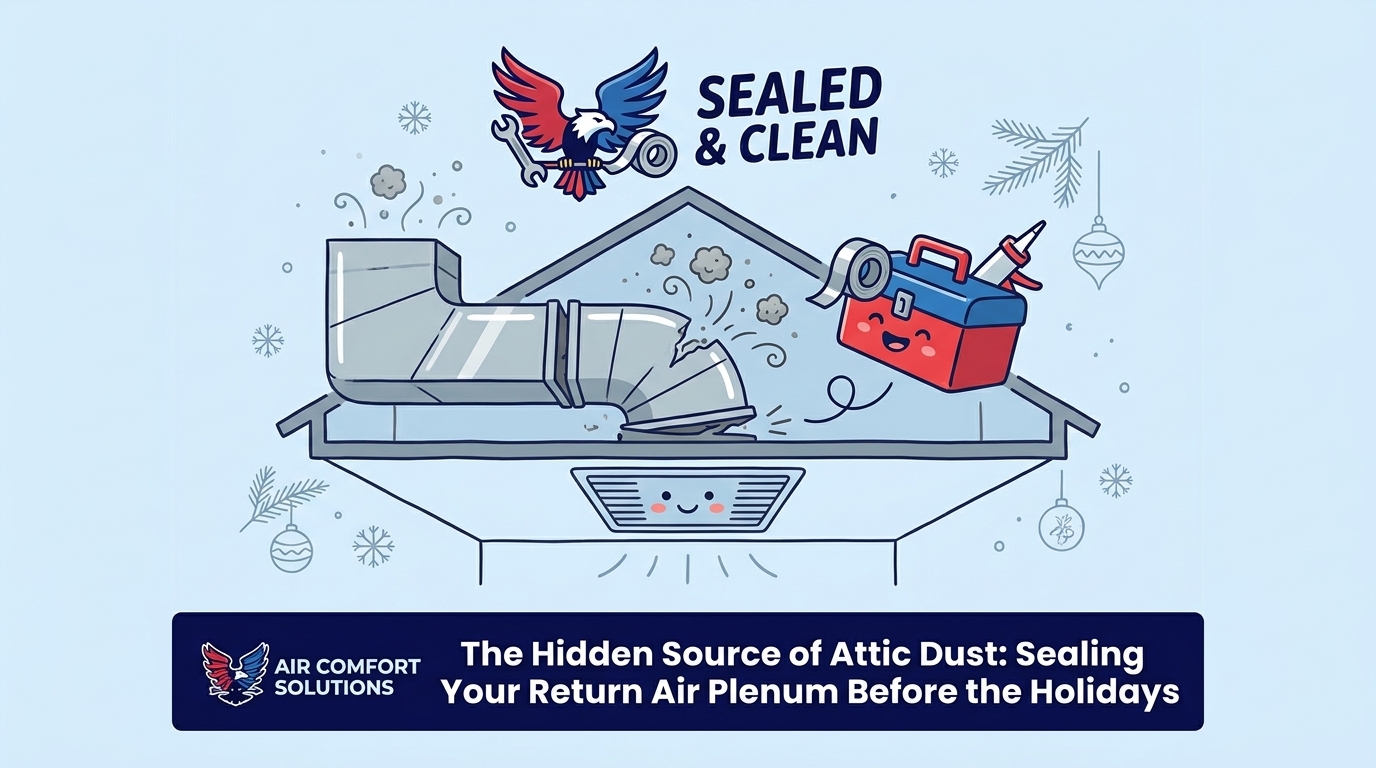
The Value of Sealing Your Return Air Plenum Before the Holidays
Most homeowners buy expensive filters to fix dusty air, not realizing a leaky return plenum in the attic is the real culprit. See why sealing it now saves your holiday gatherings.
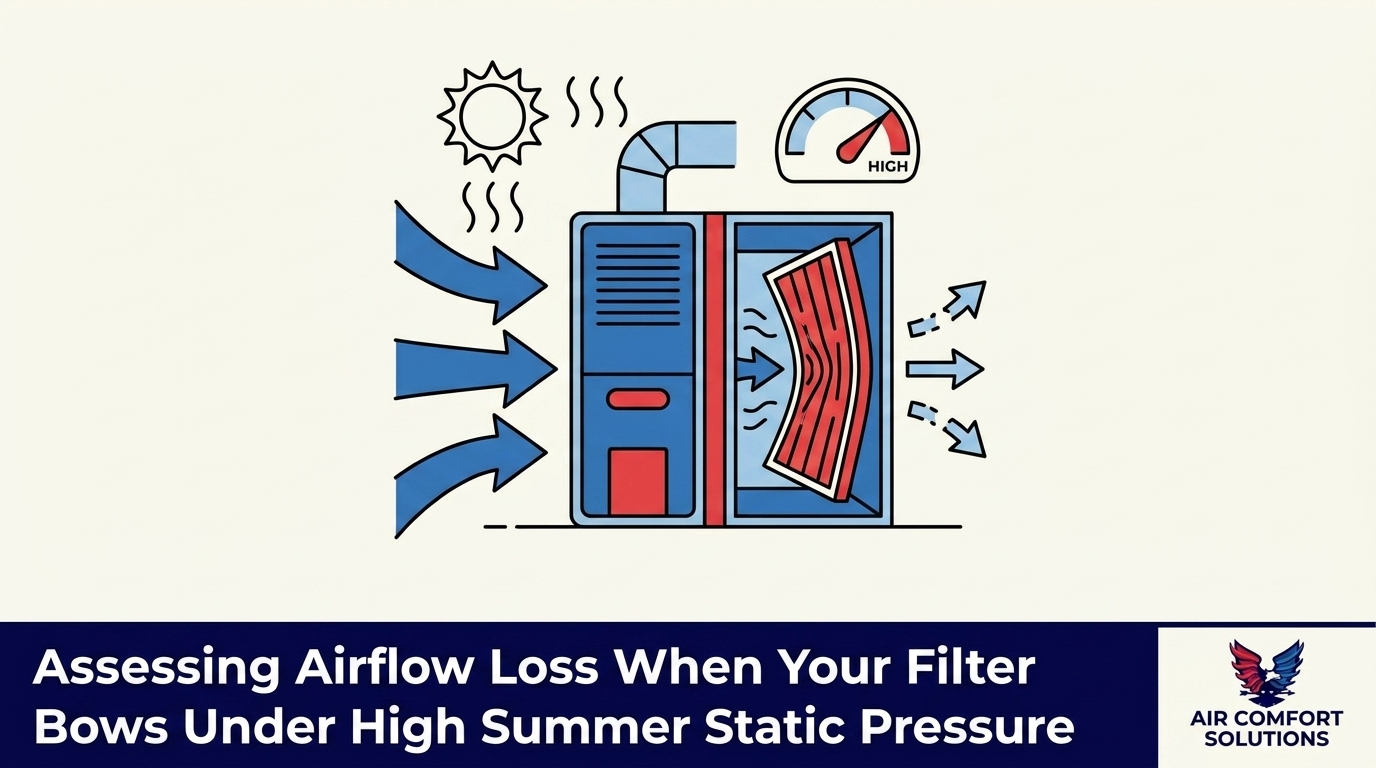
Your cooling equipment is running nonstop, but the airflow from your vents feels weak and the house is stubbornly warm. Assessing airflow loss when your filter bows under high summer static pressure is a critical step in diagnosing why your system is struggling to keep up with the July heat. At Air Comfort Solutions, our technicians frequently respond to calls where a homeowner opens the return grille to investigate, only to find an unexpected sight: the air filter is no longer sitting flat. Instead, it is bent, bowed, buckled, or even partially sucked inward toward the blower compartment.
This is a common but frequently misunderstood issue that goes far beyond simply buying a defective product. A bowed filter is a physical symptom of a severe mechanical struggle happening inside your ductwork. The equipment is attempting to pull a specific volume of air, but a restriction is forcing the blower motor to pull harder against the filter media itself. During continuous July operation, this problem is heavily magnified because the system rarely cycles off, meaning the filter material never gets a chance to relax or recover from the intense vacuum pressure.
When faced with a collapsed filter, homeowners reach a crucial decision point: do you simply throw away the ruined filter and slide a brand-new one of the exact same type into the slot, or do you investigate the underlying airflow mismatch? Simply replacing the filter addresses the symptom, but not the root cause. Without understanding the invisible forces at play inside the return drop, you risk repeating the cycle, wasting money on ruined filters, and ultimately causing catastrophic damage to your blower motor. To truly fix the issue, we have to look at the engineering behind residential air conditioning systems and how they handle the resistance of moving air.
The problem: Airflow is invisible, making it difficult to understand why a seemingly harmless air filter could suddenly turn into a heavy restriction. To understand why a filter bows, you first have to understand how residential HVAC systems are engineered to push and pull air throughout a home.
The cause: Every central cooling system operates against a certain amount of resistance, scientifically measured as Total External Static Pressure (TESP). Our team often explains static pressure like blood pressure for your ductwork. The blower motor has to generate enough force to push conditioned air through the supply ducts, out the vents, across the rooms, into the return grilles, and back through the filter and evaporator coil. Typical residential systems are engineered to operate against a maximum allowable resistance of about 0.5 inches of water column (in. w.c.).
Every single component in the airstream consumes a portion of this allowable static pressure budget. The ductwork itself creates friction. The evaporator coil creates resistance. And the air filter creates resistance. When you use highly restrictive 1-inch pleated filters, they consume a massive chunk of that 0.5 in. w.c. budget. If the combined resistance of the ducts, coil, and filter exceeds what the blower was designed to handle, the static pressure spikes.
• Evaporator Coil — Typical Allowable Resistance (in. w.c.): 0.20 to 0.25 — What Happens When Resistance is Too High: Condensation blows off the coil, or the coil freezes over due to low airflow.
• Supply & Return Ductwork — Typical Allowable Resistance (in. w.c.): 0.10 to 0.15 — What Happens When Resistance is Too High: Airflow barely reaches distant rooms; whistling noises occur at the vents.
• Air Filter — Typical Allowable Resistance (in. w.c.): 0.10 to 0.15 — What Happens When Resistance is Too High: The filter bows, buckles, or collapses into the blower compartment.
The solution: High static pressure directly correlates to a severe drop in the total cubic feet per minute (CFM) of airflow moving through the house. When the static pressure is too high, the blower motor cannot move enough air. This lack of airflow is exactly how dirty filters cause frozen evaporator coils, as the refrigerant gets too cold without enough warm house air passing over it. Resolving a bowed filter requires measuring the TESP to see exactly how much resistance the current filter is adding to the system.
There is a widespread misconception that when it comes to air filters, a higher MERV (Minimum Efficiency Reporting Value) rating is always better. While high-MERV filters are excellent at trapping microscopic particles, they achieve this by weaving the filter media incredibly tight. This density means the blower motor requires significantly more power to pull air through the material.
When you place a high-MERV rating on a standard 1-inch frame, you create an immediate airflow bottleneck. A 1-inch frame simply does not have enough surface area to accommodate dense filtration media without acting like a wall. The blower motor reacts to this restriction by working harder, which drastically increases the pressure differential across the filter. One side of the filter is experiencing a massive vacuum, while the other side is exposed to normal atmospheric pressure from the house. This pressure differential is the physical force that causes 1-inch pleated filters to bend and distort.
In our years of serving the Pinehurst community, we've seen how Texas summer peak sensible cooling loads require maximum unobstructed CFM to properly dehumidify and cool homes, making high-MERV restrictions especially problematic. When the system is fighting to remove heavy humidity and extreme heat from the indoor air, it needs a massive, steady volume of air moving across the evaporator coil. Restricting that volume for the sake of higher filtration efficiency actively sabotages the primary function of the cooling equipment. For homeowners seeking better air purity without destroying their airflow, dedicated indoor air quality solutions are a much safer route than simply buying the densest 1-inch filter on the shelf.
Cubic feet per minute (CFM) is the measurement of how much air volume is actually circulating through your rooms. As filter density increases and static pressure rises, CFM drops proportionally. A system designed to move 1,200 CFM might only be moving 800 CFM when choked by a restrictive filter.
Lower CFM leads to poor cooling performance, uneven temperatures between rooms, and significantly longer runtimes. The system has to run for much longer periods to satisfy the thermostat because it is delivering a fraction of its intended cooling capacity, driving up energy consumption while leaving the home uncomfortable.
The physical failure of an air filter does not usually happen the moment you turn the system on. It is a progressive degradation of the filter's structural integrity caused by sustained stress. During peak heat waves, the mechanics of this failure accelerate rapidly due to the sheer volume of work the system is performing.
When our crews are out on service calls during continuous 95F+ degree July days, we see systems running at near 100% duty cycles, maximizing sustained static pressure on filter media. When the system runs for twelve or fourteen hours a day with barely a pause, the physical materials holding the filter together are pushed past their breaking point. The collapse generally follows a specific mechanical sequence:
1. Sustained Vacuum Pressure: Because continuous cooling cycles mean the filter is under constant vacuum pressure with virtually no off-cycle recovery time, the media is perpetually stretched inward toward the blower.
2. Moisture Accumulation: Returns often pull slightly humid air from the home before it reaches the dehumidifying evaporator coil. This ambient humidity softens the cardboard frame of the filter over days and weeks of continuous operation.
3. Wire Mesh Fatigue: Many pleated filters use a thin wire mesh backing to maintain their shape. Under constant high static pressure, these thin wires begin to stretch, warp, and ultimately buckle.
4. Structural Bowing: The weakened cardboard frame begins to fold inward at the center, creating a distinct "U" shape as the filter bows toward the path of least resistance.
5. Complete Collapse: If the static pressure is high enough and the frame is weak enough, the filter will completely fold and be sucked out of the filter rack, collapsing into the return drop or the blower compartment itself.
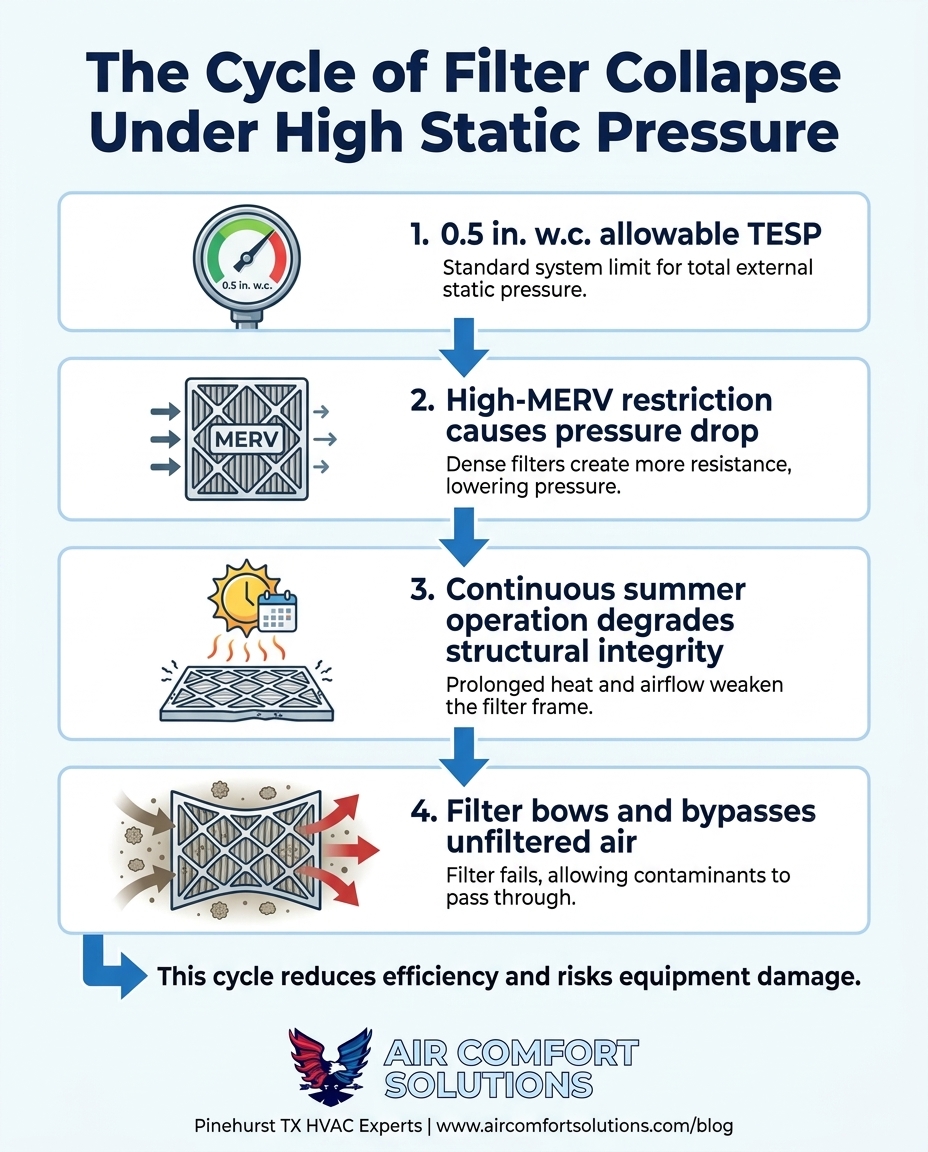
Breaking the seal: A bowed filter is not just an indicator of poor airflow; it creates a severe secondary problem for the internal components of the HVAC system. When a filter bends inward, it pulls away from the edges of the filter rack. This breaks the critical seal between the filter frame and the metal ductwork. Because air will always take the path of least resistance, the system will immediately start pulling air through these gaps rather than through the dense filter media.
Coating the components: This bypassed air is completely unfiltered. It carries dust, pet dander, lint, and airborne debris directly into the blower compartment. This bypassed debris quickly coats the blower wheel, throwing it off balance and reducing its ability to scoop air. Worse, the dirt travels up to the evaporator coil. When dust mixes with the natural condensation on a cold evaporator coil, it forms a thick layer of mud that acts as an insulator, preventing the system from cooling the air and often leading to frozen coils and water leaks.
Mechanical strain: Beyond the dirt, the mechanical strain on the blower motor is immense. As it fights against the high static pressure environment, standard motors can overheat and burn out. Modern electronically commutated motors (ECM) will actually ramp up their RPMs to try and overcome the restriction, consuming vast amounts of electricity before ultimately failing under the load. While generic chains often miss static pressure imbalances and simply swap out the dirty filter for a clean one, our local experts at Air Comfort Solutions look beyond the filter to diagnose underlying blower motor strain and systemic airflow restrictions to prevent premature equipment death.
The problem: When a homeowner in Pinehurst TX opens their return grille and finds a collapsed filter, a pattern we see often is the assumption that they just bought a "dud" or left it in too long. They pull out a new filter from the exact same multi-pack, slide it into the slot, and assume the problem is solved. Within a week or two, that new filter will bow and buckle exactly like the last one.
The cause: This creates a structural failure loop. Putting a new, highly restrictive filter into a high static pressure environment will just cause it to bow again. The issue is not the age of the filter; the issue is the density of the media combined with the limited surface area of a 1-inch frame. The blower motor is still starved for air, and the new filter is still acting as a physical barricade.
The solution: Breaking this cycle requires alternative filtration strategies. If your ductwork can only accommodate a 1-inch filter, you must use a lower MERV rating (typically MERV 4 to MERV 8) to allow adequate airflow. These lower-rated filters protect the equipment from large debris without choking the blower motor. For homeowners who want superior indoor air quality without sacrificing airflow, our team recommends upgrading to a deeper media cabinet as the best solution. A 4-inch or 5-inch thick pleated filter has exponentially more surface area than a 1-inch filter. This massive surface area allows for high-MERV filtration with a very low pressure drop. Upgrading your system's filtration or installing higher-efficiency equipment may even qualify for federal tax credits or local utility incentive programs, though you should always verify current guidelines with your utility or a tax professional. Ultimately, guessing at filter compatibility is a risk; reaching out to our Pinehurst AC experts to measure the actual TESP of your ductwork is the only way to know exactly what filtration your system can safely handle.
Your air filter bends inward because the blower motor is pulling air harder than the filter material allows air to pass through. This creates a high pressure differential, or a vacuum effect, on the back side of the filter. When the structural integrity of the filter's cardboard frame and wire mesh can no longer withstand that vacuum, it bows toward the blower compartment.
Yes, high MERV filters can significantly reduce airflow, especially when compressed into a standard 1-inch frame. The denser the filter media is to trap microscopic particles, the harder the blower motor has to work to pull air through it. If your system is not designed to handle that level of resistance, a high MERV filter will choke the system and reduce the total volume of air circulating through your home.
High static pressure is caused by excessive resistance anywhere in the airstream. Common culprits include undersized return ducts, closed or blocked supply registers, dirty evaporator coils, and highly restrictive air filters. When the combined resistance of these components exceeds the blower motor's design limits, static pressure spikes and airflow plummets.
A collapsed air filter can cause severe damage to your AC system in two ways. First, it restricts airflow so heavily that the evaporator coil can freeze solid, potentially damaging the compressor. Second, a collapsed filter breaks its seal in the rack, allowing unfiltered dust and debris to bypass the media and pack directly into the blower motor and coil, leading to overheating and mechanical failure.
If an air filter gets sucked completely into the ductwork, it can become lodged against the blower wheel. This creates a severe physical obstruction that can violently throw the wheel off balance, damage the motor bearings, or cause the motor to overheat and burn out. The system must be shut down immediately to retrieve the filter and inspect the blower assembly.
Signs of a static pressure problem include weak airflow from your vents, whistling noises at the return grilles, air filters that frequently bow or buckle, and a system that runs constantly but fails to cool the house. A professional technician can confirm the issue by using a manometer to take precise static pressure readings inside the ductwork.
The takeaway: A bowed filter is never just a minor inconvenience; it is a glaring symptom of a larger static pressure issue occurring within your ductwork. When the airflow is choked by overly restrictive materials, the entire cooling process suffers, leading to longer runtimes, higher energy consumption, and poor indoor comfort.
The next step: Addressing the root cause of the restriction prevents long-term blower motor damage and keeps your evaporator coil clean. Instead of continuously replacing collapsed filters with the exact same restrictive models, you need a professional assessment of your system's airflow capabilities. At Air Comfort Solutions, we highly encourage readers to have one of our professionals measure your system's Total External Static Pressure. By scheduling a routine HVAC maintenance plan, you can ensure your static pressure is balanced, your blower motor is protected, and your filtration strategy matches the actual engineering of your equipment.


Zane came out and did an amazing job! Super friendly, honest and transparent about the work that needed to be done. This is my second time working with Air Comfort Solutions and they’re my go to for HVAC services. Highly recommend.
God's AMAZING grace sent us Robert and Zane. We have been without air in this Texas heat for six weeks and four days. We've had a few contractors give us quotes all trying to upsell when we're at a low point. But not the guys at Air Comfort Solutions. They came in assessed our situation, gave us honest feedback, and showed us the issues as they proceeded with the assessment for clear understanding. We highly recommend them for their professionalism, quality products, and fair pricing. We hands down support them for all the work they do 💯 %.
Robert and Zane gone above and beyond to make the process easy and affordable.
Would definitely recommend!!
I’m writing this review to let everyone know that Air Comfort Solutions is the company to work with. I know the owner ( Robert) for several years now. He has been taking care of my residential and business work orders. Robert is professional, knowledgeable and will save you money. I just want to thank Robert for great job you have been doing for me.